
An AI model that combined voice features with facial movements matched the depressed or not-depressed labels on social media vlogs with 78.6% accuracy, a 2026 machine-learning study from China reported.1
It was tested on 1,823 public vlogs from 1,475 people and edged out earlier AI models, though its lead over the previous best model was not statistically significant.
Research Highlights
- About 4 in 5 vlogs labeled correctly: the model reached 78.6% accuracy and correctly flagged 80.2% of vlogs labeled as depressed.1
- Small edge over the earlier best model: MDDformer, built by the dataset's creators, scored 76.9%. The 1.7-point gap was smaller than the new model's own variation of about 4 points between test rounds, and it was not statistically significant (p = 0.21).1
- Well ahead of older methods: traditional machine-learning tools scored 58% to 69%.1
- Voice and face worked better together: letting the voice and face data inform each other raised accuracy from 66% (data simply joined) to 75%.1
- Research model only: it was tested on 1 dataset of social media videos, and different videos from the same person could land in both the training and test sets, which can inflate accuracy.1
What the Depression AI Looked At in Each Vlog
Zhonghui Jin, Pei He et al., at Northwestern Polytechnical University and Chongqing Normal University, published the model in the journal Sensors.1
The model did not watch raw video. It worked from 2 streams of numbers already extracted from each vlog:
- Face: facial action units (codes for specific muscle movements, such as a brow raise or lip-corner pull), facial landmark positions, eye gaze direction and head pose
- Voice: sound features from VGGish, a pretrained audio network that summarizes how speech and background sound change over time
Earlier research has linked depression to features such as flatter facial expression, less eye contact, slower movement, hesitation and low vocal energy.1
Jin and colleagues argued that these cues are often brief and scattered through a video. A telling moment in the face may not line up exactly with a telling moment in the voice.
Their model was designed around that problem. It lets each stream (face and voice) “look up” relevant moments in the other, then groups related moments into 4 compact summaries before making a yes-or-no call.
During training, it also practiced on audio with random gaps and small timing shifts. That pushed it to rely on the face as well when the voice track was patchy.
Which Public Vlog Datasets Were Used to Test the AI?
The main test used LMVD, a public dataset built by another team from vlogs posted on Sina Weibo, Bilibili, TikTok and YouTube.2
- Size: 1,823 videos, about 214 hours, from 1,475 people
- Labels: each video is marked depressed or not depressed; there is no severity score
- Setting: everyday recordings “in the wild,” not clinic interviews
Researchers split the videos into 10 groups. Each group took a turn as the test set while the model trained on the other 9, a standard method called 10-fold cross-validation.
They also ran the model on 2 non-depression datasets, MIntRec (what a speaker intends) and CMU-MOSI (positive vs. negative sentiment), to see if the design transferred. Those tasks do not involve depression, so their results do not show how well the model detects it.
How Accurate Was the Model Compared With Earlier AI Models?
Across the 10 test rounds, the model averaged:1
- Accuracy: 78.6% of all vlogs labeled correctly
- Recall: 80.2% of depressed-labeled vlogs flagged
- Precision: 78.0% of flagged vlogs were labeled depressed
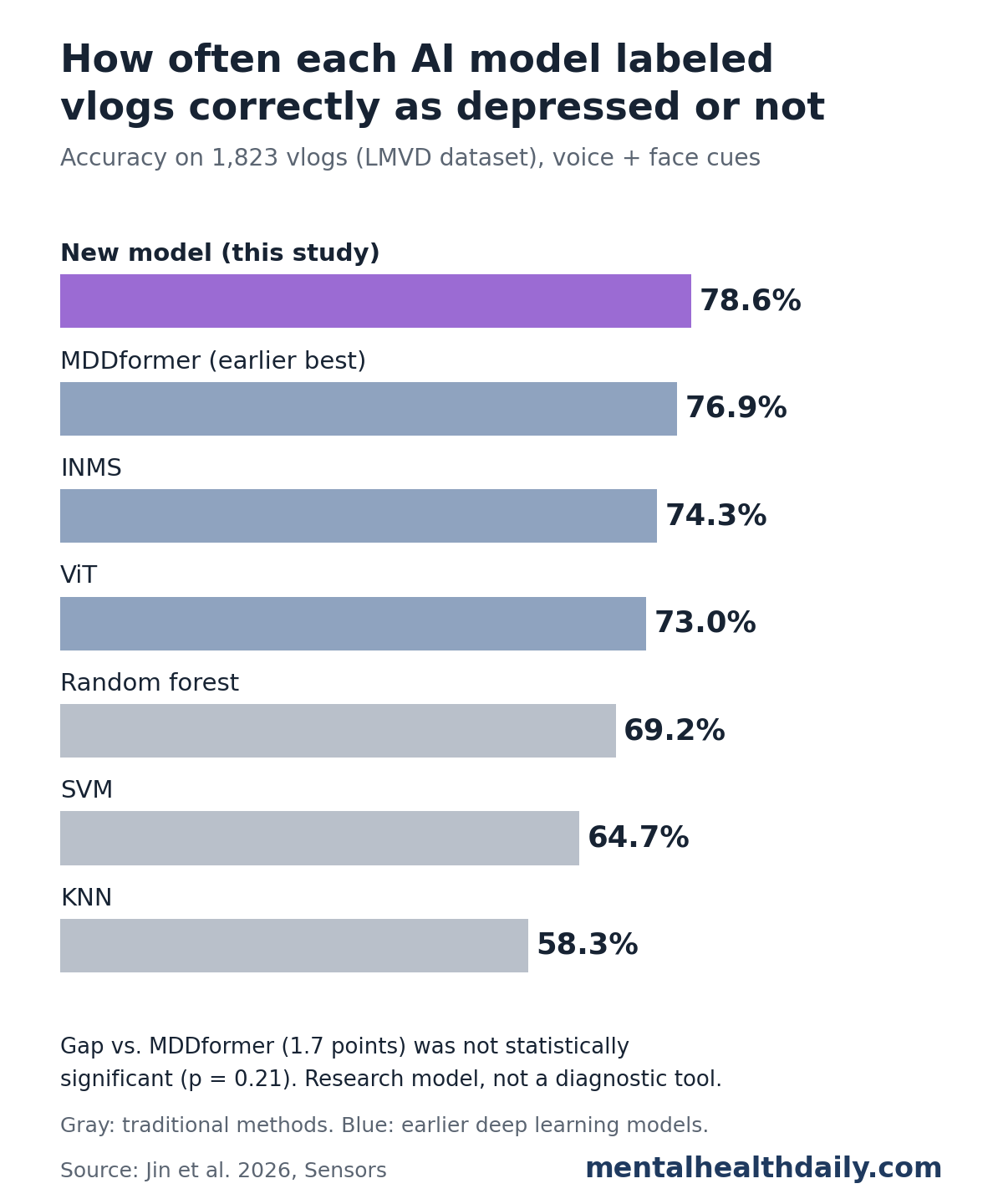
The previous best model, MDDformer, came from the team that built LMVD and scored 76.9%.2
But the new model's accuracy varied by about 4 points (standard deviation) from one test round to the next. That variation is more than twice its 1.7-point lead over MDDformer.
A statistical test comparing the new model's 10 test-round scores with MDDformer's published 76.9% gave p = 0.21, above the usual 0.05 cutoff. Researchers therefore called the gain descriptive, not evidence that the new model is better.
MDDformer was also not rerun on the same 10 test groups, so the 2 scores did not come from identical test videos.
Against older approaches the gap was clearer. Random forest, the best traditional classifier, scored 69.2%, and general-purpose deep learning models scored 71% to 73%.
Size and speed: the model has 2.64 million parameters and took about 5 milliseconds per prediction, small by current AI standards.
Which Parts of the Depression Model Made the Biggest Difference?
To see which design features mattered, researchers added them one at a time and measured accuracy after each step:
- Basic model (voice and face joined without interaction): 66.2%
- Voice and face informing each other: 75.2%
- Grouping related moments into summaries: 77.8%
- Training on patchy audio: 78.6%
The biggest jump, 9 points, came from letting the face and voice streams interact. The patchy-audio training added less than 1 point.
The test videos themselves had no added gaps or timing shifts, so this step does not show the model would hold up on noisy real-world recordings.
Why the 79% Accuracy Figure May Be Optimistic
Jin and colleagues stated some of these limits themselves; others follow from the test design:
- Same person in training and testing: videos, not people, were split into test groups. With 1,823 videos from 1,475 people, some people had more than one video, so the model may already have trained on another video of the same person it was tested on.
- 1 dataset: no test on a second dataset, a clinical sample, other languages or other recording setups
- Yes-or-no labels: no measure of how severe depression was
- Unexplained summaries: researchers said it is still unclear what the model's 4 internal summaries mean clinically
- Code not yet public: code and processed data were promised upon acceptance, so outside teams could not yet check the results
The first limit, splitting by video instead of by person, is common in this field.
A 2017 analysis in GigaScience found that splitting data by record instead of by person often “massively overestimates” accuracy, and nearly half of the wearable-sensor and smartphone studies it reviewed split their data by record.3
Vlogs also differ from a clinic visit. People who post videos online are not a representative sample of people with or without depression, and a vlog-based label is not a clinical diagnosis.
Could Voice-and-Face AI Screen for Depression?
Researchers framed the goal as future support for screening and clinical decisions, not a replacement for clinicians. They called for larger multicenter clinical datasets and person-level testing before drawing conclusions about new people.
For now, this is a research model tested on 1 benchmark dataset. It is not a diagnostic tool, and no app or clinic is described as using it.
Anyone worried about depression should talk with a doctor or mental health professional, who can use validated questionnaires and a clinical interview.
Bottom line: an AI reading facial movements and voice labeled about 4 in 5 vlogs correctly as depressed or not, slightly better than earlier models.
Its lead over the best earlier model was not statistically significant, and it has not been tested in clinics or with each person's videos kept entirely out of training.
References
- Jin Z, He P, Guo Y, Wang X, Fang A. Structured prototype learning with feature fusion for sparse and asynchronous audio-visual depression recognition. Sensors. 2026;26:5580. doi:10.3390/s26175580
- He L, Chen K, Zhao J, Wang Y, Pei E, Chen H, Jiang J, Zhang S, Zhang J, Wang Z, He T, Tiwari P. LMVD: a large-scale multimodal vlog dataset for depression detection in the wild. Information Fusion. 2026;126:103632. doi:10.1016/j.inffus.2025.103632
- Saeb S, Lonini L, Jayaraman A, Mohr DC, Kording KP. The need to approximate the use-case in clinical machine learning. GigaScience. 2017;6(5):1–9. doi:10.1093/gigascience/gix019