
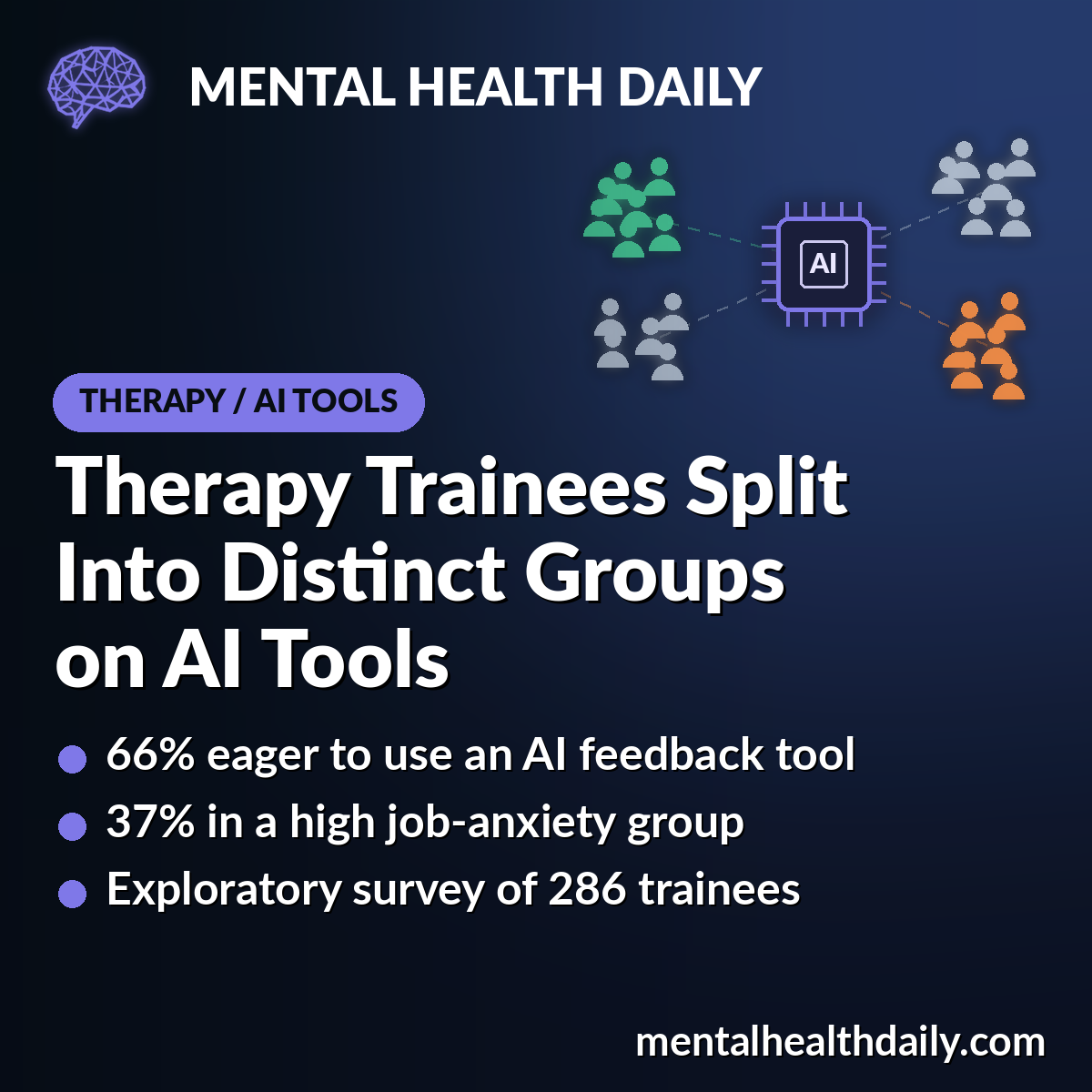
A 2026 survey study of 286 psychology students and psychotherapy trainees found that each of 6 areas of opinion about AI, from willingness to use a tool to job worries, split them into 3 or 4 distinct subgroups.1
Most were open to an AI tool that gives therapists feedback on their sessions (66% were in an enthusiastic group), yet 37% fell in a high job-anxiety group and 42% in a higher-concern group about AI risks.1
Research Highlights
- No single trainee view of AI: 6 separate analyses of 286 psychology students and psychotherapy trainees each found 3 or 4 subgroups, not one uniform group.1
- Most were open to an AI feedback tool: 66% were enthusiastic adopters of a tool that gives feedback on therapy sessions, while 20% were skeptical.1
- Worry ran alongside openness: 37% were in a high job-anxiety group and 42% in a higher-concern group about AI risk and autonomy.1
- Few felt fully ready: only 10% fell in a high-readiness group for adopting AI.1
- Exploratory, 1-time data: the subgroups were modeled separately, so this analysis cannot say whether the anxious trainees were also the skeptical ones.1
What the Survey Asked Psychology Trainees About AI Tools
This analysis, by Merve Armagan-Bogatekin of the University of Health Sciences in Istanbul, reused public survey data collected in 2022 and 2023 by a German research team.12
Participants were psychology students and psychotherapists in training from Germany, the US, the UK and Canada. Each read how 2 AI tools work before answering questions about them:
- A feedback tool that analyzes recordings of therapist-patient conversations and gives the therapist feedback on their performance
- A treatment-recommendation tool that estimates a patient’s mood from their speech and produces mood scores to support treatment decisions
Of 362 people who started the survey, 286 were included in this analysis.1
The author used latent class analysis, a statistical method that sorts people into hidden subgroups based on similar answer patterns. Rather than reporting one average score, it asks what kinds of respondents exist and how common each kind is.
The author ran 6 separate analyses, one for each set of questions:
- General attitudes toward AI
- Acceptance of the feedback tool (how useful and easy it seemed, and plans to use it)
- Readiness to adopt AI
- Anxiety about learning to use AI
- Anxiety about AI’s effect on jobs
- Concerns about AI risk and personal autonomy
Trainees Split Into 3 or 4 Subgroups on Every AI Question
Each of the 6 analyses fit best with 3 or 4 subgroups. In several of them, the largest subgroup gave moderate or mixed answers, with smaller groups at the more favorable or more wary ends.1
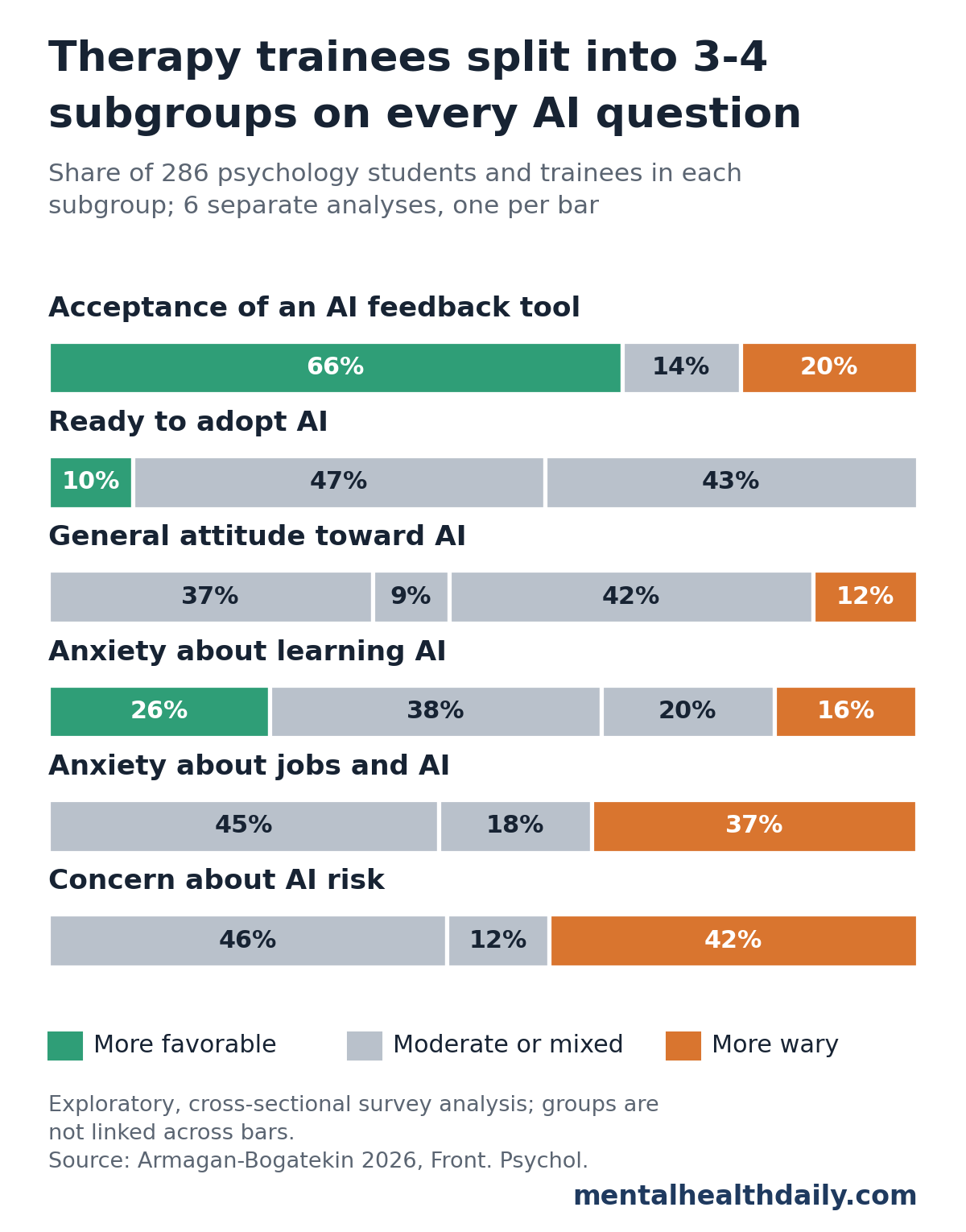
Acceptance of the feedback tool was the most positive result. About 2 in 3 trainees were in a group that rated the tool as effective and easy to use, and said they intended to use it in future practice:1
- Enthusiastic adopters: 66%
- Skeptical users: 20.4%, who mostly gave negative answers about the tool’s usefulness
- Cautious users: 13.6%, with moderate, mixed answers
Readiness to adopt AI was lower. Only 9.7% fell in a high-readiness group that felt more confident about AI’s usefulness and how to apply it.
The rest split between a moderately ready, cautiously open group (47.4%) and a mixed, lower-readiness group (42.9%) that showed uncertainty or hesitancy about adopting AI.1
General attitudes toward AI were mostly in the middle. Most trainees fell in 2 moderate or mixed groups, which made up 37.3% and 41.9% of the sample.
A smaller negative, resistant group (12%) was clearly skeptical and worried about AI’s effects on society and personal autonomy. The smallest group (8.8%) was ambivalent: it saw AI’s potential but worried about relying on it too much.1
Where Did Job Anxiety and AI Risk Concerns Show Up?
A high-anxiety group was larger for jobs (37.4%) than for learning to use AI (16.4%).
Job-related anxiety: 37.4% of trainees were in a high-anxiety group that felt threatened by AI, and 44.9% were in a moderate group.1
The remaining 17.6% were labeled a “lower anxiety” group, but they showed elevated concern on specific items about dependency, such as fear of becoming reliant on AI and losing reasoning skills.1
Learning anxiety: only 16.4% were in a high learning-anxiety group, and 25.5% were in a low-anxiety group.
The others were moderately anxious, confident learners (38.1%) or a “selective” group (19.9%) that was anxious about some aspects of learning AI and not others.1
Concerns about AI risk and autonomy: 42.4% were in a higher-concern group, and 45.8% were moderately concerned across all 4 questions. A small mixed group (11.8%) mostly disagreed with statements about AI risks.1
Put together, many trainees were willing to use a specific AI tool, while large shares worried about what AI means for their profession. Because each domain was analyzed separately, this analysis cannot show whether these were the same people.
Trainee Subgroups Echo the Undecided Middle Seen in Other AI Surveys
The German team that collected the data analyzed it first in a different way, looking at average links between answers rather than subgroups.
In 206 trainees, they found that seeing a tool as useful and sensing that others expected them to use it predicted stronger plans to use both tools, while AI anxiety predicted weaker plans. Trust in the tools was unrelated to intentions.2
This analysis adds that trainees fall into distinct types, rather than lying along one scale from “for” to “against.”
A similar pattern has appeared in a very different group. A 2024 study of 740 smartphone users aged 45 and older in Hong Kong found 3 AI attitude profiles:3
- Indecisive: 69.3%
- Enthusiasts: 18.4%
- Skeptics: 12.3%
In both studies, smaller enthusiastic and skeptical groups sat beside a large undecided or moderate middle.
Limits of a 1-Time, Exploratory Survey Analysis
The author describes the results as hypothesis-generating, not confirmatory. The main limits:1
- Separate models: each of the 6 domains was analyzed on its own, so it is unknown whether a trainee in a high-anxiety group was also in a skeptical or low-readiness group.
- Missing answers set to the middle: skipped questions were coded as the middle score (3), which could make the moderate groups look larger than they are.
- Compressed answer scales: most 5-point and 7-point answers were collapsed into low, medium and high, which discards detail.
- Exploratory choices: the number of subgroups was chosen by statistical fit and interpretability, not by a preregistered plan.
- Inconsistent labels: some subgroup names do not match their descriptions. For example, the 17.6% “lower anxiety” job group showed elevated dependency concerns.
- 1 time point, self-report: the survey cannot show whether views change as trainees use AI tools, and answers may reflect what seems socially acceptable.
- Narrow scope: the sample was trainees, not practicing clinicians, from 4 Western high-income countries. Acceptance was modeled only for the feedback tool, not for chatbots or other AI tools.
Should AI Training for Therapists Be Tailored to Subgroups?
The author suggests that training programs should not treat trainees as one group when they introduce AI tools. Trainees with low readiness might need hands-on practice, while those in high-anxiety or high-concern groups might need room to discuss ethical and professional worries.1
The author presents this as an idea to test, not a proven approach.
The next steps the author proposes are a joint model that links all 6 domains and studies that follow trainees over time, to see whether anxiety and acceptance cluster in the same people.1
References
- Armagan-Bogatekin M. Heterogeneity in AI attitudes, anxiety, and acceptance among psychology students and psychotherapy trainees: a domain-specific latent class analysis. Frontiers in Psychology. 2026;17:1859806. doi:10.3389/fpsyg.2026.1859806
- Kleine AK, Kokje E, Lermer E, Gaube S. Attitudes toward the adoption of 2 artificial intelligence–enabled mental health tools among prospective psychotherapists: cross-sectional study. JMIR Human Factors. 2023;10:e46859. doi:10.2196/46859
- Shum NYE, Lau HPB. Perils, power and promises: latent profile analysis on the attitudes towards artificial intelligence (AI) among middle-aged and older adults in Hong Kong. Computers in Human Behavior: Artificial Humans. 2024;2(2):100091. doi:10.1016/j.chbah.2024.100091