
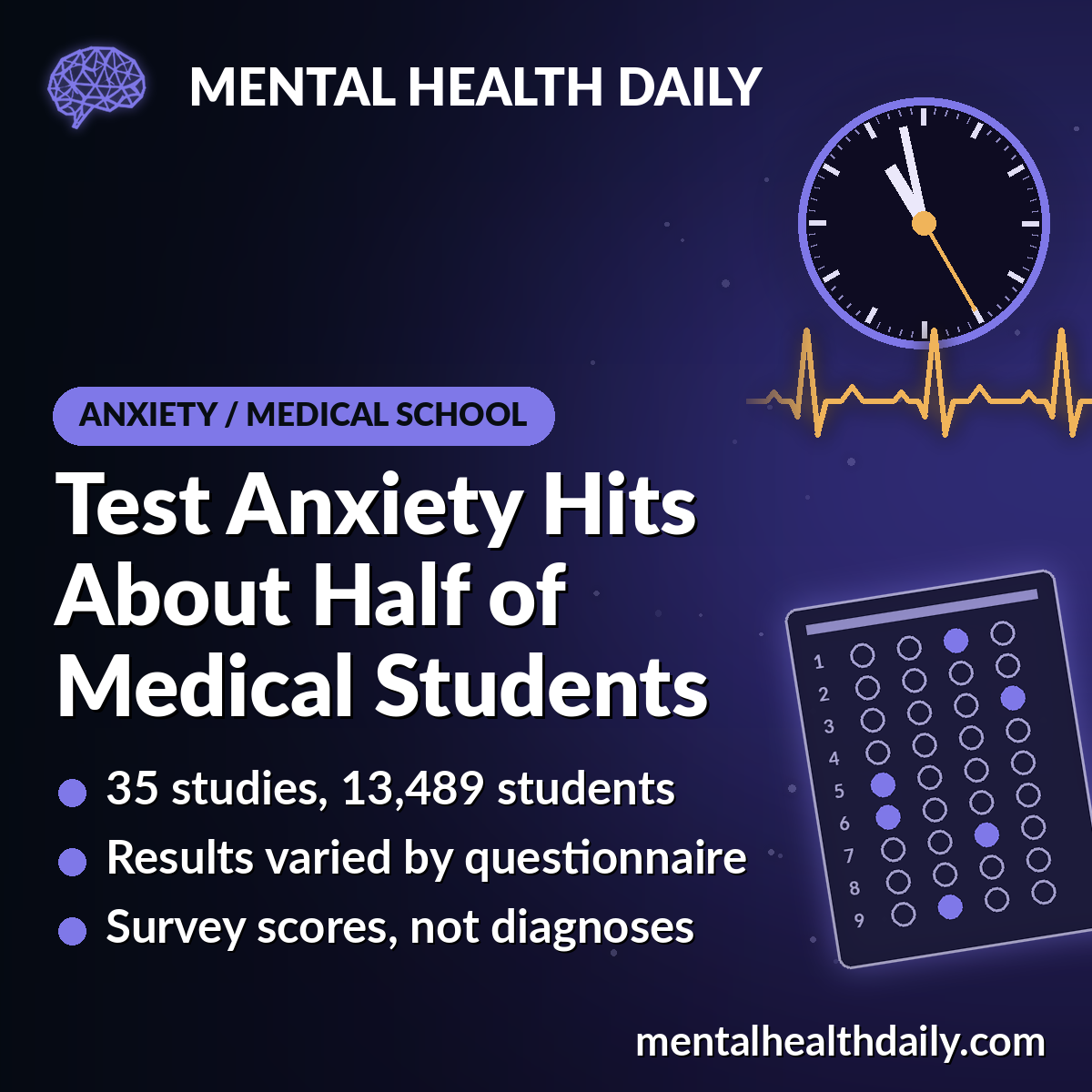
About half of medical students score in the moderate-to-severe range on test anxiety questionnaires. A 2026 meta-analysis in BMC Medical Education pooled 35 studies covering 13,489 students and arrived at 49.8%.1
That headline number hides a lot of spread. Individual studies ranged from 10% to 99%, and the questionnaire a study used mattered more than anything else the authors tested, including gender, year of training, region, and whether students were surveyed before, during, or after exams.
Research Highlights
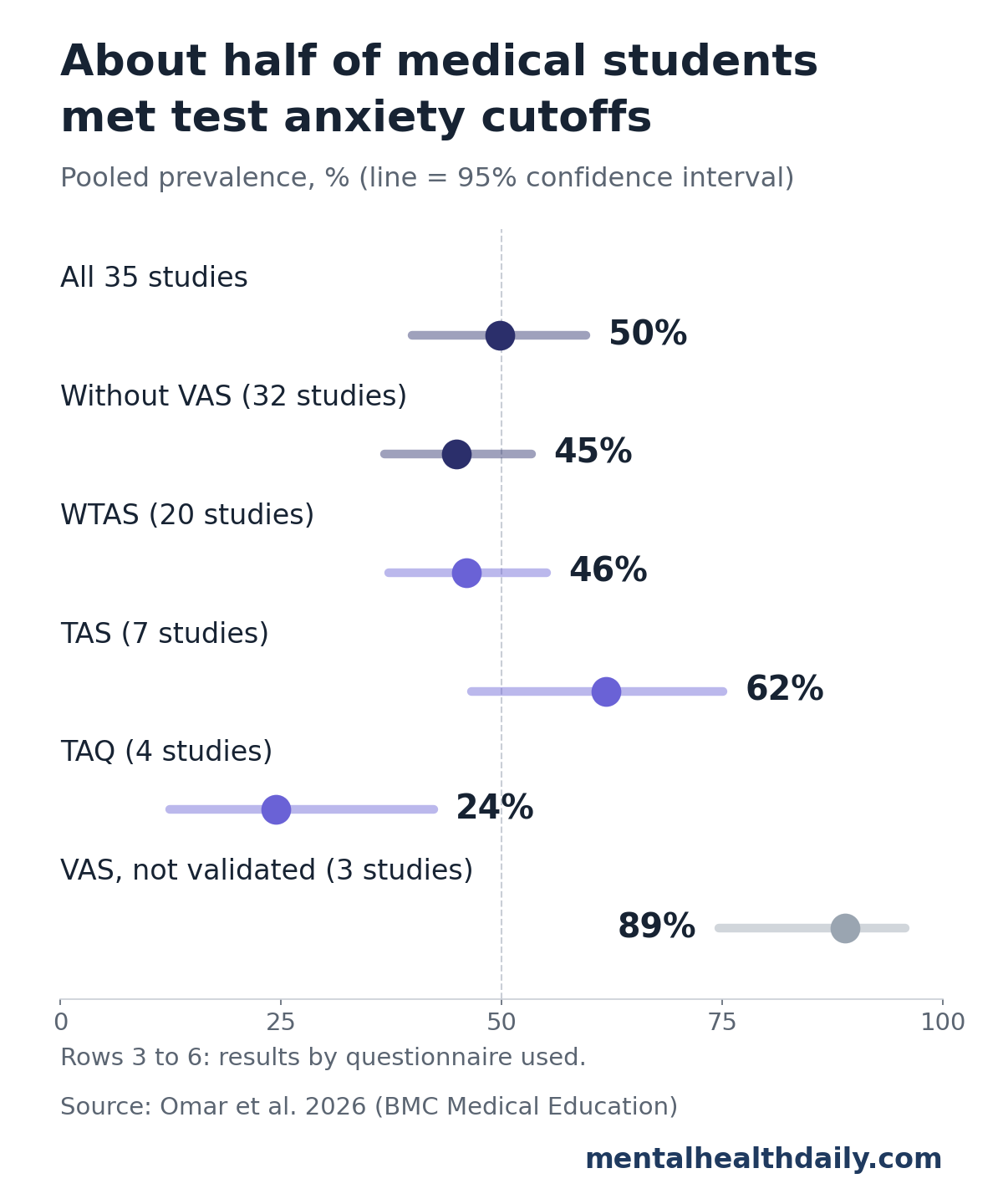
- About 1 in 2: pooled prevalence of test anxiety was 49.8% (95% CI 39.9% to 59.6%) across 35 studies of undergraduate medical students.1
- Without the weakest measure: dropping 3 studies that used a non-validated visual analogue scale lowered the estimate to 44.9%.1
- The questionnaire drove the result: among validated questionnaires used in multiple studies, estimates ran from 24% with the Test Anxiety Questionnaire to 62% with the Test Anxiety Scale, the only significant subgroup difference (p < 0.001).1
- No significant gaps by gender, year, region, or timing: women 52.6% vs. men 46.3%, first-year students 58.6% vs. fifth-year 47.9%.1
- Higher than general anxiety: an earlier meta-analysis put general anxiety among medical students at 33.8%.2
Test Anxiety Is Its Own Kind of Anxiety
Test anxiety (also called exam anxiety) is a situation-specific reaction to being evaluated. It has a mental side, such as catastrophic worry and intrusive thoughts, and a body side, such as a racing heart, muscle tension, fast breathing, and an upset stomach.1 It differs from trait anxiety, which is a lasting tendency to see threats everywhere. A student can be calm most of the year and still freeze in front of a licensing exam.
A little test anxiety can sharpen focus. Too much can crowd working memory: part of a student’s attention goes to the exam and part goes to self-critical thoughts, which slows thinking and can push a score below what the student actually knows.1 Medical school, with its steady stream of high-stakes exams, is a natural place to look for it.
Scoring above a cutoff on a test anxiety scale is not the same as having an anxiety disorder. The 49.8% figure counts students whose questionnaire scores fell in the moderate or higher range, not students diagnosed by a clinician.
How the Review Counted Cases
The team, from Mansoura and Cairo universities in Egypt, searched 4 databases in March 2026 and registered the review in advance (PROSPERO CRD420261347431). The database search returned 1,101 records and yielded 28 eligible studies; citation searching added 7 more, for 35. Most were cross-sectional surveys from 12 countries published between 2012 and 2026, with India (8 studies) and Pakistan (7) contributing the most.1
Earlier studies defined “test anxiety” in very different ways, so the authors set a single rule:
- Counted as a case: moderate, high, or severe categories on each questionnaire
- Merged categories: when a study lumped low and moderate together, only half of that group was counted
- “Healthy” anxiety: when a scale described its moderate band as helpful, only the high and severe bands were counted
- Excluded: studies that only reported average scores, and studies that defined cases by splitting their own sample at the median or into quartiles, which fixes prevalence at 25% or 50% by design
The questionnaires included the Westside Test Anxiety Scale (WTAS) in 20 studies, Sarason’s Test Anxiety Scale (TAS) in 7, the Test Anxiety Questionnaire (TAQ) in 4, a single-item visual analogue scale (VAS) in 3, and a German exam anxiety questionnaire in 1.1
About Half of Students, With Wide Variation
Across all 35 studies, 49.8% of students met the case definition. The 95% prediction interval, which estimates where the result of a new study would likely fall, ran from 8.4% to 91.4%. Heterogeneity between studies was very high (Tau² = 1.33; I² = 98.2%).1
The main estimate held up in several checks:
- Dropping one study at a time: results stayed between 47.1% and 51.3%
- Dropping the 3 VAS studies: 44.9% (95% CI 36.7% to 53.4%)
- Counting only high or severe anxiety in the 4 merged-category studies: 46.8%
The authors suggest treating 44.9% to 49.8% as the plausible range, depending on how strictly a case is defined.1
The Questionnaire Mattered Most
Assessment tool was the only factor that significantly changed prevalence (p < 0.001), and it explained more of the spread between studies than any other grouping.1
- TAS (7 studies): 61.8% (95% CI 46.6% to 75.1%)
- WTAS (20 studies): 46.0% (95% CI 37.2% to 55.1%)
- TAQ (4 studies): 24.4% (95% CI 12.4% to 42.3%)
- VAS (3 studies): 88.9% (95% CI 74.6% to 95.7%)
The VAS asks students to mark their anxiety on a line and has not been validated for test anxiety. One VAS study classified 99.1% of first-year students as test-anxious.1 One reason the TAQ figure is lower: the review counted only its high and severe bands, since the scale treats moderate anxiety as healthy. So the tool gap reflects both what each questionnaire measures and where its cutoffs sit.
Gender, Year, Region, and Timing
None of these made a statistically significant difference, though some numbers leaned in expected directions:1
- Gender: women 52.6% (19 studies) vs. men 46.3% (17 studies), p = 0.511
- Year of training: 58.6% in first year, 43.4% to 47.9% in fourth and fifth years, p = 0.880
- Region: highest in South-East Asia (59.3%) and the Eastern Mediterranean (54.1%, the largest group with 17 studies), p = 0.439
- Timing: 55.4% when measured during exams, 51.7% before, and 41.5% after, p = 0.831
The gender result stands out because test anxiety is usually higher in women across education levels. The authors suggest that medical school admission selects high-achieving, performance-focused students of both sexes, which may narrow the gap. Timing was hard to judge: 13 of the 35 studies did not say when students filled out the survey, and “pre-exam” ranged from days to months before a test.1
The year the data were collected did not predict prevalence either (meta-regression coefficient 0.003, p > 0.9). The authors contrast this with studies showing rising general anxiety among college and medical students, and suggest that exam-bound anxiety may track broader trends less closely.1
How This Compares With General Anxiety
A 2019 meta-analysis of 69 studies and 40,348 medical students found a 33.8% prevalence of general anxiety (95% CI 29.2% to 38.7%), highest in the Middle East and Asia, with no significant difference by gender or year of study.2 The higher test anxiety figure fits with the idea that exam-specific distress runs above students’ everyday anxiety. The authors also note that the new estimate is close to a 2025 meta-analysis across mixed student groups, which found 48.4% overall and 47.3% in healthcare students.1
What Helps With Test Anxiety
This review measured how common test anxiety is, not how to treat it. A few included studies tested support programs in medical students, each tested in a single study:1
- Peer-led mentoring (India): lowered test anxiety scores and eliminated severe cases, though grades did not significantly improve
- Hypnosis vs. progressive muscle relaxation (China): hypnosis reduced test anxiety more
- Group music therapy (China): lower test anxiety and better emotion regulation
- Test-taking strategies course (USA): a modest drop in test anxiety
The broader evidence is stronger. A 2019 meta-analysis of 44 randomized trials in 2,209 test-anxious university students found that interventions reduced test anxiety compared with control conditions by a moderate-to-large margin (Hedges’ g = −0.76) and improved academic performance (g = 0.37). Behavior therapy, such as relaxation training and systematic desensitization, had the most support. Cognitive behavioral therapy and study skills training showed promise with fewer trials, and the authors flagged publication bias and poor reporting.3
Omar and colleagues recommend that medical schools screen for test anxiety before exams using validated questionnaires such as the WTAS or TAS, and offer structured help such as cognitive behavioral techniques, mindfulness, and study skills training.1
Limitations
- Questionnaire cutoffs, not diagnoses. Every case came from a self-report scale, harmonized to “moderate or worse.” A different threshold would give a different number.
- Very different studies. The prediction interval of 8.4% to 91.4% shows how much individual schools can differ from the average.
- Uneven geography. 17 studies came from the Eastern Mediterranean region, while Europe and Africa had 2 each and the Americas 1. The review searched English-language papers only and did not search PsycINFO.
- Sample quality. About half of the studies used convenience samples, 7 did not describe how students were recruited, and only 13 calculated a needed sample size.
- Cross-sectional data. The surveys show how common test anxiety is at one point in time. They cannot show that medical training causes it or how it changes across a student’s career.
What the Findings Mean
High test anxiety is common enough in medical school that schools can treat it as a routine part of student support rather than a rare individual problem. For schools, the practical lessons are to measure it with validated tools, report exactly when students were surveyed, and offer support programs that have trial evidence behind them.
For students, feeling intense anxiety around exams is shared by many classmates. When it regularly blocks recall, disrupts sleep, or spreads beyond exam periods, talking with student counseling services or a clinician is a reasonable next step.
References
- Omar YM, Darwish NE, Elsaadany MA, Darwish Y, Eladawy Y. Prevalence of test anxiety among medical students: a systematic review and meta-analysis. BMC Medical Education. 2026;26:1448. doi:10.1186/s12909-026-10270-2
- Quek TTC, Tam WWS, Tran BX, et al. The global prevalence of anxiety among medical students: a meta-analysis. International Journal of Environmental Research and Public Health. 2019;16(15):2735. doi:10.3390/ijerph16152735
- Huntley CD, Young B, Temple J, et al. The efficacy of interventions for test-anxious university students: a meta-analysis of randomized controlled trials. Journal of Anxiety Disorders. 2019;63:36–50. doi:10.1016/j.janxdis.2019.01.007