
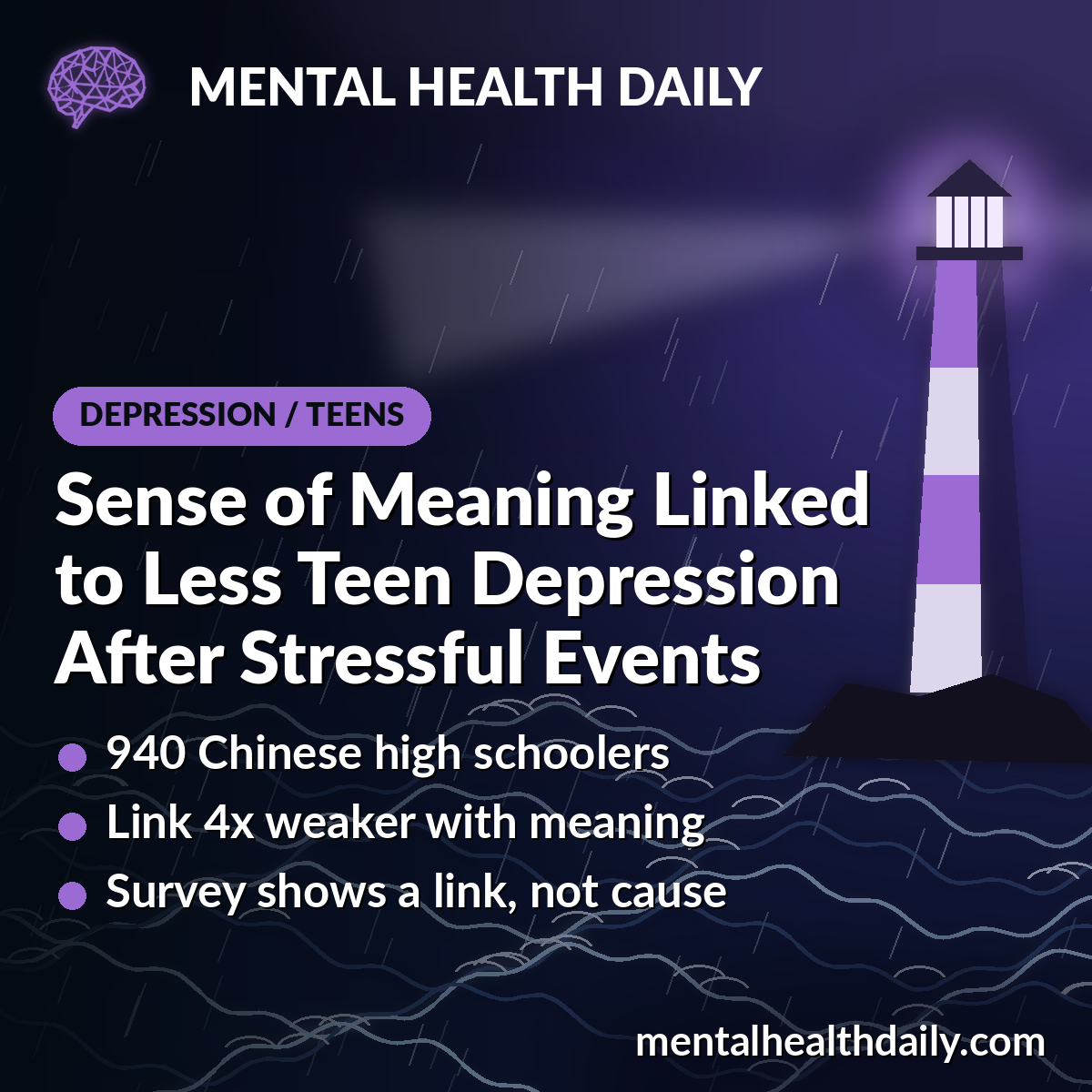
Stressful life events were linked to more depression symptoms 3 months later in 940 Chinese high school students, and that link was much weaker in teens who felt their lives had meaning.1
Research Highlights
- Who and how: 940 eleventh graders at one high school in Hunan Province, China, filled out surveys in October 2025 and again in January 2026. The study was published in Frontiers in Public Health in September 2026.1
- Stress linked to later depression: students who reported more negative life events in the fall had more depression symptoms in winter, even after accounting for their fall depression scores.1
- Rigid coping was part of the path: psychological inflexibility, a habit of avoiding painful feelings and getting stuck in negative thoughts, accounted for about 13% of the link.1
- Meaning in life went with a weaker link: in students with a strong sense of meaning, the link between stress and later depression was about one quarter as strong as in students with a weak sense of meaning.1
- Observational data: the study shows associations over time and cannot prove that meaning in life protects teens or that inflexibility causes depression.
Why Researchers Looked at High School Students in China
Depression symptoms are common in Chinese teens. A 2024 meta-analysis of 439 studies and nearly 1.5 million children and adolescents put the pooled rate of depressive symptoms at 26%, with high school students the highest of any age group at 28%.2
Senior high school students in China also face the gaokao, the national college entrance exam, on top of the usual friendship, family and school pressures. The authors wanted to see how everyday stressful events turn into depression symptoms in this group, and what might soften that effect.1
What the Study Measured
All students were in grade 11 (average age 16.5; 487 boys and 453 girls). They filled out these questionnaires in October and January, 3 months apart, except meaning in life, which was measured only in October:1
- Negative life events: a 26-item checklist of stressful events and how much each one affected them, covering study pressure, relationship problems, punishment, loss (such as being away from family) and adjustment problems
- Depression symptoms: the PHQ-9, a standard 9-question depression screening questionnaire
- Psychological inflexibility: an 8-item teen questionnaire with statements like “I am afraid of my feelings”
- Meaning in life: a 10-item scale with statements like “My life has a clear direction”
Psychological inflexibility comes from acceptance and commitment therapy (ACT). It describes two habits: pushing away uncomfortable feelings (experiential avoidance) and treating negative thoughts as plain facts (cognitive fusion). The opposite, psychological flexibility, means noticing hard thoughts and feelings while still acting on what matters to you.
More Stressful Events, More Depression Symptoms 3 Months Later
Students who reported more negative life events in October had more depression symptoms in January. The models controlled for each student’s October depression and inflexibility scores, so the link reflects change over the 3 months, not just students who were already depressed.1
In standardized terms, the direct link was 0.20 on a scale where 0 means no link. That is a modest association for a single 3-month window, and it is consistent with the earlier studies the authors review linking stressful events to teen depression.
How Psychological Inflexibility Fits In
The researchers tested mediation: whether part of the stress-depression link runs through a middle step. It did. More negative life events in the fall went with more psychological inflexibility in winter, and more inflexibility went with more depression symptoms.1
- Life events to inflexibility: 0.25
- Inflexibility to depression: 0.13
- Path through inflexibility: 0.03, about 13% of the total link
So inflexibility explained a small slice of the connection, and most of the link ran through other routes. Inflexibility and depression were also measured at the same time, which matters for how this result is read (see limitations below).
Meaning in Life Went With a Much Weaker Link
The study also tested moderation: whether the strength of a link changes depending on a third factor. Here, the third factor was how much meaning students felt in their lives in October.1
To show the pattern, the authors compared students with a weak sense of meaning (1 standard deviation below average) and a strong sense of meaning (1 standard deviation above average):
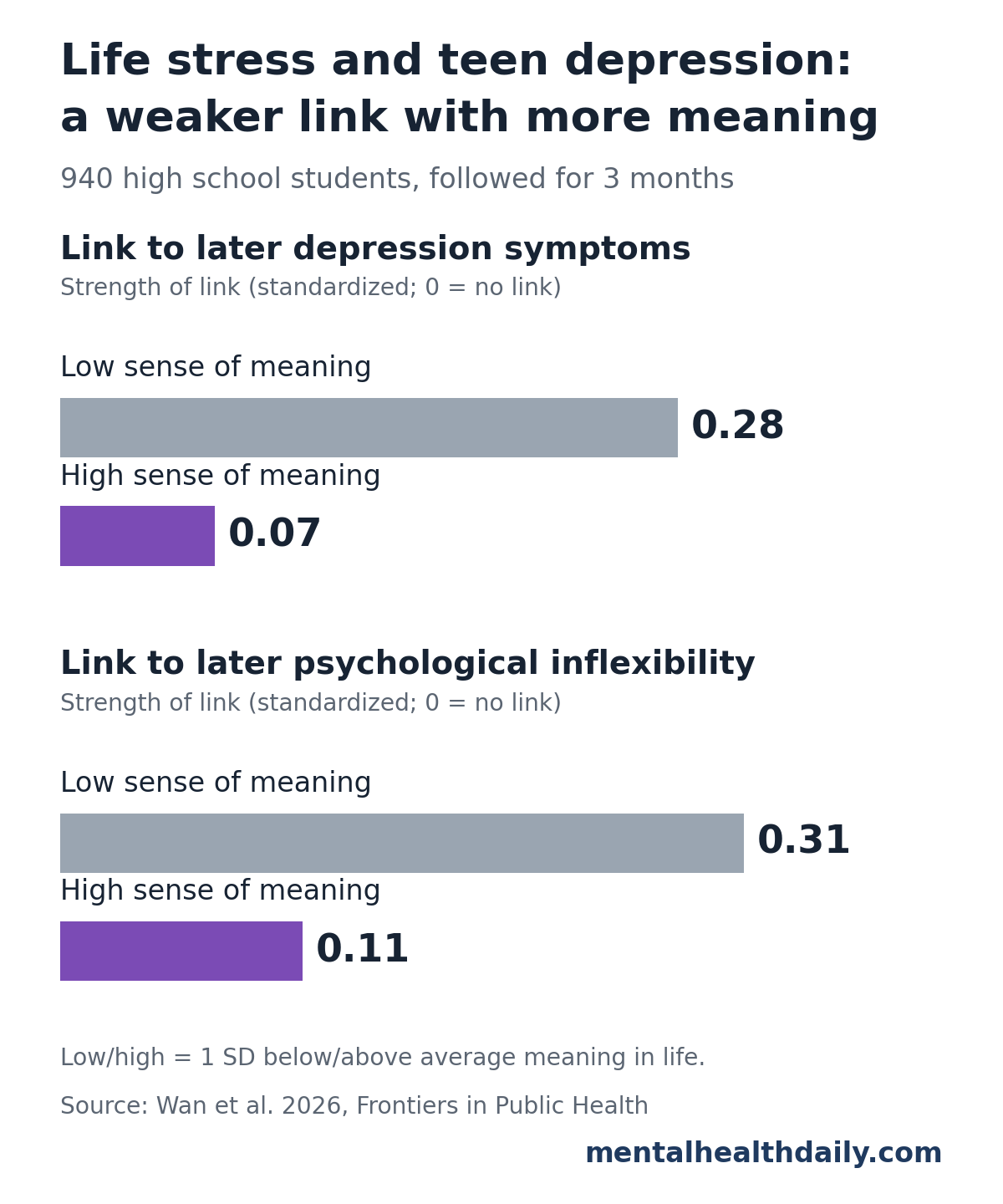
- Stress to later depression: 0.28 with low meaning vs. 0.07 with high meaning
- Stress to later inflexibility: 0.31 with low meaning vs. 0.11 with high meaning
In plain terms, teens with a strong sense of meaning were less likely to become rigid or more depressed when hard things happened. Meaning in life did not change the link between inflexibility and depression, though. Once a student was stuck in rigid coping, inflexibility went with more depression symptoms whatever their sense of meaning.1
The authors suggest meaning in life works early, shaping how a teen interprets a setback before rigid habits set in. They call this a theory, not something their data could show directly.
Limitations
This is an observational survey, so it shows which experiences go together over time, not what causes what. Other limits bear directly on the findings:
- Only two time points. Inflexibility and depression were both measured in January, so the study cannot show that inflexibility came first. Depression may also make teens more rigid. A Finnish study that followed 740 ninth graders through a school year found that psychological flexibility and stress and depression symptoms moved in opposite directions together, consistent with influence running both ways.3
- One school. All students came from a single high school in one Chinese province, and only grade 11.
- Self-report only. Every measure was a questionnaire, and depressed teens may rate past events more harshly.
- Missing background factors. Family income, urban or rural location and family situation were not measured.
- All stressors lumped together. Study pressure, loss and relationship problems were combined into one score, so the study cannot say which events matter most.
- Symptoms, not diagnoses. The PHQ-9 measures symptom levels; the study did not report how many students had clinical depression.
What It Means for Teens, Parents and Schools
The findings point to two things worth building on: helping teens respond to hard feelings with more flexibility, and helping them develop a sense of purpose and direction. The authors suggest school mental health courses and ACT-style skills training, along with closer attention to students going through stressful events.1
Those programs were not tested in this study, so whether they would prevent depression is a question for future trials. For a teen who is struggling now, a school counselor, doctor or mental health professional is the right first step. In the US, the 988 Suicide & Crisis Lifeline is available by call or text at any time.
References
- Wan Z, Cao M, Fang S, Yang S, Zhang X. Longitudinal association between negative life events and depression among Chinese senior high school students: the mediating role of psychological inflexibility and the moderating role of meaning in life. Frontiers in Public Health. 2026;14:1898663. doi:10.3389/fpubh.2026.1898663
- Zhou J, Liu Y, Ma J, et al. Prevalence of depressive symptoms among children and adolescents in China: a systematic review and meta-analysis. Child and Adolescent Psychiatry and Mental Health. 2024;18:150. doi:10.1186/s13034-024-00841-w
- Puolakanaho A, Muotka JS, Lappalainen R, et al. Adolescents’ stress and depressive symptoms and their associations with psychological flexibility before educational transition. Journal of Adolescence. 2023;95(5):990–1004. doi:10.1002/jad.12169