
Teens who spent more time on screens slept worse and reported slightly more depression and stress, according to a 2026 survey of 48,432 secondary school students in Fujian, China.1 Sleep had the strongest link, but every link was small.
Research Highlights
- Sleep was the strongest link: in an adjusted model, worse sleep quality had the largest association with screen time (standardized β = 0.116), ahead of every demographic, family and mood factor.1
- Short sleepers were more often heavy users: 23.6% of students sleeping under 5 hours a night reported more than 4 hours of daily screen time, compared with 8.7% of those sleeping over 7 hours.1
- Depression and stress, but not anxiety: depression (β = 0.047) and stress (β = 0.075) scores were linked to more screen time; anxiety was not.1
- 11.3% used screens more than 4 hours a day: the most common answer was 30 minutes to 1 hour (36.5%).1
- Small effects overall: all the measured factors together explained 6.9% of the differences in screen time, and the survey cannot say which came first.1
What the Fujian Teen Screen Time Survey Measured
The Fujian Adolescent Mental Wellness Study (FAMWeS) is a large school survey of mental health, lifestyle and family life in Fujian Province on China’s southeast coast. Lin et al. analyzed its screen-time data, collected in 2023, and published the results in Frontiers in Psychology.1
- Who: students in grades 7 to 12 at randomly selected schools in 7 cities spanning 3 economic tiers. Most were 12 to 17, and 50.6% were boys.
- When and how: paper questionnaires completed in class from May to July 2023. Of 58,381 collected, 48,432 complete responses were analyzed.
- Screen time: one question, “How many hours per day do you use electronic devices?”, covering phones, computers, TV and games together, with 4 answer bands from under 30 minutes to over 4 hours.
Sleep was measured with the Pittsburgh Sleep Quality Index (PSQI), a 19-item questionnaire scored 0 to 21 that covers how long it takes to fall asleep, sleep length, night waking, daytime tiredness and more. A score above 5 marks poor sleep quality.
Mood was measured with the Depression, Anxiety and Stress Scale for Youth (DASS-Y), a self-report questionnaire for ages 7 to 18 with separate depression, anxiety and stress scores.
Half the Students Reported Poor Sleep
Sleep problems were common. More than half of the students (52.2%) scored above 5 on the PSQI, and the average score was 5.88.1 Nearly a third (30.8%) slept less than 6 hours a night.
Most students scored in the normal range for mood symptoms. Still, about 1 in 5 scored in the mild range or higher for depression (19.2%) and anxiety (22.3%), and 9.4% did so for stress.
Screen time was modest for most students:
- Under 30 minutes a day: 26.2%
- 30 minutes to 1 hour: 36.5%
- 1 to 4 hours: 26.0%
- More than 4 hours: 11.3%
Heavy use varied a lot by city, from 27.2% of students in Zhangzhou to 1.8% in Quanzhou, with no clear pattern by how wealthy a city was.1
Poor Sleep Had the Strongest Link With Teen Screen Time
To see which factors went with more screen time, the researchers used partial least squares structural equation modeling (PLS-SEM). It works like a multiple regression: each factor’s link with screen time is estimated while holding the others constant, and the result is a standardized coefficient (β) that can be compared across factors.1
Worse sleep quality (a higher PSQI score) had the largest coefficient, β = 0.116. By comparison, age came in at 0.069 and parents’ education at about −0.06.
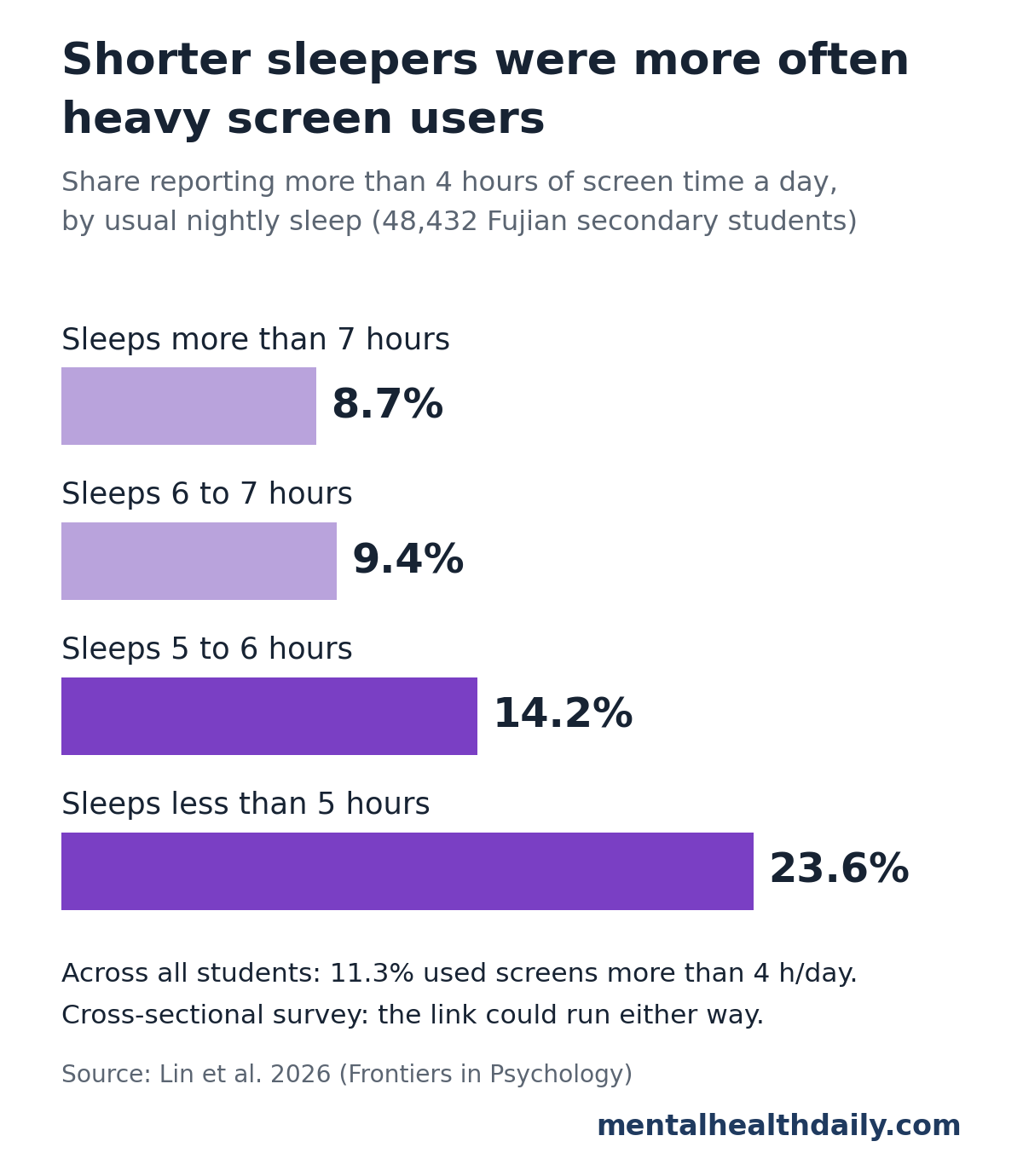
A separate analysis compared students using screens more than 4 hours a day with everyone else, adjusting for other factors. Heavy users had higher odds of nearly every kind of sleep problem:1
- Sleeping under 5 hours: 51% higher odds than sleeping over 7 hours (adjusted odds ratio 1.51)
- “Very bad” self-rated sleep: 57% higher odds than “very good” sleep (1.57)
- Low sleep efficiency: about twice the odds of being asleep for less than 65% of the time spent in bed, compared with more than 85% (2.02)
- Daytime dysfunction: 56% higher odds of the most severe daytime problems, such as trouble staying awake or keeping up enthusiasm, compared with no daytime problems (1.56)
These results fit a long line of research. A 2015 review of 67 studies found screen time linked to worse sleep, mainly shorter and later sleep, in 90% of them.2 A 2016 meta-analysis of 20 studies involving 125,198 children found that using a phone or tablet at bedtime more than doubled the odds of not getting enough sleep (odds ratio 2.17) and raised the odds of poor sleep quality (1.46).3
Depression and Stress Were Linked to Screen Time, but Anxiety Was Not
In the same adjusted model, higher depression scores (β = 0.047) and higher stress scores (β = 0.075) went with more screen time. Anxiety scores showed no link (β = −0.011, p = 0.149).1
Those coefficients are smaller than the one for sleep. In practical terms, knowing a student’s depression or stress score tells you very little about how much time they spend on screens.
That is consistent with larger analyses. A 2019 study of 3 datasets covering 355,358 adolescents found the link between digital technology use and well-being was negative but small, explaining at most 0.4% of the variation in well-being.4
Other Factors Linked to More Screen Time
- Boys and older teens: both reported more screen time.
- Parents’ education: students whose mothers or fathers had more education reported less screen time.
- Time with parents: more time with either parent went with slightly more screen time, possibly because families watch or play together.
Every one of these factors had a small effect size. Together with sleep and mood, they explained 6.9% of the differences in screen time between students, so most of what drives teen screen use lies outside this survey.1
Limits of This Screen Time and Sleep Survey
The survey is large and covered 7 cities, but it has clear limits:
- Direction is unknown. The survey captured one moment in time, and the model actually treated screen time as the outcome. Screens may cut into sleep, but teens who sleep badly or feel low may also reach for their phones more.
- All screen use was lumped together. Homework, looking things up, videos and games were counted as one number. About half the students used devices for study (52.6%) and about half for games (50.9%), so the survey cannot separate schoolwork from recreation.
- Timing was not asked. Bedtime use, the pattern most closely linked to sleep problems in earlier research, was not measured separately.3
- Self-report and broad bands. Screen time came from one question with 4 answer bands, and sleep and mood were self-rated.
- Missing factors. Physical activity, caffeine, chronotype (being a night owl or early bird), family functioning and past mental health problems were not measured.
- Statistical shortcuts. The analysis did not account for students being clustered in the same classes and schools, which can make results look more certain than they are. About 10,000 incomplete questionnaires were dropped without checking how those students differed.
- One province. Results come from Fujian in 2023 and may not carry over to other regions or countries.
What the Findings Mean for Teen Sleep and Screens
Sleep is the clearest target. Across this survey and earlier reviews, heavy screen use and poor sleep show up together in teens again and again.12 In the 2016 meta-analysis, even having a device in the bedroom without using it was linked to poorer sleep, so keeping phones out of the bedroom at night is a reasonable, low-cost step.3
Total hours are a blunt measure. The researchers argue against simply cutting all screen time, since much of it is schoolwork. They suggest focusing on excessive recreational and late-night use instead.1
Mood links are small. Screen time is one small piece of teen depression and stress. A teen with persistent low mood, heavy stress or ongoing sleep problems is worth a conversation with a doctor or school counselor, whatever their screen habits.
Next steps for research: studies that follow teens over time, record what they do on screens and when, and measure sleep more objectively.
References
- Lin Y, Jiang J, Luo Z, Wang Q, Zou F, Alias H, Wong LP, Hu Z. Screen time and its association with psychological wellbeing and sleep quality: overview of the Fujian Adolescent Mental Wellness Study (FAMWeS). Frontiers in Psychology. 2026;17:1686399. doi:10.3389/fpsyg.2026.1686399
- Hale L, Guan S. Screen time and sleep among school-aged children and adolescents: a systematic literature review. Sleep Medicine Reviews. 2015;21:50–58. doi:10.1016/j.smrv.2014.07.007
- Carter B, Rees P, Hale L, Bhattacharjee D, Paradkar MS. Association between portable screen-based media device access or use and sleep outcomes: a systematic review and meta-analysis. JAMA Pediatrics. 2016;170(12):1202–1208. doi:10.1001/jamapediatrics.2016.2341
- Orben A, Przybylski AK. The association between adolescent well-being and digital technology use. Nature Human Behaviour. 2019;3(2):173–182. doi:10.1038/s41562-018-0506-1