
A new 28-item questionnaire built to measure how people hold their sense of self together found that needing recognition and support from others was strongly linked to vulnerable narcissism.1 Researchers developed and tested it in about 5,800 mostly young, nonclinical participants in mainland China.
Research Highlights
- Need for support tracked vulnerable narcissism: the scale’s “Self-Space Need” score correlated r = .64 with a standard vulnerable-narcissism questionnaire in 1,235 adults.1
- Self-investment barely tracked grandiosity: the “Self-Cathexis” score correlated only r = .18 with grandiose narcissism. Its overall link to vulnerable narcissism was near zero (r = −.04) because its 2 facets pulled in opposite directions.1
- Healthy self-worth went the other way: people who scored higher on “Positive Self” reported less vulnerable narcissism (r = −.34).1
- 4 facets, not a neat 2-level model: the questionnaire held together best as 4 overlapping facets; the planned structure of 2 broad dimensions sitting on top did not fit well.1
- Stable over 2 months: total scores in 128 people who retook it gave a test–retest reliability of .87.1
- Early evidence: online volunteers, one country, no clinical patients, and no depression, anxiety, or wellbeing measures.
What “Self-Structure” Means
Self-structure is the researchers’ term for the fairly lasting way a person organizes their sense of self: how they link feelings, memories, values, and self-images, and how they keep that sense of self steady across situations.1 The idea comes from psychoanalytic theory, especially Freud’s writing on narcissism and Heinz Kohut’s self psychology.
The 2026 study, led by Xinyi Li at Peking University with corresponding authors Jie Zhong and Wei Li, proposed that self-structure has 2 dimensions:1
- Self-Cathexis (self-investment): how much a person treats themselves as worth caring about and investing in. “Cathexis” is an old psychoanalytic word for emotional investment. High levels can look like secure self-worth, or like inflated self-importance and entitlement.
- Self-Space Need (need for relational room): how much the self depends on other people and admired figures for recognition, support, and a sense of direction in order to feel whole. When that support is missing, people high on this dimension may feel insecure, ashamed, or empty.
Neither dimension is meant as healthy vs unhealthy on its own. The theory is that narcissistic patterns come from how the 2 combine.
How the Self-Structure Scale Was Built and Tested
The Scale of Self Structure (SOSS) started as 37 statements written by a clinical psychology team, rated from 1 (completely disagree) to 5 (completely agree). After statistical pruning, 28 items remained, grouped into 4 facets:1
- Positive Self (9 items): stable inner self-worth and realistic self-acceptance.
- Self-Center (7 items): putting one’s own view and needs first and expecting recognition.
- Idealized Identification (5 items): drawing stability and self-worth from admired people, role models, or ideals.
- Vulnerable Self (7 items): shaky self-worth, sensitivity to rejection, and a strong need for outside support.
The first 2 facets were designed to reflect self-investment; the last 2, the need for relational room.
Study 1: 1,954 adults (ages 18–73, average about 27) completed the draft version online. A subset of 128 retook it 2 months later to check whether scores stayed stable.
Study 2: a separate 3,805 people completed the final version. Of those, 1,235 also completed 2 established narcissism questionnaires. Most were young adults, about 70% were women, and participants received free access to an online course for taking part.1
Needing Recognition Was Strongly Linked to Vulnerable Narcissism
Narcissism research usually separates 2 forms:
- Grandiose narcissism: self-importance, entitlement, showing off, and high outward self-esteem. Here it was measured with the 13-item Narcissistic Personality Inventory (NPI).
- Vulnerable narcissism: hypersensitivity, shame, insecurity, and self-worth that depends on others’ approval. Here it was measured with the Pathological Narcissism Inventory (PNI).
Results are reported as correlations (r), which run from −1 to 1. Values near 0 mean no link; around .3 is a moderate link; .6 or higher is a strong one for questionnaire research.
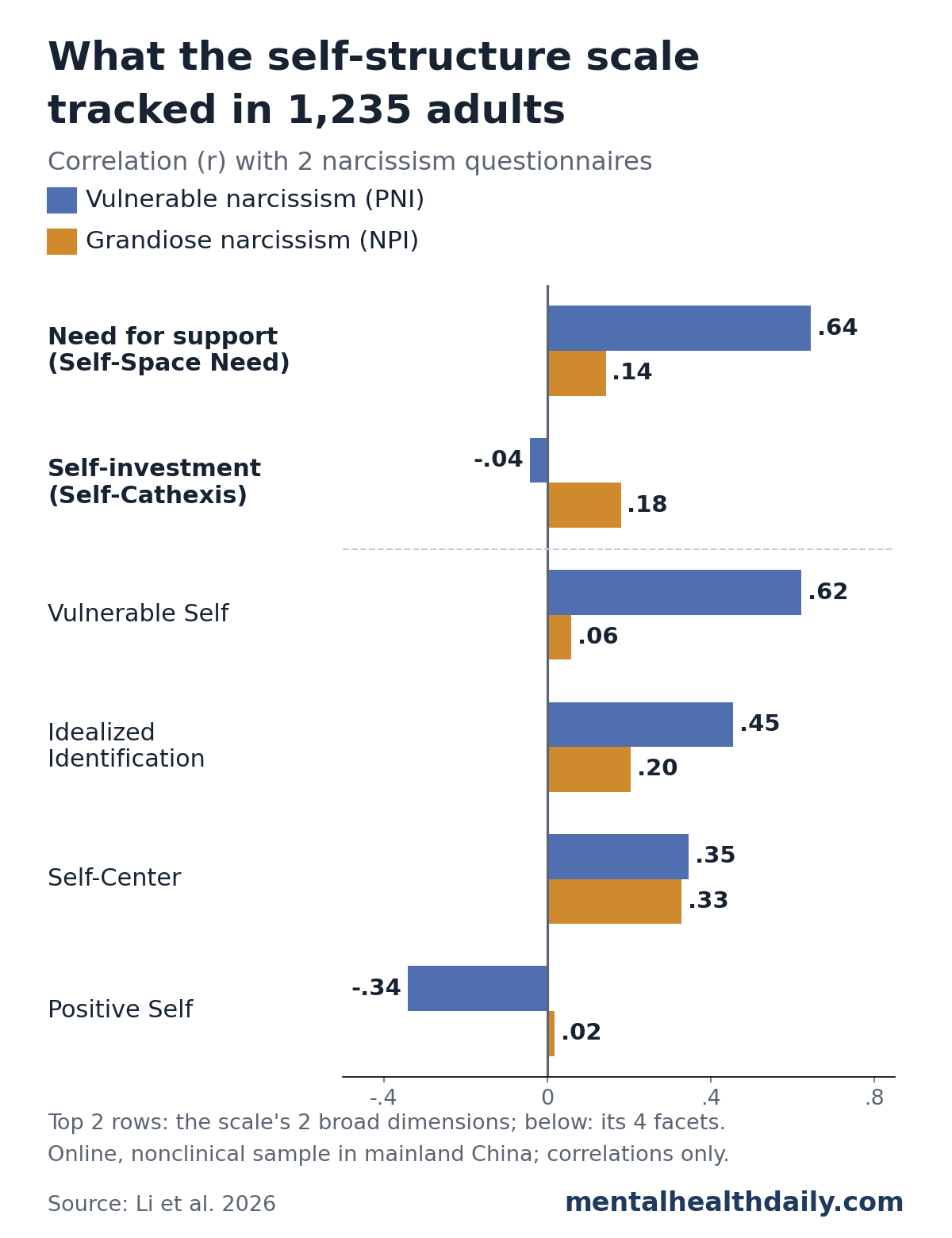
The strongest links ran to vulnerable narcissism. Self-Space Need correlated .644 with the PNI, and the Vulnerable Self facet alone correlated .622. Idealized Identification (.454) and Self-Center (.346) were also moderately linked.1
Self-investment and grandiosity were only weakly linked. Self-Cathexis correlated .180 with the NPI. The Self-Center facet had a moderate link (.329), while Positive Self had no link to grandiose narcissism at all (.018).1
Secure self-worth stood apart from narcissism. Positive Self correlated −.341 with the PNI: people with steadier, more realistic self-regard reported fewer vulnerable-narcissism traits. The researchers read this as evidence that healthy self-regard is its own part of the self, not just the opposite of vulnerability.1
The overall pattern fits the theory. Vulnerable narcissism was most closely linked to leaning on others to hold the self together. The total self-investment score showed almost no link (−.042) because its 2 facets canceled out: people with vulnerable traits scored lower on secure self-worth but higher on self-centeredness. Grandiose narcissism, meanwhile, was not simply a lot of self-investment. The grandiose result is harder to judge, though, because the NPI had modest reliability in this sample (alpha = .658).1
The 4 Facets Fit Better Than the Planned 2-Dimension Model
The researchers tested several ways the 28 items might hang together, using confirmatory factor analysis (a check of whether answers cluster the way a proposed model predicts).1
- 2 dimensions only: poor fit.
- 4 separate facets: better, but still below usual standards.
- 4 facets grouped under the 2 dimensions: 1 version would not run, 1 gave no usable fit numbers, and 1 fit poorly.
- 4 overlapping facets: best fit. This approach, called exploratory structural equation modeling, lets an item relate a little to more than 1 facet.
Even the best model was only borderline by common benchmarks (comparative fit index .901; values of at least .90, and ideally .95, are usually wanted). The researchers concluded that the 2 dimensions work better as broad ways of interpreting the facets than as measurable layers of the questionnaire.1
Reliability was acceptable. In the 3,805-person sample, the total score had an internal consistency (how well items agree with each other) of .795 by Cronbach’s alpha. Facets ranged from .657 to .841, with Vulnerable Self the weakest. The 4-facet structure also worked the same way for men and women.1
4 Self-Structure Profiles Emerged, With Fuzzy Edges
Grouping all 3,805 people by their 2 dimension scores produced 4 clusters:1
- High on both (711 people): the theory calls this an expansive, self-driven pattern.
- Low self-investment, high need for support (1,238): the theory’s vulnerable pattern, with fragile self-worth and a strong need for recognition.
- Low on both (704): a constricted pattern with little self-assertion.
- Higher self-investment, low need for support (1,152): a compact, rigid pattern that the theory says may overlap with antagonistic narcissistic traits.
These groups overlapped a lot. The separation statistic was .31, which the researchers describe as weak to moderate. They stress that the clusters are not personality types or diagnoses, and no outcomes were compared between them.1
Limitations of This Self-Structure Scale Study
This is a first validation of a new questionnaire, and one sample of evidence is an early step.
- Narrow sample: online volunteers from mainland China, mostly young adults and university students, with no clinical patients and no testing in other cultures.
- Narcissism was the only outside check: the scale was not compared with depression, anxiety, wellbeing, relationships, or a clinical interview, so whether it predicts anything about mental health is unknown.
- Self-report only: both the new scale and the narcissism questionnaires were filled out by the same person at the same time, which can inflate correlations.
- Snapshot design: the data cannot show whether needing support leads to vulnerable narcissism or the reverse.
- Imperfect structure: the planned 2-dimension model did not hold up, and the Vulnerable Self facet was the least reliable.
- Same group, same theory: the 2-dimension model comes from Zhong’s earlier theory papers; independent teams have not yet tested it.
- Small retest group: stability was checked in 128 people, 80% of them women.
What the Self-Structure Findings Mean for Readers
- Not a self-test or diagnosis. The researchers say directly that the scale is a research tool and cannot identify narcissistic personality disorder or guide treatment.1
- Vulnerable narcissism and dependence on others go together. In this sample, the traits most linked to vulnerable narcissism were a strong need for outside support, rejection sensitivity, and leaning on admired figures.
- Healthy self-worth looks different from narcissism. Steady, realistic self-regard was unrelated to grandiosity and lower in people with vulnerable traits.
- Next tests: clinical samples, other countries, long-term follow-up, and links to everyday mental health outcomes.
References
- Li X, Zhong J, Fan S-S, Yin J-Y, Gao X, Li W. The construction and psychometric evaluation of the self-structure scale: a bidimensional model of self-structure. Frontiers in Psychiatry. 2026;17:1942305. doi:10.3389/fpsyt.2026.1942305