
More than half of 101 caregivers looking after a person with dementia at home in Qatar scored in the 2 highest ranges of a standard caregiver burden questionnaire, and every spouse in the survey did.1
Research Highlights
- Heavy burden was common: the average Zarit Burden Interview score was 42.8 out of 88, and 56 of 101 caregivers landed in the “moderate to severe” (37) or “severe” (19) band.1
- Spouses carried the most: all 13 spouse caregivers were in those 2 top bands, and 7 of them were in the severe band.1
- Less schooling, more burden: 26 of 33 caregivers with secondary schooling were in the top 2 bands, compared with 15 of 45 with a university degree or higher.1
- Long hours did not reach significance: caregivers working 16 to 24 hours a day made up most of the severe band, but the overall link between daily hours and burden was not statistically significant.1
- Similar to the global picture: a meta-analysis of 43 studies put moderate-to-severe burden at about 49% of informal dementia caregivers.2
How the Qatar Dementia Caregiver Survey Worked
Abdo et al. surveyed caregivers of people with dementia receiving care through the Private Nursing Services (PNS) program at Hamad Medical Corporation in Qatar, and collected the data in patients’ homes. The study was published in Frontiers in Dementia in September 2026.1
Researchers approached all 146 registered caregivers during routine visits, and 101 completed the survey, a 69.1% response rate. “Caregiver” was defined broadly: family members, friends, and paid or unpaid helpers who handled the person’s daily care.1
- Who they were: average age 43; 76 women and 25 men; 55 Arab and 45 Asian caregivers
- Relationship: 33 sons or daughters, 13 spouses, 6 siblings, 2 in-laws, and 47 in an “other” category the paper does not break down
- Time spent: 44 caregivers (43.6%) reported 16 to 24 hours of caregiving a day
- Language: the survey was completed in English on a tablet, so caregivers who could not read English were excluded
The Zarit Burden Interview (ZBI) is a widely used 22-item questionnaire about the strain of caring for someone. Each item, such as “not enough time for yourself” or “fear the future regarding your relative,” is rated 0 to 4. Totals run from 0 to 88, and higher scores mean heavier burden.1
Over Half of Caregivers Scored in the Top 2 Zarit Burden Bands
The researchers grouped total scores into 4 bands. They did not report the score cutoffs, so the bands are described here by the paper’s own labels:1
- Minimal burden: 15 caregivers (14.9%)
- Moderate burden: 30 (29.7%)
- Moderate to severe burden: 37 (36.6%)
- Severe burden: 19 (18.8%)
The paper’s abstract highlights the 36.6% figure, but that is one band. Together with the severe band, 56 of 101 caregivers (55%) were in the 2 heaviest categories. The average score was 42.8 (standard deviation 19.6), which reflects a wide spread between caregivers.1
Where the strain showed up. Individual items point to the kinds of pressure caregivers felt most:1
- Dependence: 37% rated how much the person depends on them at the extreme level, and another 26% at the severe level
- Self-doubt: 32% felt at the extreme level that they could do a better job of caring
- Time: 34% rated not having enough time for themselves at the severe level
- Money: 39% rated fear of not having enough money to care for their relative as severe or extreme
- Anger and embarrassment: less common; 45% and 44% reported none
These numbers are in line with research elsewhere. A 2020 meta-analysis by Collins and Kishita pooled 43 studies with 16,911 informal dementia caregivers and estimated that 49.26% had moderate-to-severe burden and 31.24% had depression, with wide variation between studies.2
Spouses and Caregivers With Less Schooling Reported the Most Burden
Of all the caregiver traits tested, only 2 were significantly linked to burden band: relationship to the patient (p = 0.011) and education (p = 0.019).1
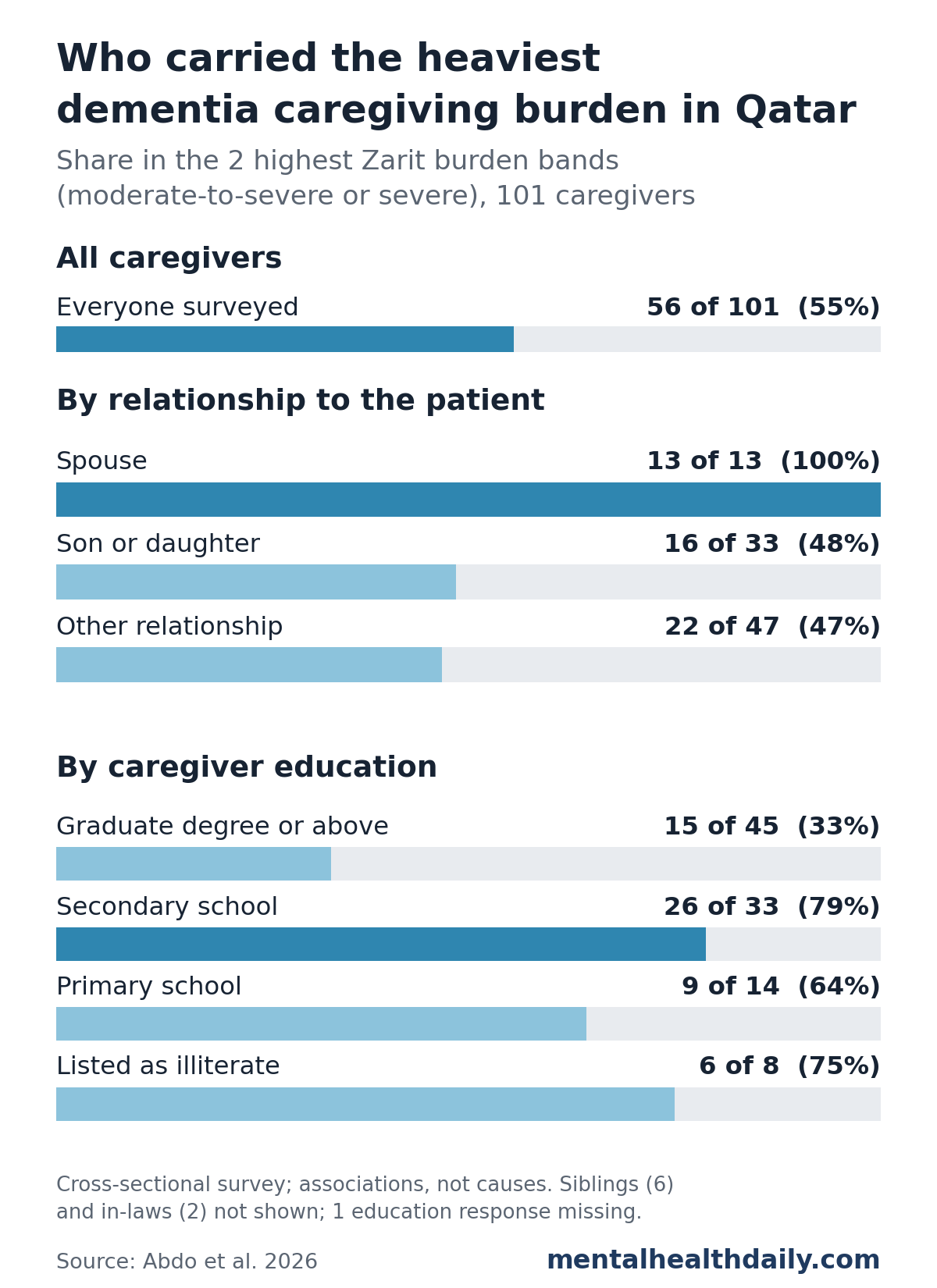
Spouses. None of the 13 husbands or wives caring for a partner scored in the minimal or moderate bands: 6 were in the moderate-to-severe band and 7 in the severe band. By comparison, 16 of 33 sons and daughters were in the top 2 bands.1
The spouse finding matches a large body of earlier work. A 2011 meta-analysis of 168 studies of caregivers for older adults found that spouses reported more depression, more financial and physical burden, and lower well-being than adult children, largely because spouses provided more care.3 The Qatar study team also pointed to the role strain, isolation, and loss of companionship that spouses face.
Education. A third of caregivers with a university degree or higher (15 of 45) were in the top 2 bands, compared with 26 of 33 with secondary schooling, 9 of 14 with primary schooling, and 6 of 8 listed as illiterate. The study team suggested that education may bring better problem-solving skills and easier access to support, though the survey did not measure either.1
Daily hours. Caregivers who reported 16 to 24 hours of care a day made up 13 of the 19 people in the severe band.
Within each hours group, 13 of 44 round-the-clock caregivers were in the severe band, compared with 3 of 34 working 8 to 16 hours and 3 of 23 working up to 8 hours. Across all 4 bands, though, the difference was not statistically significant (p = 0.32), even though the abstract describes these caregivers as reporting intense burden.1
Not linked to burden: caregiver age, gender, nationality (Arab or Asian), whether the caregiver lived alone with the patient, and years spent caring for this patient.1
Family Duty and Domestic Help Shape Dementia Care in Qatar
Earlier work from Qatar adds context the survey could not capture. In interviews with 32 family caregivers of people with Alzheimer’s disease and related dementias in Qatar, Hammad et al. described caregiving shaped by religious and cultural motivations, the role of the extended family, social stigma, and limited knowledge about dementia.4
A 2025 narrative review of 32 studies from the Middle East and North Africa reached similar themes:5
- financial strain
- a burden that falls unevenly by gender
- limited government support
- limited knowledge about dementia
- heavy reliance on domestic workers
Domestic workers may be part of the Qatar sample too. Close to half of the caregivers were in the undefined “other” relationship group, and the definition included paid helpers, but the paper does not say how many were hired domestic workers rather than relatives.1
Limits of This Dementia Caregiver Burden Survey
This is a single cross-sectional survey, which can show which caregivers reported more burden at one point in time but not what caused it. Other limits bear directly on the findings:1
- Small subgroups: the spouse group had 13 people and the illiterate group 8, so a few caregivers could shift those percentages a lot.
- No adjustment: the tests compared one trait at a time. Spouses may also differ in age, hours, and the patient’s illness stage, and the analysis did not account for dementia severity, behavioral symptoms, or the patient’s daily functioning.
- Who was missed: caregivers who could not read English were excluded, and 45 of the 146 approached did not complete the survey.
- Reporting errors: the paper’s text reads some table percentages as shares of each caregiver group when they are shares of each burden band, and 2 tables disagree on years of caregiving. The counts used here come directly from the table cells.
- Narrow setting: all participants had professional home nursing through one provider, and all authors work for that provider.
Support the Researchers Recommend for Dementia Caregivers
The study team called for support built into Qatar’s existing health system, including expanded respite care through the home nursing program, caregiver education workshops at primary care centers, counseling and peer support groups, and financial help for caregiving households.1 The survey did not test any of these services.
For families, the results point to who may need help first: spouses caring for a partner and caregivers with less formal education. If you are caring for someone with dementia and feel overwhelmed, a doctor, nurse, or local dementia service can help with respite options and support.
References
- Abdo AAM, Manalo ELC, Santander L, et al. The burden among caregivers who are caring for patients with dementia admitted under private nursing services. Frontiers in Dementia. 2026;5:1873575. doi:10.3389/frdem.2026.1873575
- Collins RN, Kishita N. Prevalence of depression and burden among informal care-givers of people with dementia: a meta-analysis. Ageing & Society. 2020;40(11):2355–2392. doi:10.1017/S0144686X19000527
- Pinquart M, Sörensen S. Spouses, adult children, and children-in-law as caregivers of older adults: a meta-analytic comparison. Psychology and Aging. 2011;26(1):1–14. doi:10.1037/a0021863
- Hammad SH, Daher-Nashif S, Kane T, Al-Wattary N. Sociocultural insights on dementia care-giving in Arab and Muslim communities: the perspectives of family care-givers. Ageing & Society. 2024;44(2):357–384. doi:10.1017/S0144686X22000277
- Al-Namla M, Mahboob A, Radwan E, et al. A narrative review of challenges faced by informal caregivers of people with dementia in the Middle East and North Africa. Frontiers in Medicine. 2025;12:1610957. doi:10.3389/fmed.2025.1610957