
A 2026 case report from Paris follows a young Congolese woman with chronic, disabling pain through 7 sessions of transcultural group therapy. Her pain did not go away, but it weighed less on her daily life as she began to tell her family’s war and separation story in her own words.1
Research Highlights
- One patient, 7 sessions: interpreter-assisted group consultations ran from December 2024 to November 2025, alongside her regular psychiatric care.1
- Pain persisted but became less disabling: by the 5th session she used prayer in place of painkillers, and by the 7th the pain had a smaller effect on her daily functioning.1
- Dreams came back: she went from no dreams and fear of sleep to dreaming every night by the 6th session.1
- Mother and daughter began to separate their pain: early on, her mother said she felt her daughter’s pain “doubly”; later, each spoke from her own position.1
- No measured outcomes: all changes are clinician descriptions from session transcripts, and other care running at the same time cannot be separated out.1
Chronic Pain After War, Migration and Family Separation
The young woman, called Gloria in the report, belongs to the Banyamulenge, a Kinyarwanda-speaking community in the South Kivu region of the Democratic Republic of the Congo that has faced repeated persecution.1
Her history, as the researchers lay it out:1
- Childhood: vision problems, fatigue, memory problems, recurrent dizziness, occasional fainting, and possible anxious school refusal, all before any migration.
- Age 13 (2017): her village was attacked. She fled with her father and older sister across Lake Tanganyika and eventually reached France. Her mother and 3 younger siblings escaped into Uganda and spent 2 to 3 years in a refugee camp.
- Age 17 (2021): she was hospitalized for diffuse pain so intense that at times she could not get out of bed. Individual psychiatric care began.
- 2023: the family was reunited in France after 6 years apart.
- Age 20 (December 2024): she started transcultural group consultations, with chronic pain, severe school-related anxiety, and major problems functioning day to day.
Her physical exam was normal, but some lab findings raised the possibility of an autoimmune contribution, and that workup was still under way when the report was written.1
Her psychiatrists diagnosed somatic symptom disorder with predominant pain (called bodily distress disorder in the ICD-11), with anxiety features. The diagnosis means the pain itself, and the worry and disruption around it, take over daily life. It does not require the pain to be “all in the head,” and it does not rule out a medical cause.1
Why Refugees Often Express Trauma Through Pain
Bodily symptoms are a common way for war and displacement to show up. A 2014 review found that refugees from non-Western countries report more medically unexplained physical symptoms than the general Western population. Its authors pointed to trauma, torture, other psychiatric illness, and the stigma of psychiatric care as overlapping explanations.2
Standard trauma diagnoses can miss this. A 2011 review of PTSD across cultures noted that physical complaints after trauma vary across cultures.3
Intergenerational trauma is the idea that the effects of a parent’s trauma can reach their children. A 2017 systematic review of refugee families pointed to parenting, family relationships, and family communication patterns as the pathways through which this happens. It also found the research scattered and inconsistent in its methods.4
What Mentalization and Transcultural Consultation Mean
Mentalization is the everyday ability to understand your own and other people’s behavior in terms of thoughts, feelings, and intentions. Children learn it from parents who notice and reflect back what the child is feeling.1
Faustino et al. suggest that trauma passed down in a family can overwhelm this ability. Feelings then circulate between parent and child without being named, and the body carries what cannot yet be put into words.1
Transcultural consultation is a group-based approach developed in France for families whose care has stalled, often where culture, language, or migration complicates things. Here is how it works:1
- A lead therapist: runs the session with the family.
- Several co-therapists: from different cultural, language, and professional backgrounds, who offer ideas and images and help clinicians step outside their own assumptions.
- An interpreter: in this case the same Kinyarwanda-speaking interpreter at every session, acting almost as a co-therapist.
- The family’s own explanations: religious, cultural, and family beliefs about illness are treated as tools for therapy, not obstacles.
The team’s idea is that the group can temporarily do the reflecting a strained family cannot yet do on its own, until the family can take it over.1
What Changed Across the 7 Group Sessions
A co-therapist transcribed each session and the team’s debriefing word for word. The first author analyzed these transcripts with a senior author’s supervision, tracking moments where family history surfaced and how the group helped turn it into a story.1
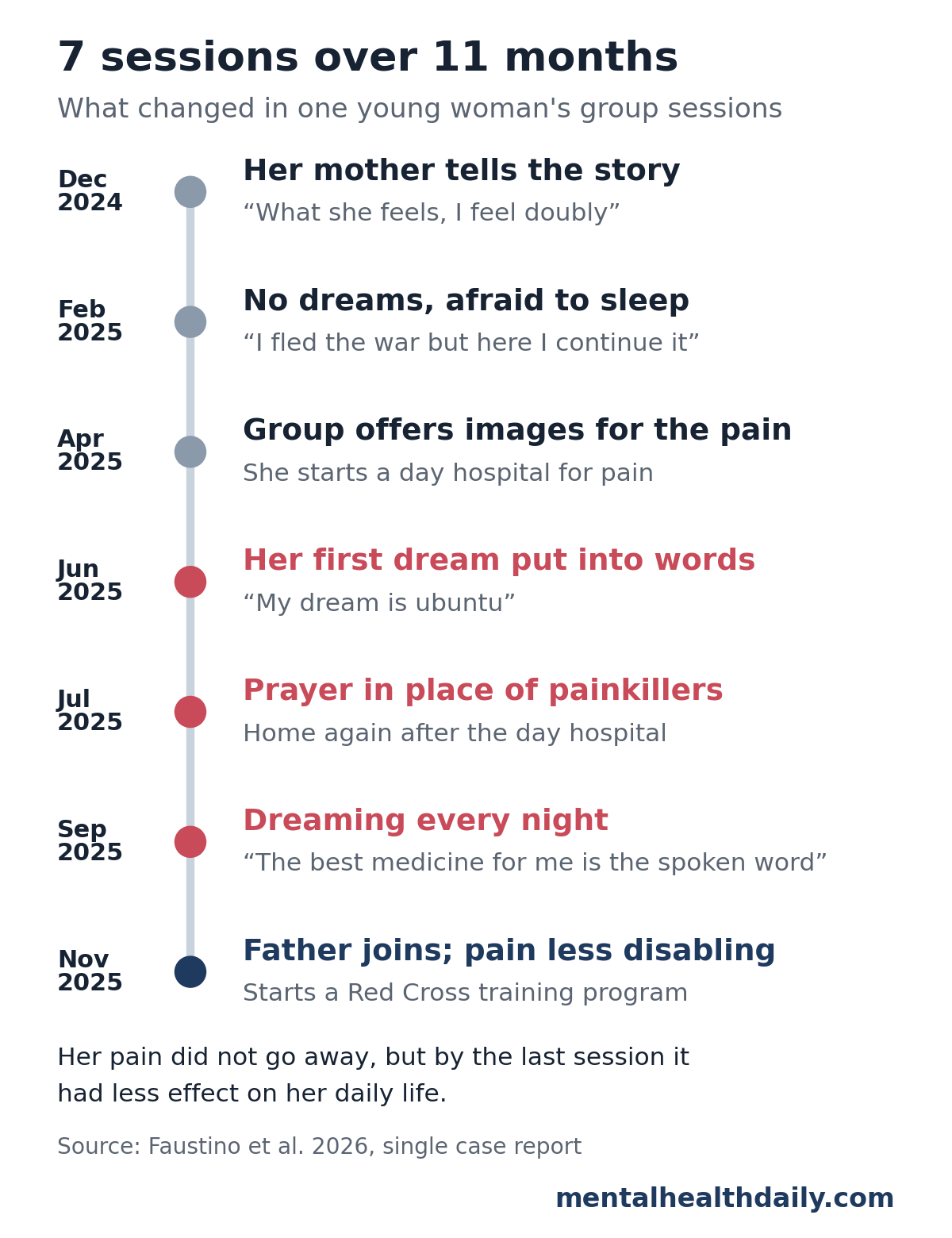
Session 1 (December 2024): Gloria said little, and her mother carried most of the story. Her mother described the bond this way: “Gloria’s pain reaches me before she feels her own; what she feels, I feel doubly.” The team saw the pain as something shared between them rather than belonging to one person.1
Session 2 (February 2025): her pain had flared after a trip abroad. She leaned on prayer, said she did not dream, and was afraid to sleep, while her mother described a vivid religious dream life. Gloria summed up her situation: “I fled the war but here I continue it.”1
Session 3 (April 2025): she felt more stable and had started a day hospital that combined medical and psychological care for her pain with schooling. Since she still could not dream, the group offered images on her behalf, including her pain as the trace of an exhausting “crazy race” of migration, and a ritual of separation so mother and daughter could each set down what they carried.1
Session 4 (June 2025): Gloria asked about the word Ubuntu on a board in the room. The group explained it as a philosophy of shared humanity: “I am who I am thanks to who we all are.” She then described her first dream in the sessions, one of protection rather than achievement: “My dream is ubuntu… If you are there, nothing can happen.”1
Session 5 (July 2025): she had finished the day hospital and returned home. She still had pain episodes but now used prayer instead of painkillers. The lead therapist put the shift into words: “It is as if the pain were a marker of what you feel.”1
Session 6 (September 2025): for the first time she talked about school, including teachers who had called her “good for nothing,” a memory that came back during pain episodes. She reported dreaming every night and said, “The best medicine for me is the spoken word.” Her mother now spoke from her own, separate position.1
Session 7 (November 2025): her father attended for the first time and filled in his side of the family history, including that Gloria had health problems before the 2017 attack. Gloria had improved overall and had joined a Red Cross program toward becoming a medical secretary.1
Care closed in January 2026, when her individual psychiatric follow-up was transferred to another center. The report notes complete attendance and no adverse events over the 11 months.1
How the Researchers Explain the Change
Faustino et al. describe the group as a temporary “mentalizing envelope”: a stable, containing setting where the family’s pain could be named, separated out, and placed in a shared story. They point to 3 processes:1
- From body to story: pain shifted from something that simply happened to her body to a signal of feelings she could talk about.
- From merged to separate: mother and daughter moved from sharing one undifferentiated pain toward early, symbolic separation, partly through the image of the pagne, a wax-print cloth linked to womanhood and what mothers pass on, with Gloria “weaving her own.”
- Cultural images as tools: Ubuntu, the cloth, a biblical name tradition, and a co-therapist’s image of the family history as “even and odd pages,” one set read with each parent, all came out of the group’s conversation and gave the family new ways to talk.
These are interpretations within a psychoanalytic, transcultural framework, and the researchers present them as a clinical hypothesis rather than a tested model.1
How Strong Is the Evidence for These Approaches?
Mentalization-based treatment (MBT) is a structured therapy built on the same theory. A 2019 systematic review found its strongest evidence in borderline personality disorder, with promising results in adolescents who self-harm. Evidence for other conditions was still developing, 60% of studies carried a risk of confounding bias, and nearly half reported poorly on whether therapists followed the treatment model.5
That evidence comes from a different therapy and different patients, so it does not establish that transcultural group consultation works for pain.
Cultural consultation services in other countries share some of the same goals. A 2003 evaluation of one such service in Montreal, built on an expanded cultural formulation with cultural consultants and culture brokers, found that referring clinicians were highly satisfied, though many said their patients needed longer-term follow-up.6 Satisfaction is not the same as a measured improvement in symptoms.
Limits of This Single Case Report
The researchers state plainly that no generalization is claimed from one case. Other limits:1
- No measurements: there were no pain scores, anxiety scales, or functioning scores, only clinicians’ descriptions.
- Overlapping care: individual psychiatric follow-up, medical care, the day hospital, and the family’s recent reunion all ran at the same time, and their effects cannot be separated from the group’s.
- One theoretical lens: the material was read through a transcultural psychoanalytic framework; other approaches would highlight different things.
- Translated words: every quote passed through consecutive Kinyarwanda-French interpretation, then into English.
- Analysis by the treating team: the transcripts were analyzed by a member of the clinical group, without independent coding.
- Unsettled medical picture: the autoimmune workup was ongoing, so a physical contribution to her pain has not been ruled out.
What This Case Suggests for Young Migrants With Unexplained Pain
The case shows one way clinicians can work with pain that resists purely medical treatment: keep the medical workup going while making room for the family’s history, language, and beliefs in the same care plan.1
- Look beyond the individual: in families separated by war, distress may be shared between parent and child, and bringing both parents into the room can open up parts of the story.
- Use interpreters well: a consistent interpreter can do far more than translate words.
- Do not stop pain medicine on your own: Gloria’s switch to prayer happened within ongoing medical and psychiatric care. Any change to medication should go through the prescribing clinician.
Whether transcultural group consultation helps young people like Gloria more than standard care will take comparative studies with measured outcomes, which the researchers themselves call for.1
References
- Faustino I, Rizzi AT, Moro MR, Radjack R. Case Report: From somatic pain to shared narrative—mentalization and intergenerational trauma in a transcultural group consultation. Frontiers in Psychology. 2026;17:1933126. doi:10.3389/fpsyg.2026.1933126
- Rohlof HG, Knipscheer JW, Kleber RJ. Somatization in refugees: a review. Social Psychiatry and Psychiatric Epidemiology. 2014;49:1793–1804. doi:10.1007/s00127-014-0877-1
- Hinton DE, Lewis-Fernández R. The cross-cultural validity of posttraumatic stress disorder: implications for DSM-5. Depression and Anxiety. 2011;28:783–801. doi:10.1002/da.20753
- Sangalang CC, Vang C. Intergenerational trauma in refugee families: a systematic review. Journal of Immigrant and Minority Health. 2017;19(3):745–754. doi:10.1007/s10903-016-0499-7
- Malda-Castillo J, Browne C, Perez-Algorta G. Mentalization-based treatment and its evidence-base status: a systematic literature review. Psychology and Psychotherapy: Theory, Research and Practice. 2019;92:465–498. doi:10.1111/papt.12195
- Kirmayer LJ, Groleau D, Guzder J, Blake C, Jarvis E. Cultural consultation: a model of mental health service for multicultural societies. Canadian Journal of Psychiatry. 2003;48(3):145–153. doi:10.1177/070674370304800302