
Pharmacy students who self-medicated often rated their own drug knowledge higher and more often agreed that stress pushes them toward risky medication habits, according to a 2026 survey of 244 Doctor of Pharmacy students at Umm Al-Qura University in Makkah, Saudi Arabia.1
Research Highlights
- Nearly everyone self-medicated: 230 of 244 students (94.3%) said they had treated themselves without a doctor, and 102 did it often or always.1
- Confidence went with frequent use: each extra point on a 5-to-25 self-rated knowledge score was linked to 21% higher odds of frequent self-medication (OR 1.21, 95% CI 1.12–1.32).1
- Stress attitudes did too: each extra point on a stress-attitudes score was linked to 11% higher odds (OR 1.11, 95% CI 1.04–1.19), after adjusting for sex, academic year, GPA and training.1
- Painkillers led, but sleep and anxiety drugs appeared: 82.2% of self-medicating students used painkillers, 30.0% sleeping aids and 10.9% anti-anxiety drugs.1
- Safety habits were uneven: only 38.7% always read the label, and 29.1% had experienced side effects from self-medication.1
What Counted as Self-Medication in the Saudi Pharmacy Survey
Self-medication means treating a symptom you have diagnosed yourself without seeing a clinician first. The researchers cited the World Health Organization definition, which also counts continuing a prescribed drug beyond the recommended duration.1
The study centered on over-the-counter (OTC) medicines, sold without a prescription. Students rated how often they self-medicated, from never to always, and picked the types of medicine they usually used:1
- Painkillers: 189 students (82.2%)
- Topical creams or gels: 154 (67.0%)
- Cough syrup: 106 (46.1%)
- Sleeping aids: 69 (30.0%)
- Anti-anxiety drugs (anxiolytics): 25 (10.9%)
Anxiolytics usually require a prescription, and the survey did not ask where students got them or whether they were left over from an earlier prescription.
Why students did it: the top reason was “I know which medication to take” (67.4%), followed by believing the illness was minor (47.8%), prior experience with the drug (47.4%) and saving time (45.7%). Only 9.6% said they could not afford a doctor’s visit.1
Self-Rated Knowledge and Stress Attitudes Both Linked to Frequent Self-Medication
The researchers split students into 2 groups: those who self-medicated often or always (102 students) and everyone else, from never to sometimes (142). They then tested which factors were linked to being in the frequent group.1
Each predictor was a 5-item score running from 5 to 25:
- Medication knowledge: how strongly students agreed with statements such as “I can identify when a medication requires a prescription” and “I’m familiar with the proper dosages for common medications.” This measures confidence in one’s own knowledge, not a graded test.
- Stress-related attitudes: how strongly students agreed that stress leads to medication misuse, that self-medication relieves stress faster than medical advice, or that high stress makes them more likely to ignore safety guidelines. Higher scores mean a stronger sense that stress pushes medication use in a risky direction.
Frequent self-medicators scored higher on both. Median knowledge was 21 vs 18 (p < 0.001), and median stress attitudes were 15 vs 14 (p = 0.007).1
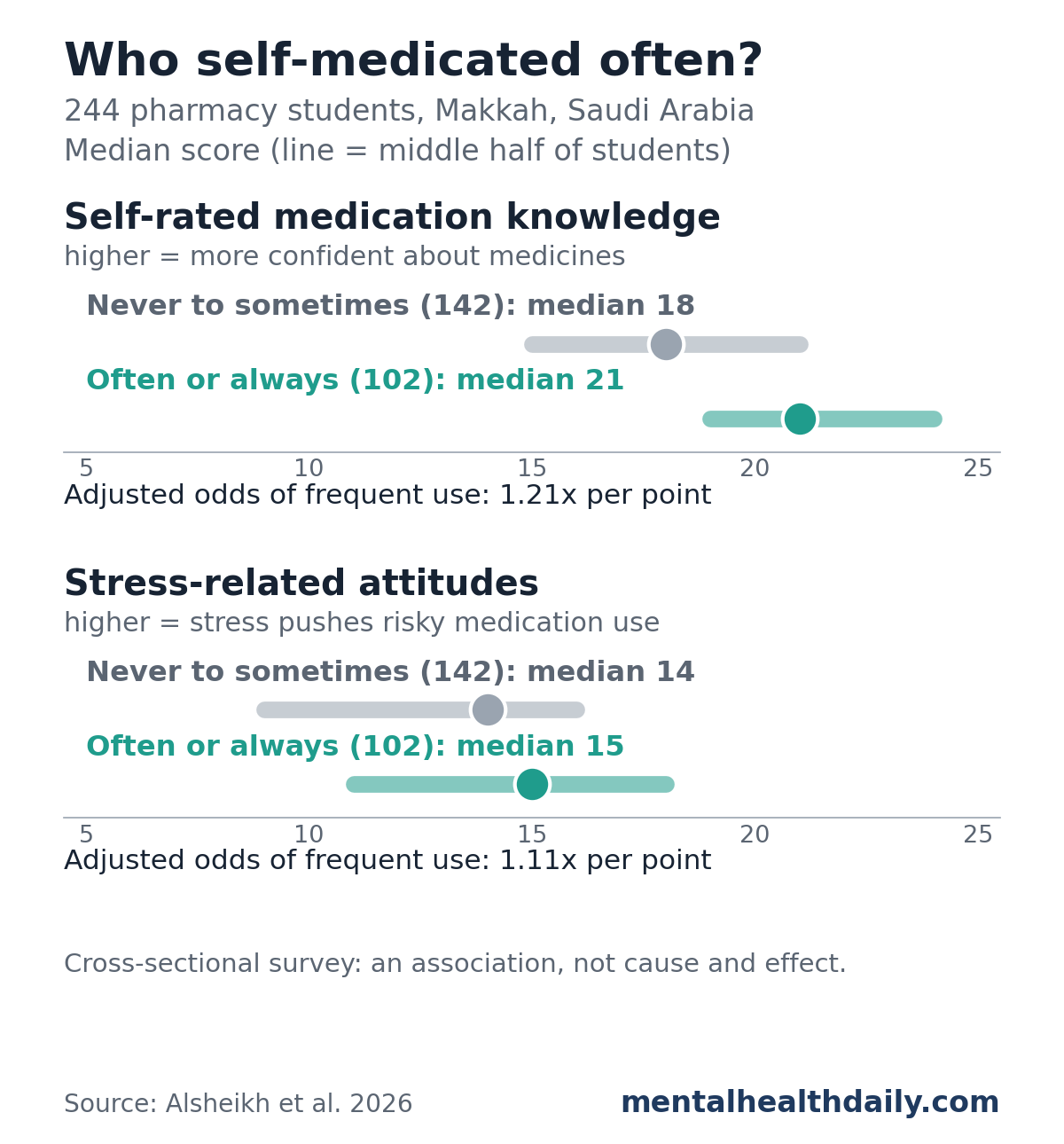
Adjusted model: with sex, academic year, GPA, extra medication training and having a health professional at home all in the model, both scores stayed significant. Knowledge carried an odds ratio of 1.21 per point (95% CI 1.12–1.32), and stress attitudes 1.11 per point (95% CI 1.04–1.19).1
An odds ratio compares the odds of an outcome between groups; 1.21 per point means 21% higher odds for every extra point. Across the 3-point gap in median knowledge scores, that adds up to roughly 1.8 times the odds.
No demographic factor stood out. Sex, year of study, GPA and medication training were not linked to frequent self-medication once the 2 scores were included. Female students, for example, had an odds ratio of 1.05 (95% CI 0.54–2.05).1
How Pharmacy Students Described Stress and Medication Use
Answers to the 5 stress items show a group that recognized the risk in general but split on whether it applied to them:1
- 50.4% agreed that stress leads pharmacy students to misuse or overuse medications.
- 39.7% agreed that self-medication helps them manage stress faster than seeking medical advice.
- 25.5% agreed that high stress makes them more likely to ignore medication safety guidelines.
- 22.6% agreed that under stress they follow friends or family over a doctor.
- 20.1% agreed that fear of symptoms returning keeps them self-medicating longer than recommended.
Pharmacy school is demanding, and stress is common across the field. A 2026 meta-analysis of 51 studies covering 17,717 pharmacy students in 16 countries, including Saudi Arabia, put the pooled prevalence of stress at 48.1%, with anxiety at 52.0% and depression at 44.3%.2
Earlier Saudi work measured stress directly. Among male pharmacy and medical students in Dammam, 51.6% reported moderate stress on the Perceived Stress Scale, exams were the top stressor, and stress-related self-medication was reported by 31.6% of pharmacy students and 29.2% of medical students.3
Male Students Cited Cost and Time More Often
Male and female students self-medicated frequently at similar rates (41.0% vs 42.2%), but their reasons and choices differed. Compared with female students, male students more often:1
- said they could not afford a doctor’s visit (18.3% vs 4.7%)
- self-medicated to save time (58.5% vs 38.5%)
- used cough syrup (56.1% vs 40.5%)
- reported side effects from self-medication (39.0% vs 23.6%)
Sleeping-aid use was higher among female students (34.5% vs 22.0%), but that gap was not statistically significant. Sleeping-aid use did rise with GPA, from 7.4% of students below a 3.00 to 35.4% of those at 3.50 or above.1
Self-Medication Is Common Among Health-Science Students Worldwide
The 94.3% figure is high but consistent with earlier research. A meta-analysis of 89 studies covering 60,938 university students found a pooled self-medication prevalence of 70.1%, with 97.2% among medical students vs 44.7% among students in other fields.4
At Qassim University in Saudi Arabia, a survey of 316 medical and pharmacy students found that 94.6% had good knowledge of self-medication, 63.9% had self-medicated in the past 6 months, and painkillers were the most common choice (88.3%).5
Together, these studies show that knowing more about medicines does not stop students from self-medicating. The Makkah survey adds that confidence and frequent use went together.
Limitations of This Pharmacy Student Survey
Evidence strength: a single-university, cross-sectional survey. It shows which traits went together at one point in time, not whether stress or confidence causes self-medication.
- Direction unknown: students who self-medicate often may grow more confident in their knowledge because of that experience, rather than the other way around.
- Stress was not measured directly. The stress score captures beliefs about how stress affects medication use, not how stressed students were. Its fit statistics were only marginal (RMSEA 0.104).
- Knowledge was self-rated. Students rated their own confidence; no one tested whether their dosing or drug knowledge was correct.
- Small per-point effects: the median stress score differed by only 1 point between groups.
- Sampling: a convenience sample at 1 university, with no reported response rate, and all answers self-reported.
- Missing details: the survey did not record where anxiolytics or sleeping aids came from, or how often each drug was used.
What This Means for Students Under Stress
The researchers recommend pairing medication-safety teaching with stress-management training in pharmacy programs, since knowledge alone did not keep students from frequent self-treatment.1
- Notice the pattern: reaching for sleep aids or anti-anxiety medicine to get through exam periods is worth raising with a doctor, pharmacist or campus counseling service.
- Confidence is not supervision: even students trained in pharmacology reported side effects and inconsistent label reading.
- Stress is treatable on its own: sleep problems and anxiety that keep returning deserve an assessment, not just repeated symptom relief.
References
- Alsheikh EO, Al-Majnoni NN, Al-Zahrani MA, et al. Influence of stress and knowledge on self-medication practices among pharmacy students: a cross-sectional study. Frontiers in Medicine. 2026;13:1877740. doi:10.3389/fmed.2026.1877740
- Pradubkham T, et al. Prevalence of depression, anxiety, stress, and suicidal ideation among pharmacy students: an updated systematic review and meta-analysis. International Journal of Environmental Research and Public Health. 2026;23(2):155. doi:10.3390/ijerph23020155
- Al-Shagawi MA, Ahmad R, Naqvi AA, Ahmad N. Determinants of academic stress and stress-related self-medication practice among undergraduate male pharmacy and medical students of a tertiary educational institution in Saudi Arabia. Tropical Journal of Pharmaceutical Research. 2017;16(12):2997–3003. doi:10.4314/tjpr.v16i12.26
- Behzadifar M, Behzadifar M, Aryankhesal A, et al. Prevalence of self-medication in university students: systematic review and meta-analysis. Eastern Mediterranean Health Journal. 2020;26(7):846–857. doi:10.26719/emhj.20.052
- Alduraibi RK, Altowayan WM. A cross-sectional survey: knowledge, attitudes, and practices of self-medication in medical and pharmacy students. BMC Health Services Research. 2022;22:352. doi:10.1186/s12913-022-07704-0