
First-time mothers at a Chinese hospital had fewer birth-trauma symptoms and about half the rate of probable childbirth-related PTSD after nurses began delivering a structured psychological care program around labor and delivery.1 The study compared 2 halves of the same year rather than randomizing women, so other changes over time could explain part of the difference.
Research Highlights
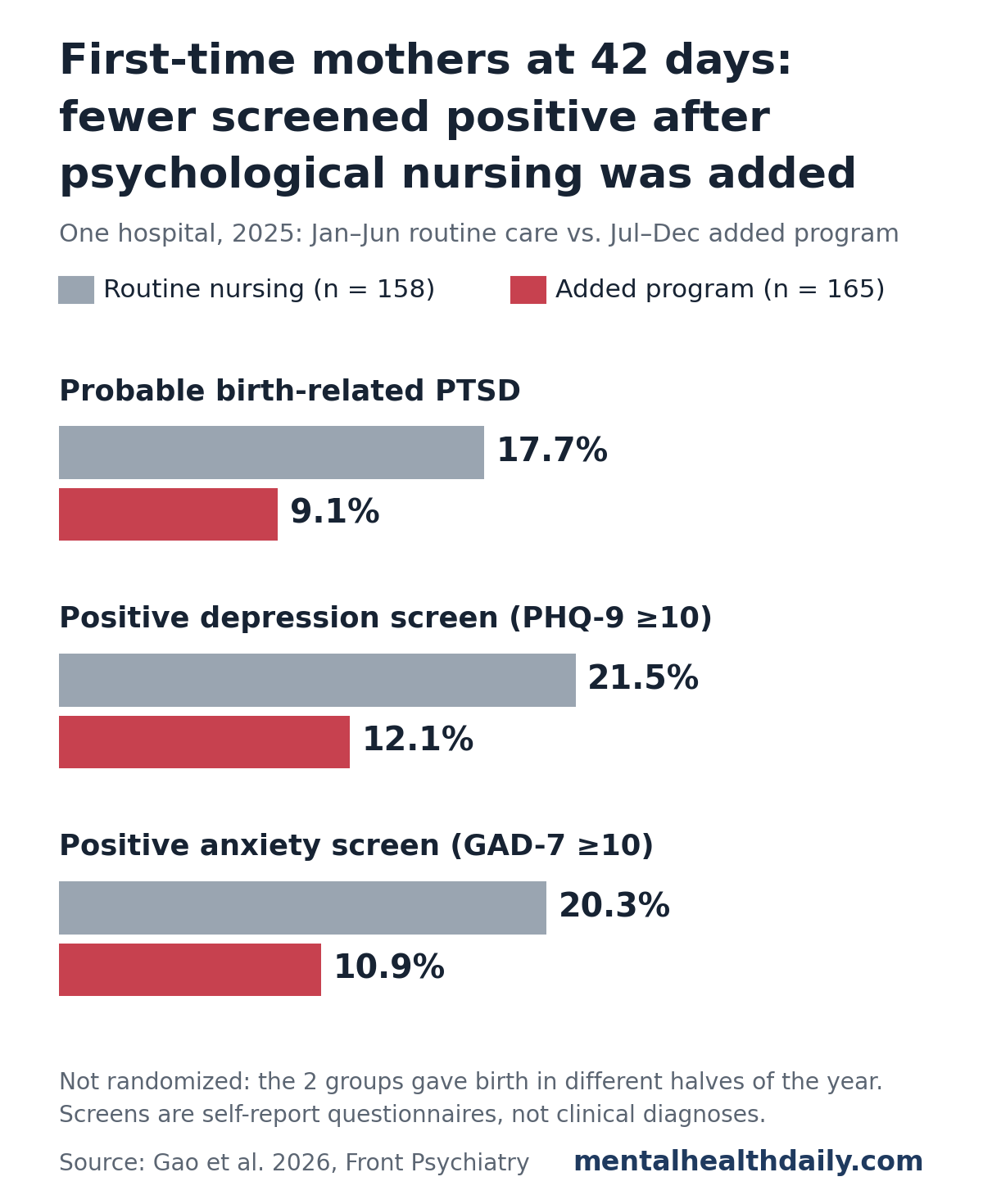
- Probable PTSD roughly halved: 9.1% of mothers in the psychological nursing period met criteria for probable childbirth-related PTSD at 42 days after birth, compared with 17.7% in the routine-care period (risk ratio 0.51, 95% CI 0.28 to 0.92).1
- Lower birth-trauma scores: average City Birth Trauma Scale scores were 14.1 vs. 18.6 on a 0-to-60 scale, a moderate difference.1
- Fewer positive depression and anxiety screens: 12.1% vs. 21.5% screened positive for depression and 10.9% vs. 20.3% for anxiety.1
- Not a randomized trial: 158 women who gave birth from January to June 2025 received routine nursing, and 165 who gave birth from July to December received routine care plus the new program.1
- Consistent with trial evidence: randomized trials of counseling and nurse-led psychological support have lowered perinatal depression, and early psychological interventions have reduced childbirth-related PTSD symptoms.234
A Before-and-After Study of 323 First-Time Mothers
Gao et al. studied primiparous women, meaning mothers giving birth for the first time, who had a single baby at Xinxiang Central Hospital in Henan, China, during 2025. The results were published in Frontiers in Psychiatry in September 2026.1
This was a retrospective temporal cohort study: researchers looked back at hospital records and compared women by when they gave birth. The hospital switched its standard practice midyear, so the groups were defined by the calendar, not by random assignment:
- Routine nursing group (January to June): 158 women who received standard obstetric nursing
- Psychological nursing group (July to December): 165 women who received the same routine care plus the structured psychological nursing program
Of 354 women screened, 29 were excluded before follow-up, including 8 with a documented psychiatric history, and 2 did not complete the 42-day assessment. Women with known psychiatric disorders, severe complications, stillbirth, or newborn death were not included.1
What the Structured Psychological Nursing Program Involved
Structured psychological nursing here was a written hospital protocol that added emotional and mental health support to normal labor and delivery care. Obstetric nurses delivered it as part of their usual care, with no separate therapist involved. Routine care already covered monitoring, pain support, breastfeeding guidance, and discharge education, but had no set psychological component.1
Core steps offered to every woman:
- A psychological check within 2 hours of hospital admission
- Education about what to expect during labor or cesarean delivery
- At least 2 supportive conversations focused on listening and validating feelings
- Guided relaxation, such as breathing exercises or progressive muscle relaxation
- A session with the partner or main caregiver on how to support the mother, when one was available
- Emotional support during labor
- A psychological follow-up 24 to 72 hours after birth
Extra steps based on need: help challenging catastrophic thinking or intense fear of childbirth (given to 61 women), brief mindfulness exercises for high anxiety or distress (89 women), added support for distress that persisted or worsened (29 women), and referral to a psychologist or psychiatrist for severe symptoms (6 women).1
The program was meant to supply at least 3 contacts and 60 minutes in total. In practice, women had a median of 4 contacts and 95 minutes. Of 157 women with complete records, 148 (94.3%) received every core step that applied to them.1
Who delivered it: 12 registered obstetric nurses who completed an 8-hour workshop, a 2-hour simulation session, and a competency test. An audit of 33 records found that 30 followed the protocol fully.1
Lower Birth-Trauma, Depression, and Anxiety Scores at 42 Days
All outcomes were measured at the routine 42-day postpartum visit by 4 follow-up nurses who had not delivered the program. Women completed 3 standard questionnaires:
- City Birth Trauma Scale (City BiTS): a self-report questionnaire built around the diagnostic criteria for PTSD, specific to symptoms that start after childbirth, such as intrusive memories of the birth, avoidance, and feeling on edge
- PHQ-9: a 9-question depression scale, with 10 or more counted as a positive screen
- GAD-7: a 7-question anxiety scale, with 10 or more counted as a positive screen
Probable childbirth-related PTSD meant a woman met every DSM-5 symptom, duration, and distress criterion on the City BiTS, with symptoms that began after this birth. It is a questionnaire-based classification, not a diagnosis made by a clinician in an interview.1
Results, routine nursing vs. psychological nursing:
- Probable childbirth-related PTSD: 28 of 158 (17.7%) vs. 15 of 165 (9.1%), an absolute difference of about 8.6 percentage points
- Birth-trauma symptom score: 18.6 vs. 14.1 out of 60 (difference −4.5 points, 95% CI −6.2 to −2.8)
- Depression: average PHQ-9 of 6.3 vs. 4.8; positive screens in 21.5% vs. 12.1%
- Anxiety: average GAD-7 of 5.6 vs. 4.2; positive screens in 20.3% vs. 10.9%
Taking delivery type and maternal age into account, the psychological nursing period was still linked to lower odds of probable PTSD (adjusted odds ratio 0.46, 95% CI 0.23 to 0.91). A second statistical method designed for small numbers of cases gave nearly the same result.1
Satisfaction with nursing care was also higher in the program period (91.6 vs. 86.9 out of 100). The hospital’s satisfaction questionnaire has not been independently validated, so the researchers treated it as exploratory.1
Emergency Cesarean Births Carried the Highest PTSD Risk
Across both groups, women who had an emergency cesarean delivery had about 3 times the odds of probable childbirth-related PTSD compared with women who gave birth vaginally (adjusted odds ratio 2.97, 95% CI 1.40 to 6.32). Probable PTSD occurred in 14 of 55 emergency cesarean births, 6 of 38 planned cesareans, and 23 of 230 vaginal births.1
The researchers pointed to the unexpected nature of emergency surgery, long labor, fetal distress, and a reduced sense of control as possible contributors, and suggested closer psychological assessment after emergency cesareans. The groups had similar rates of emergency cesarean (18.4% in the routine period and 15.8% in the program period), and the main result held after adjusting for delivery type.1
Why a Before-and-After Comparison Cannot Prove the Program Worked
The 2 groups looked alike on age, education, pregnancy complications, delivery type, labor length, and newborn health. Even so, comparing 2 time periods leaves other explanations open:1
- Changes over time. Obstetric practice, staffing, or nursing quality could have shifted between the first and second half of 2025. The researchers state that the findings should not be read as cause and effect.
- No starting mental health scores. The study reported no mental health scores from before birth for either group, so their starting points cannot be compared.
- Imperfect blinding. Follow-up nurses did not deliver the program and could not see its records, but they may have known which period a woman gave birth in.
- Self-report only. PTSD, depression, and anxiety were measured with questionnaires, not clinical interviews.
- One hospital, one time point. Results come from a single Chinese hospital, measured once at 42 days, in first-time mothers without a known psychiatric history.
- A bundle, not a single technique. The program combined many steps, so the study cannot show which part, if any, made the difference.
The researchers call for multicenter randomized trials with longer follow-up to test the program properly.1
Randomized Trials Support Psychological Care Around Birth
The result is consistent with stronger evidence on psychological support for new and expecting mothers:
- Counseling to prevent depression: the US Preventive Services Task Force recommends counseling, such as cognitive behavioral or interpersonal therapy, for pregnant and postpartum women at increased risk of depression. In its evidence review, counseling was linked to a 39% lower likelihood of perinatal depression (pooled relative risk 0.61).2
- Nurses and midwives as providers: a 2021 meta-analysis of 12 studies with 4,141 women found that psychological interventions led by nurses or midwives lowered the risk of perinatal depressive symptoms (risk ratio 0.72). Cognitive behavioral approaches and supportive counseling worked best; education alone did not reach significance.3
- Preventing birth-related PTSD: a 2024 meta-analysis of 41 intervention studies, 32 of them randomized, found moderate reductions in childbirth-related PTSD symptoms from early psychological interventions given after a traumatic birth, compared with usual care.4
The new study adds a practical model: support built into ordinary nursing during the hospital stay, given to all first-time mothers rather than only those flagged as high risk.
What This Means for First-Time Mothers
- Birth trauma is common enough to ask about. About 1 in 6 first-time mothers in the routine-care period met questionnaire criteria for probable childbirth-related PTSD at 6 weeks.
- Emotional support during the hospital stay is reasonable to request. Preparation for labor, a chance to talk through fears, relaxation coaching, and a check-in a day or two after birth are low-risk and consistent with trial evidence.
- An emergency cesarean is a reason for a follow-up conversation. It carried the highest risk in this study.
- Symptoms deserve care. Repeated intrusive memories of the birth, avoiding reminders, feeling constantly on edge, low mood, or anxiety that lasts beyond the first couple of weeks are worth raising with an obstetric provider. In the US, the National Maternal Mental Health Hotline (1-833-852-6262) offers free, confidential support, and anyone with thoughts of self-harm can call or text 988.
References
- Gao Q, Zhu L-L, Guo H, Zhu Z-L, Zhang F-Q, Wang Y-Q, Hou B-J. Structured psychological nursing and postpartum psychological outcomes in primiparous women: a retrospective temporal cohort study. Frontiers in Psychiatry. 2026;17:1857487. doi:10.3389/fpsyt.2026.1857487
- US Preventive Services Task Force. Interventions to prevent perinatal depression: US Preventive Services Task Force recommendation statement. JAMA. 2019;321(6):580–587. doi:10.1001/jama.2019.0007
- Wang TH, Pai LW, Tzeng YL, Yeh TP, Teng YK. Effectiveness of nurses and midwives-led psychological interventions on reducing depression symptoms in the perinatal period: a systematic review and meta-analysis. Nursing Open. 2021;8(5):2117–2130. doi:10.1002/nop2.764
- Dekel S, Papadakis JE, Quagliarini B, et al. Preventing posttraumatic stress disorder following childbirth: a systematic review and meta-analysis. American Journal of Obstetrics and Gynecology. 2024;230(6):610–641.e14. doi:10.1016/j.ajog.2023.12.013