
Among premenopausal women seen at a pelvic floor clinic in China, those with sexual dysfunction had higher depressive symptom scores than those without it. Of all the pelvic floor problems the researchers measured, sexual dysfunction showed the strongest link to depressive symptoms.1
Research Highlights
- Sexual dysfunction was common: 530 of 876 women (60.5%) scored in the sexual dysfunction range on a standard questionnaire.1
- About 3 points higher on depression: after adjustment for other pelvic floor problems, breastfeeding, age, weight and birth history, sexual dysfunction was linked to depression scores 3.14 points higher (95% CI 1.97 to 4.31), the largest link of any pelvic floor problem.1
- The link held after adding symptom distress: it stayed at 2.52 points when overall pelvic symptom distress and incontinence quality of life were added; the urinary link dropped to near zero.1
- More problems, higher scores: average depression scores ran from 29.0 in women with none of 3 problems (urinary, pain, sexual) to 34.5 in women with all 3.1
- Snapshot data: the study was cross-sectional, so it cannot show whether sexual problems raise depression, depression causes sexual problems, or both.1
How the Pelvic Floor Clinic Study Measured Sexual Function and Depression
The pelvic floor is the sling of muscles and connective tissue that supports the bladder, uterus and bowel. When it weakens or works poorly, women can develop urine leakage, bladder urgency, constipation, pelvic pain, prolapse (organs sagging into the vagina) and sexual difficulties, often several at once.
Li et al. analyzed records from one pelvic floor specialist clinic at the Seventh Affiliated Hospital of Sun Yat-sen University in Shenzhen, China, for 2020. They kept only premenopausal women, because menopause brings its own hormonal changes to mood and sexual function.1
- Sample: 876 premenopausal women (average age 33), all sexually active in the prior 4 weeks; 764 had complete data for the adjusted analyses
- Sexual function: the Female Sexual Function Index (FSFI), a 19-item questionnaire covering desire, arousal, lubrication, orgasm, satisfaction and pain; a total of 26.55 or lower counted as female sexual dysfunction (FSD), a cutoff validated in a 2005 study2
- Depressive symptoms: the Zung Self-Rating Depression Scale (SDS), a 20-item questionnaire scored 20 to 80, where higher means more depressive symptoms; it was used as a continuous score, not as a diagnosis
- Other problems: urinary leakage with coughing or exercise (stress incontinence) or sudden urgency (overactive bladder), pelvic pain, constipation, and prolapse
Almost every woman (871 of 876) had at least stage I prolapse (the mildest stage) on exam, so prolapse could not be compared across groups.1
Women With Sexual Dysfunction Scored About 3 Points Higher on Depression
Before any adjustment, average SDS scores were 33.04 in women with sexual dysfunction and 30.15 in women without it (P < 0.001). That was the largest gap for any single pelvic floor problem.1
The researchers then fit a regression model that estimated each problem’s link to depression scores while holding the others constant, along with age, body mass index, breastfeeding, and delivery history (vaginal, cesarean, assisted delivery, and a large baby).
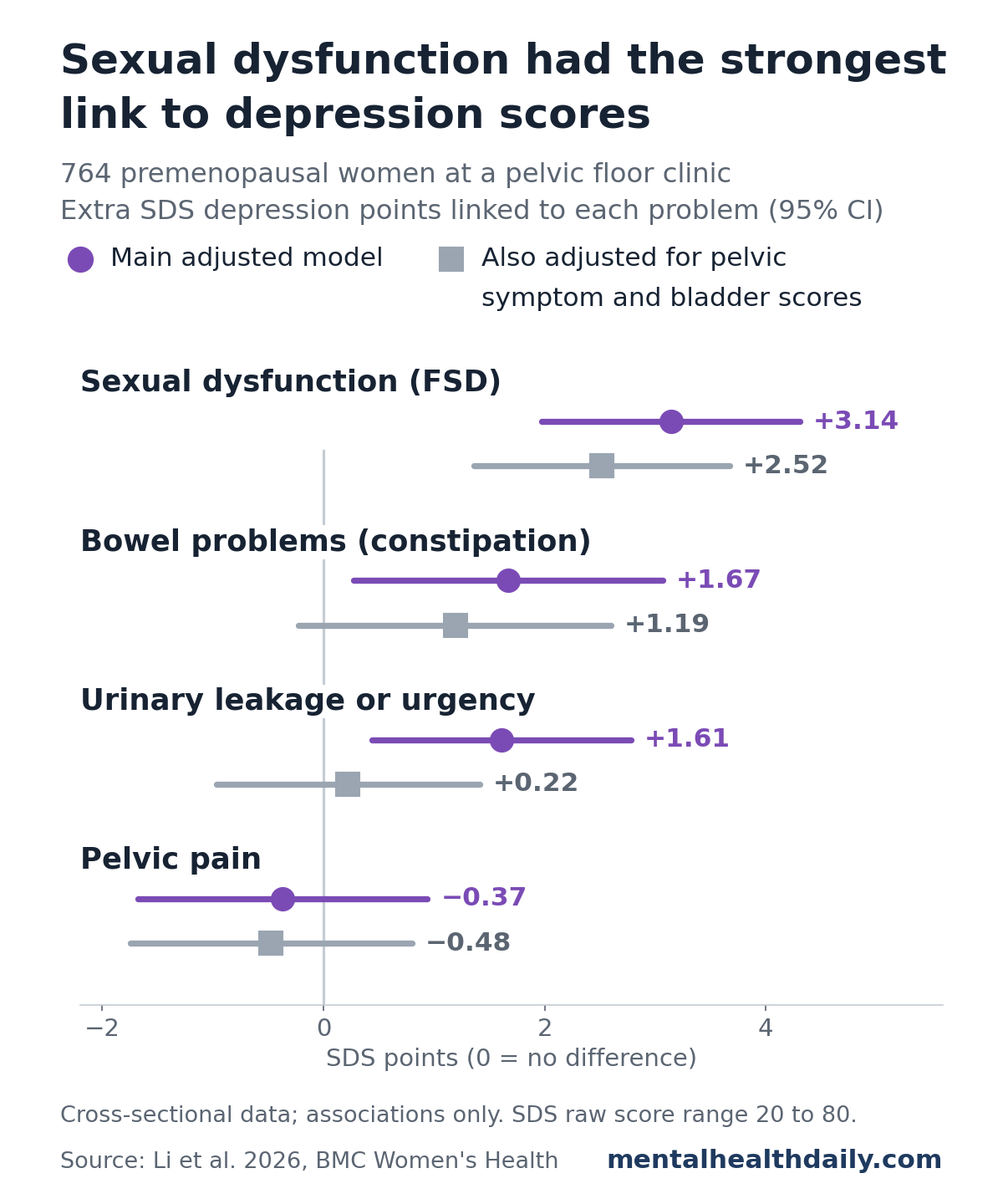
- Sexual dysfunction: 3.14 points higher (95% CI 1.97 to 4.31)
- Constipation: 1.67 points higher (95% CI 0.27 to 3.07)
- Urinary leakage or urgency: 1.61 points higher (95% CI 0.44 to 2.78)
- Pelvic pain: no link (−0.37 points, 95% CI −1.68 to 0.94)
How big is 3 points? Average scores in this clinic sat in the low 30s on a 20-to-80 scale, toward the lower end of the range. A 3-point shift is a modest difference across a group. The researchers did not test whether it reaches a clinically meaningful change for an individual.1
Breastfeeding was linked to depression scores about 4 points lower (−4.02, 95% CI −5.40 to −2.64). That could reflect timing after birth, healthier women, or women with more depressive symptoms stopping breastfeeding sooner; the data cannot tell these apart.1
Sexual Dysfunction Held Up After Adjusting for Bladder and Pelvic Symptom Distress
A fair objection is that women with sexual dysfunction might simply have worse pelvic floor problems overall, and that general distress drives both. To test this, the researchers added 2 more questionnaires to the model:
- PFDI-20 (Pelvic Floor Distress Inventory-20): how much bladder, prolapse and bowel symptoms bother a woman
- I-QOL (Incontinence Quality of Life): how much urine leakage limits daily life and affects emotional well-being
The sexual dysfunction link shrank by about 20%, to 2.52 points (95% CI 1.36 to 3.67), and stayed clearly significant. The urinary link shrank by about 88%, to 0.22 points (95% CI −0.97 to 1.41), and was no longer significant. Constipation fell to 1.19 points, also no longer significant.1
So the depression link for bladder problems seems to run largely through how bothersome and limiting those symptoms feel. Sexual dysfunction carried something those questionnaires did not capture. The researchers suggest possibilities such as strain in the relationship and shame that keeps sexual concerns unspoken, but none of these were measured.1
Depression Scores Rose With the Number of Pelvic Floor Problems
The researchers also counted how many of 3 problems each woman had: urinary symptoms, pelvic pain, and sexual dysfunction. Average SDS scores by count:
- None: 29.0 (164 women)
- 1 problem: 32.4 (353 women)
- 2 problems: 32.1 (267 women)
- All 3: 34.5 (92 women)
The overall trend was upward (rank correlation r = 0.158, P < 0.001), although scores for 1 and 2 problems were nearly the same. The correlation is weak, which fits the bigger picture: the full adjusted model explained only about 12% to 16% of the variation in depression scores.1
Sexual Dysfunction and Depression Feed Each Other in Long-Term Studies
The clinic data fit a larger body of evidence. A 2012 meta-analysis of prospective cohort studies in men and women found the link runs both ways over time:3
- Sexual dysfunction to depression: people with sexual dysfunction had higher odds of later depression (adjusted odds ratio 3.12, 95% CI 1.66 to 5.85; 6 studies, 11,171 participants)
- Depression to sexual dysfunction: people with depression had a higher risk of later sexual dysfunction (adjusted estimate 1.71, 95% CI 1.05 to 2.78; 6 studies, 3,285 participants)
Depressive symptoms are also common in pelvic floor care. At a Dutch pelvic care center, 20.3% of 1,510 new patients (average age 57) reported depression complaints and 30.9% reported anxiety complaints. Pelvic floor problems explained 12% of the variation in depression scores.4
The 60.5% sexual dysfunction rate in the Shenzhen clinic is well above the roughly 41% pooled estimate for premenopausal women in general populations, which comes from a meta-analysis of 95 studies.5 Those studies used varied definitions, so the comparison is rough.
Limits of a Single-Clinic Snapshot
- No direction of cause: all measures came from the same visit. Depression can lower sexual desire and pleasure, and sexual problems can lower mood. The SDS also includes an item about enjoying sex, so the 2 questionnaires partly overlap.
- Missing confounders: the records had no data on relationship quality, past psychiatric diagnoses, medications such as antidepressants (which can affect sexual function), sleep, thyroid function or income.
- Questionnaire cutoffs: sexual dysfunction was defined by an FSFI total score alone, with no domain scores, and depression was a symptom score, not a clinical diagnosis.
- Who was left out: 112 women lacked birth-history data and were dropped from the adjusted models; they were older, breastfed less and had higher depression scores (34.3 vs. 31.5). Results with statistically filled-in data were similar (3.03 vs. 3.14 points).
- One setting: a single Chinese clinic in 2020, premenopausal and sexually active women only.
What This Means for Women in Pelvic Floor Care
- Sexual concerns deserve a direct question. Sexual dysfunction was the pelvic floor problem most strongly linked to depressive symptoms here, and the researchers note that sexual concerns often go unmentioned unless a clinician asks.
- Brief mood screening fits naturally. The researchers recommend a short depression questionnaire for pelvic floor patients, with closer follow-up for women who have sexual dysfunction or several problems at once.1
- Treatment effects are untested. The study did not test whether treating sexual dysfunction improves mood, or the reverse; that needs follow-up studies.
- Speak up about low mood. Women who notice persistent low mood alongside pelvic or sexual problems can raise both with their clinician; each is treatable in its own right.
References
- Li M, Liu Y, Mo D, Li J, He J, Li T. Female sexual dysfunction is independently associated with depressive symptom burden in premenopausal pelvic floor clinic patients: a cross-sectional analysis. BMC Women’s Health. 2026;26:473. doi:10.1186/s12905-026-04890-5
- Wiegel M, Meston C, Rosen R. The Female Sexual Function Index (FSFI): cross-validation and development of clinical cutoff scores. Journal of Sex & Marital Therapy. 2005;31(1):1–20. doi:10.1080/00926230590475206
- Atlantis E, Sullivan T. Bidirectional association between depression and sexual dysfunction: a systematic review and meta-analysis. Journal of Sexual Medicine. 2012;9(6):1497–1507. doi:10.1111/j.1743-6109.2012.02709.x
- Vrijens D, Berghmans B, Nieman F, van Os J, van Koeveringe G, Leue C. Prevalence of anxiety and depressive symptoms and their association with pelvic floor dysfunctions: a cross sectional cohort study at a Pelvic Care Centre. Neurourology and Urodynamics. 2017;36(7):1816–1823. doi:10.1002/nau.23186
- McCool ME, Zuelke A, Theurich MA, Knuettel H, Ricci C, Apfelbacher C. Prevalence of female sexual dysfunction among premenopausal women: a systematic review and meta-analysis of observational studies. Sexual Medicine Reviews. 2016;4(3):197–212. doi:10.1016/j.sxmr.2016.03.002