
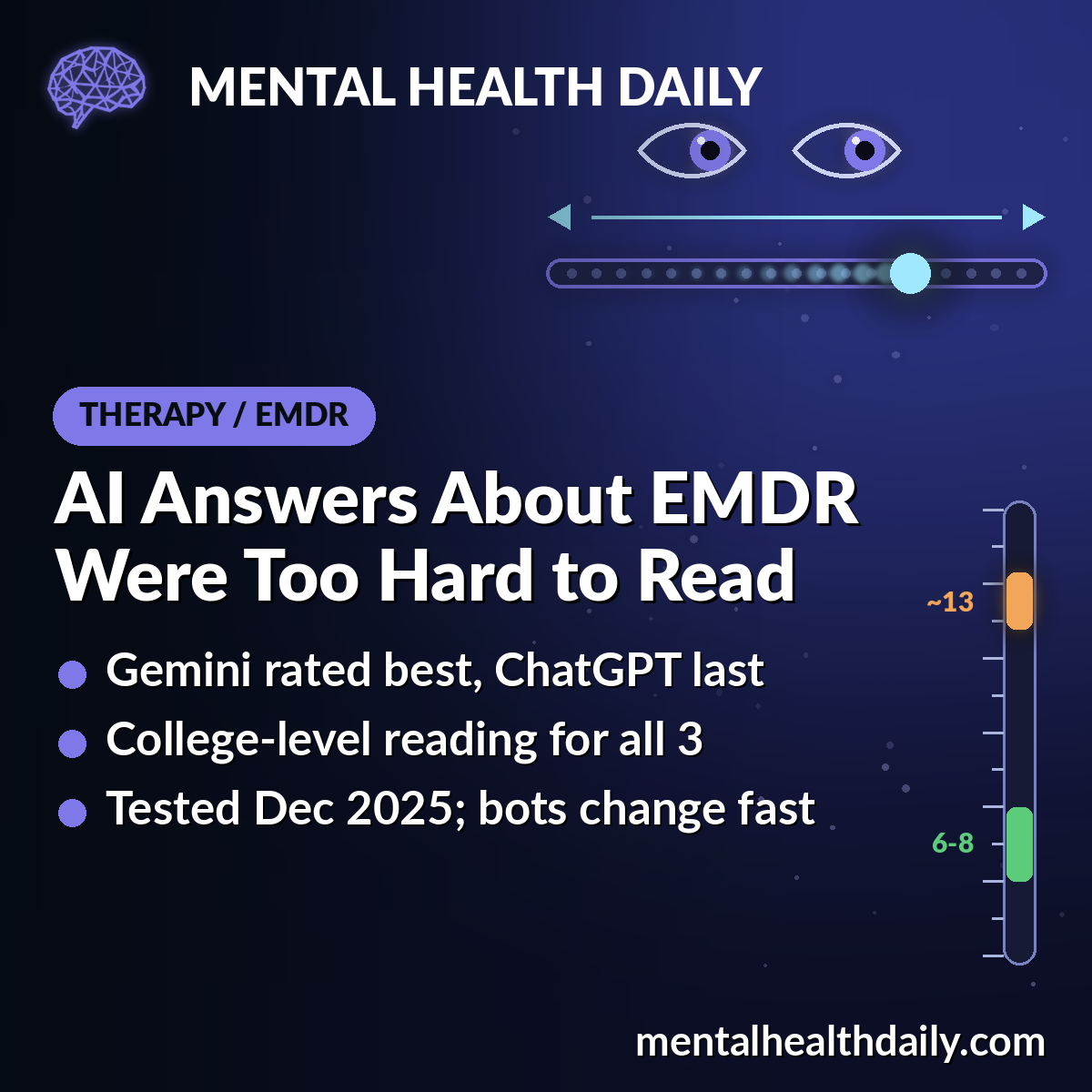
When researchers asked ChatGPT, Gemini, and DeepSeek 20 common questions about EMDR therapy, the answers varied in quality by chatbot, and all 3 wrote at roughly a college reading level.1 Gemini scored best on a patient-information quality scale, and ChatGPT scored lowest.
Research Highlights
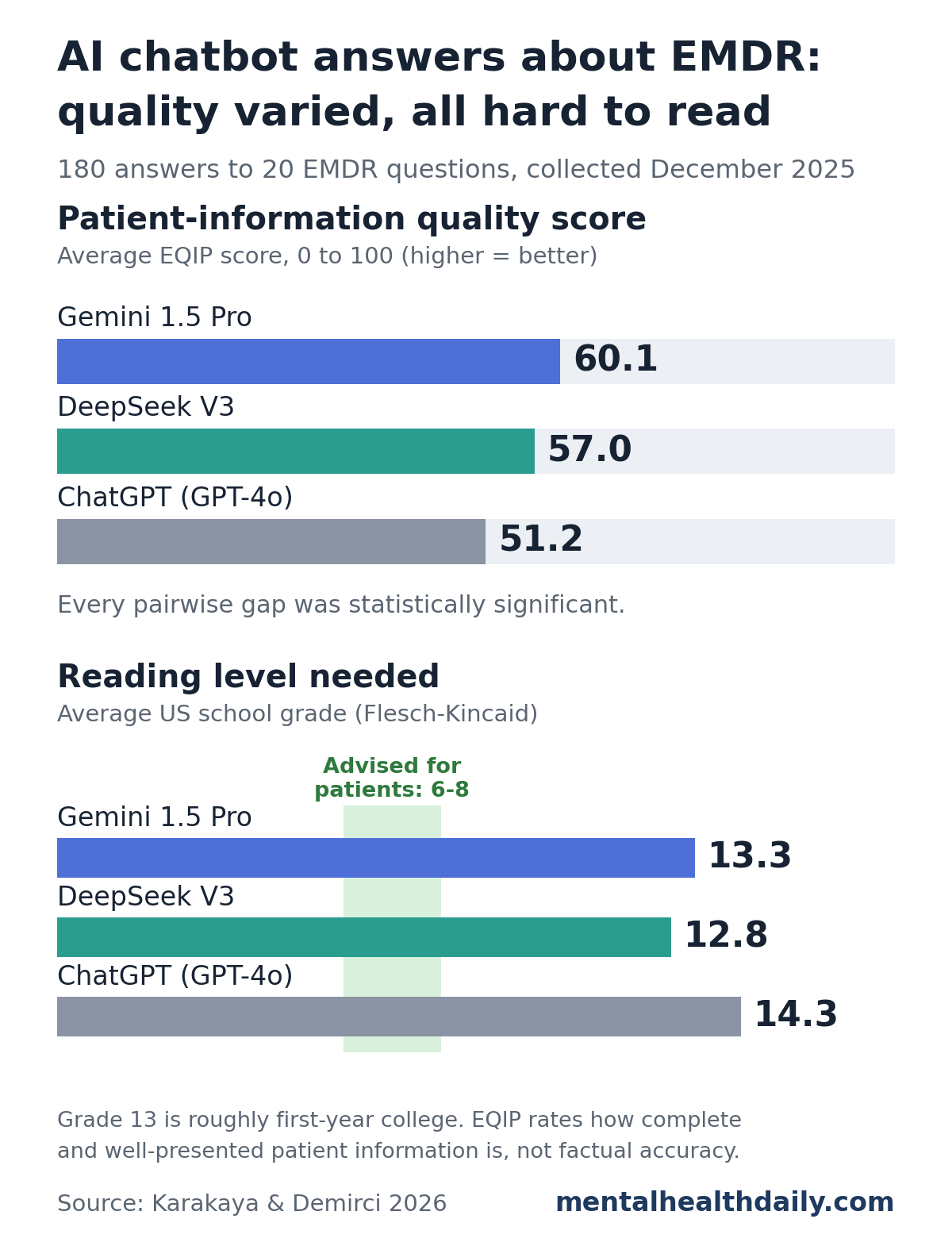
- Gemini rated highest, ChatGPT lowest: average quality scores were 60.06 for Gemini 1.5 Pro, 57.01 for DeepSeek V3, and 51.18 for ChatGPT (GPT-4o) on a 0-to-100 scale, and every pairwise gap was statistically significant.1
- Too hard to read for most patients: answers averaged a Flesch-Kincaid grade level of 13.48, well above the sixth-to-eighth-grade level advised for patient materials.1
- Topic made little difference: quality was about the same whether the question was about EMDR in general, trauma, anxiety, or depression.1
- Better answers were easier to read: higher-quality answers tended to be longer and written at a lower grade level.1
- A December 2025 snapshot: the chatbot versions tested have already been updated or replaced.1
What EMDR Is and Why People Ask Chatbots About It
Eye movement desensitization and reprocessing (EMDR) is a structured trauma therapy. A patient briefly holds a distressing memory in mind while following a back-and-forth stimulus, usually the therapist’s moving fingers, with the aim of making the memory less upsetting and less intrusive.
EMDR follows a set protocol with defined phases, including assessment and a preparation phase that teaches coping skills before any trauma memories are processed. That protocol makes it a good test case: a chatbot either explains the steps, the evidence, and the preparation well, or it doesn’t.1
EMDR’s evidence is strongest for post-traumatic stress disorder (PTSD). A 2020 meta-analysis of 76 trials by Cuijpers et al. found a large effect compared with control conditions, but only 4 of 27 studies had a low risk of bias, and the researchers judged the evidence for other mental health problems too thin to recommend EMDR for them.2 A good chatbot answer about EMDR for anxiety or depression should reflect that gap.
How the Researchers Tested ChatGPT, Gemini, and DeepSeek
Ibrahim Karakaya and Onur Okan Demirci, psychiatrists in private practice in Istanbul, built their question list from Google Trends searches about EMDR. They turned the top searches into 20 patient-style questions, 5 in each of 4 groups:1
- EMDR in general: “What is EMDR?” and “How many sessions does EMDR take?”
- EMDR and trauma: “Does EMDR work for childhood trauma?”
- EMDR and anxiety: “Does EMDR work for panic attacks?”
- EMDR and depression: “Can EMDR be used together with medication?”
Chatbots tested: ChatGPT running GPT-4o, Gemini running Gemini 1.5 Pro, and DeepSeek running DeepSeek-V3, each through its official website between December 15 and 20, 2025.
Method: each question went into a fresh chat 3 separate times per chatbot, in English, with no special instructions. That produced 180 answers.
Scoring: 2 board-certified psychiatrists, blinded to each other’s ratings, scored every answer with the 20-item short version of the Ensuring Quality Information for Patients (EQIP) tool. EQIP is a checklist built for patient leaflets that asks whether the material covers things like benefits, risks, realistic expectations, special populations, and who wrote it. Each answer got a percentage score.1
Readability came from 2 standard formulas based on sentence length and word length: the Flesch-Kincaid Grade Level, which estimates the US school grade needed to follow a text, and Flesch Reading Ease, a 0-to-100 score where higher means easier.
Gemini Scored Highest on EMDR Answer Quality
The average EQIP score across all 180 answers was 56.08. By chatbot:1
- Gemini 1.5 Pro: 60.06
- DeepSeek V3: 57.01
- ChatGPT (GPT-4o): 51.18
In the researchers’ main model, which accounted for the same question being asked of every chatbot, Gemini scored 8.88 points above ChatGPT and DeepSeek scored 5.83 points above ChatGPT. Gemini also beat DeepSeek by 3.05 points. All 3 gaps held up after correction for multiple comparisons.
Question topic barely moved the scores. Compared with general EMDR questions, answers about depression, anxiety, and trauma scored 0.50 to 1.41 points higher, and none of those differences was statistically significant.1
The researchers suggest the chatbots explain EMDR at the same general level no matter what is asked, even though using EMDR for depression or anxiety is a different clinical question from using it for PTSD.
EMDR Answers Were Written Well Above Patient Reading Level
Patient-education guidelines generally advise writing at a sixth-to-eighth-grade level. Every chatbot missed that by a wide margin:1
- ChatGPT: grade level 14.29, Reading Ease 27.28, shortest answers (205 words on average)
- Gemini: grade level 13.33, Reading Ease 28.32, 215 words
- DeepSeek: grade level 12.83, Reading Ease 34.97, longest answers (230 words)
A grade level around 13 means a reader would need about a year of college to follow the text comfortably. Reading Ease scores of 27 to 35 sit around the line between “difficult” and “very difficult” on the Flesch scale.
Length and clarity went together. Across all answers, higher quality scores went with longer answers (r = 0.243) and a lower grade level (r = −0.338). Longer answers were also slightly easier to read. The researchers took this to mean that thorough information does not have to be dense, and DeepSeek’s long but comparatively readable answers fit that pattern.1
The researchers acknowledge that some EMDR concepts, such as bilateral stimulation and memory reprocessing, are hard to explain in very simple terms without losing clinical detail. They call for studies testing whether simpler versions are understood as well.
How This Compares With Earlier Chatbot Health Studies
Chatbot answers can look strong in head-to-head tests. In a 2023 study by Ayers et al., licensed health care professionals preferred ChatGPT’s answers over physicians’ answers in 78.6% of evaluations of 195 real patient questions from a Reddit forum. Chatbot answers were also much longer, averaging 211 words vs. 52.3
Checklist scoring tells a more modest story. When Walker et al. scored ChatGPT-4’s information on 5 liver, gallbladder, and pancreas conditions with the full 36-item EQIP, the median was 16 of 36 items, and its answers matched clinical guideline recommendations 60% of the time.4 The EMDR answers, which earned 51% to 60% of possible EQIP points on average, fit that middling pattern: they covered some, but far from all, of what a good patient leaflet includes.
Limits of This EMDR Chatbot Study
- EQIP is not a fact-check. It rates how complete and well-presented patient information is. The study did not count factual errors or compare answers with EMDR guidelines, so it cannot say how often a chatbot got EMDR wrong.
- Scores are relative. The researchers say the EQIP numbers show how the chatbots compared with each other, not whether any of them reached an adequate standard.
- A tool built for leaflets. 12 of the 20 EQIP items got identical scores from both raters on every answer, which may mean those items did not fit chat-style text.
- Hard-to-judge items. The raters showed no agreement on whether answers were balanced and unbiased and little agreement on whether they named an author or organization or covered cost, even though their total scores agreed closely.
- Older model versions. GPT-4o, Gemini 1.5 Pro, and DeepSeek-V3 were tested in December 2025. Chatbots change quickly, and current versions may score differently.
- Narrow setup. English only, 20 questions, single answers with no follow-up, and no testing of whether real patients understood the answers.
Using AI Chatbots to Learn About EMDR
The researchers see chatbots as a supplement for learning about EMDR, not a replacement for a therapist. The answers in this study were written for college-level readers, and on average they earned only about 56% of the points on a patient-information checklist.1
- Ask for plain language. The study used raw questions with no instructions. Earlier work cited by the researchers found that chatbots can rewrite health material at an easier reading level when asked to.1
- Check the evidence claims. EMDR has its strongest support for PTSD; evidence for anxiety, depression, and other problems is much thinner.2
- Talk to a trained EMDR therapist. Whether EMDR fits, how much preparation is needed, and how many sessions to expect depend on the person, and the researchers say chatbots are not a substitute for that clinical judgment.
References
- Karakaya İ, Demirci OO. Artificial intelligence as a source of psychotherapy-related psychoeducation: a cross-sectional content analysis of information on eye movement desensitization and reprocessing. Frontiers in Psychiatry. 2026;17:1937506. doi:10.3389/fpsyt.2026.1937506
- Cuijpers P, van Veen SC, Sijbrandij M, Yoder W, Cristea IA. Eye movement desensitization and reprocessing for mental health problems: a systematic review and meta-analysis. Cognitive Behaviour Therapy. 2020;49(3):165–180. doi:10.1080/16506073.2019.1703801
- Ayers JW, Poliak A, Dredze M, et al. Comparing physician and artificial intelligence chatbot responses to patient questions posted to a public social media forum. JAMA Internal Medicine. 2023;183(6):589–596. doi:10.1001/jamainternmed.2023.1838
- Walker HL, Ghani S, Kuemmerli C, et al. Reliability of medical information provided by ChatGPT: assessment against clinical guidelines and patient information quality instrument. Journal of Medical Internet Research. 2023;25:e47479. doi:10.2196/47479