
Mental health staff who treat teens in crisis at home, at school, and in the community say the extra time and flexibility let them build the trust that care depends on. A 2026 interview study of 34 UK child and adolescent mental health workers found that staff in usual clinic and hospital care valued trust just as much but described less room to build it.1
Research Highlights
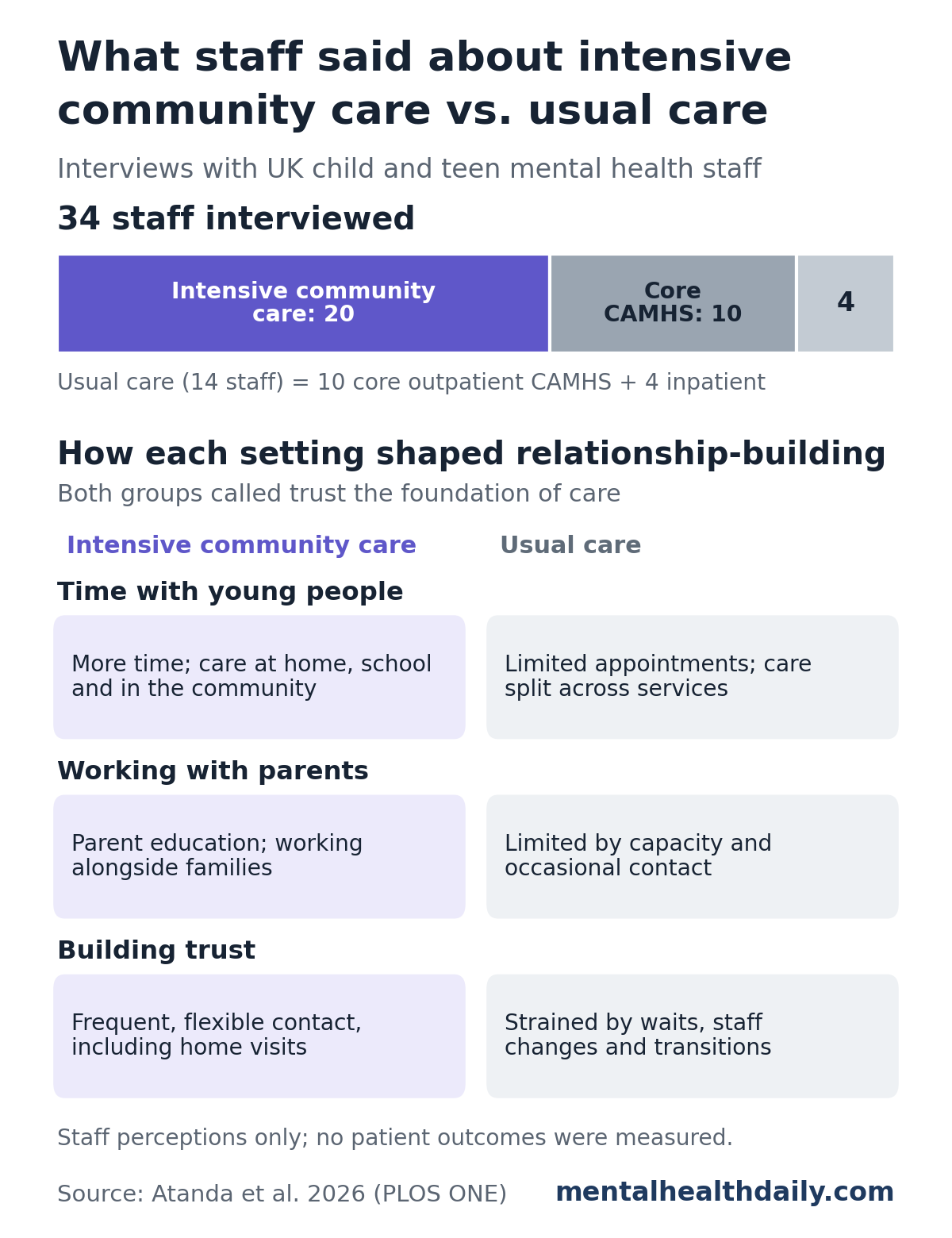
- Who was interviewed: 34 staff — 20 from intensive community care teams and 14 from usual care (10 outpatient, 4 inpatient) — in 45- to 60-minute interviews.1
- Trust came first in both settings: staff across services said treatment rarely takes hold until young people and families trust the team.1
- Community staff described more room to build it: informal visits, one main clinician, and flexible timing, place, and length of care.1
- Usual-care staff described the obstacles: waiting lists, limited appointments, staff changes, and care split across services.1
- Staff views only: the study measured what professionals reported, not patient outcomes. The parent randomized trial was too small to test whether intensive community care works better.4
What Intensive Community Care for Teens Looks Like
Intensive Community Care Services (ICCS) are multidisciplinary teams that treat young people with severe mental health problems, who would otherwise be candidates for a psychiatric ward, in their own homes, schools, and neighborhoods. The goal is to keep them out of the hospital and in their normal routines while giving them intensive support.1
In the UK, the comparison is CAMHS (Child and Adolescent Mental Health Services), the National Health Service’s youth mental health system. Its usual care in this study meant either:
- Core outpatient CAMHS: clinic-based appointments, with contact set by clinical need and service capacity
- Inpatient care: admission to a specialist adolescent psychiatric unit
ICCS teams include psychiatrists, psychologists, nurses, occupational therapists, and social workers. They practice assertive outreach — going to the young person rather than waiting for them to attend a clinic — and adjust how often they visit to the level of need.1
How the Staff Interview Study Was Done
Atanda et al. ran the interviews as the qualitative arm of a randomized trial funded by the UK National Institute for Health and Care Research (NIHR) comparing ICCS with usual care for young people at risk of psychiatric admission in England and Wales.1 The interviews themselves were not randomized; they asked staff how delivering each kind of care felt in practice.
- Sample: 34 professionals recruited through clinical leads between December 2022 and January 2024, chosen to cover a range of roles
- Roles: consultant psychiatrists, psychologists, nurses, social workers, family therapists, support workers, and crisis practitioners, with 6 months to about 28 years of experience
- Analysis: 3 researchers coded each transcript line by line, then the team grouped the codes into themes
The analysis produced 3 themes: the network of relationships around each young person, the role of parents, and how trust gets built. The researchers then compared how each theme played out in ICCS and in usual care.1
Staff Said Trust Comes Before Treatment
The clearest message was that treatment does not take hold until a young person trusts the clinician. One ICCS clinician put it simply: young people and families “are not going to respond to any treatment if they don’t engage, they don’t trust.”1
Staff described building that trust in deliberately non-clinical ways:
- Informal contact: coffee, bubble tea, or a game at lunchtime as part of the relationship-building
- Visits with no agenda: going to a home on the first day without doing an assessment, and returning several times if needed
- Following the young person’s interests: one clinician spent 15 minutes of an appointment talking about food and a restaurant with an autistic boy who had refused to speak to every other professional
- No pressure: telling young people they cannot be forced into anything, because pressure makes hard-to-reach teens pull back further
One main clinician. ICCS staff said having a single main contact meant young people did not have to repeat “your whole life story” to someone new. An inpatient clinician described the opposite problem: many people to talk to, a risk of mixed messages, and a sense among young people that only the consultant could actually make decisions.1
Flexible length. One clinician described a service meant to last 12 weeks that was often extended, in one case to nearly a year, because engagement took longer than planned.1
Parents Were Central to Engagement
Staff in both models saw families as a main driver of whether a young person engaged. Parental frustration was a common starting point: after long waits for help, families arrived disappointed, and staff said that disappointment carried over to the young person’s willingness to engage.1
ICCS staff described 3 kinds of parent work:
- Education. Psychoeducation — teaching parents about their child’s mental health problem — so they felt more comfortable talking about it at home.
- Handing control back. Professionals take some control early in a crisis for safety reasons, then deliberately return decisions to the parents who live with the young person.
- Building independence. Some parents called daily for support, which staff said helped in the short term but could not last, so they worked on parents’ independence too.
Staff also raised peers. Friends can be a source of support, but staff worried that young people who mostly confide in struggling friends can pick up harmful ways of coping, including self-harm.1
The Strain of Intensive Community Work
ICCS staff also described a demanding job. Caseloads were small by design, but cases were complex and support could run around the clock.1
- Risk at home: responding to crises at odd hours, and sometimes feeling “on their own” when handling a severe crisis in the field
- Burnout concerns: the emotional load of managing risk outside a hospital
- Coordination: difficulty working with schools, social services, and inpatient units when roles were unclear or colleagues doubted the community approach
- What helped: team debriefs after crises, supervision, and shared problem-solving
Usual-care staff, for their part, worried about some high-risk young people being managed at home, and described understaffing, bed shortages, and young people “bounced” between hospital and home after discharge.1
What Other Research Shows About Intensive Community Care
Staff views had been missing from this research. A 2026 systematic review of experiences with intensive community care for under-18s found 9 studies, none of which examined clinicians’ experiences.2 That review found satisfaction was generally higher than with routine care, especially among parents, who valued how accessible and responsive the teams were. Its themes closely match what staff described here: strong relationships built through frequent, flexible contact, and support for caregivers.
Outcome evidence is thinner:
- 2018 London trial: a randomized trial of an intensive community supported discharge service for adolescents admitted to a psychiatric unit reduced hospital bed use at 6 months, with no difference in functioning or symptoms compared with usual care.3
- 2026 multicenter trial: the trial these interviews belonged to randomized 36 adolescents aged 12 to 17. It missed its recruitment targets and was judged not feasible to continue to a full trial. Estimates pointed toward benefit for ICCS on satisfaction, symptoms, and functioning, at lower cost, but the sample was too small to confirm any effect.4
Limitations of This ICCS Staff Interview Study
- Perceptions, not outcomes. Staff accounts show how care felt to deliver. They cannot show that ICCS improves recovery, even though some staff believed it did.
- Possible loyalty to their own model. Staff may favor the model they work in, and recruitment went through clinical leads.
- No young people or parents. Their views appear in a separate report from the same study.
- Descriptive comparison. Themes were built from all 34 interviews together, and the ICCS-versus-usual-care contrasts were not counted or tested.
- Inside a trial. Services running within a research study may not reflect routine practice.
- Reporting slips. The methods section says “thirty-five” interviews but lists 20 + 4 + 10 = 34, which matches the abstract and participant table.
The paper’s conclusion calls the findings “compelling evidence” that relational care is central to successful community treatment. Interviews with 34 staff support a narrower claim: professionals in both models value trust and family work, and ICCS staff say their model gives them more room to practice it.1
What This Means for Teen Mental Health Services
- Time is part of the treatment. Staff in both settings said engagement depends on trust that takes time to build, and usual-care staff said waiting lists and limited appointments squeeze that time.
- Parents need support of their own. Education and a gradual return of control to families were recurring themes in ICCS staff accounts.
- Intensive care needs staff support. The researchers call for manageable caseloads, regular supervision, and reflective practice so that intensive relational work does not burn staff out.
- Effectiveness is still an open question. Whether ICCS improves outcomes for teens needs larger trials than have been possible so far.
If a young person is in immediate danger or thinking about suicide, contact local emergency services; in the US, call or text 988 for the Suicide & Crisis Lifeline.
References
- Atanda O, Reavey P, Wong B, et al. Relational care in community mental health: evaluating staff experiences in Intensive Community Care Services (ICCS) vs treatment as usual. PLOS ONE. 2026;21(9):e0356608. doi:10.1371/journal.pone.0356608
- Wong BH-C, Burrage J, Albazi M, et al. Experiences and satisfaction with intensive community care services for children and adolescents with severe mental health disorders: a mixed-methods systematic review. European Child & Adolescent Psychiatry. Published online August 13, 2026. doi:10.1007/s00787-026-03147-8
- Ougrin D, Corrigall R, Poole J, et al. Comparison of effectiveness and cost-effectiveness of an intensive community supported discharge service versus treatment as usual for adolescents with psychiatric emergencies: a randomised controlled trial. Lancet Psychiatry. 2018;5(6):477–485. doi:10.1016/S2215-0366(18)30129-9
- Ougrin D, Thaventhiran T, Wong B, et al. Effectiveness of intensive community care services for adolescents with acute psychiatric emergencies: findings from a feasibility multi-centre, parallel-group, single-blinded RCT. Health Technology Assessment. 2026;30(40):1–32. doi:10.3310/GJDO2425