
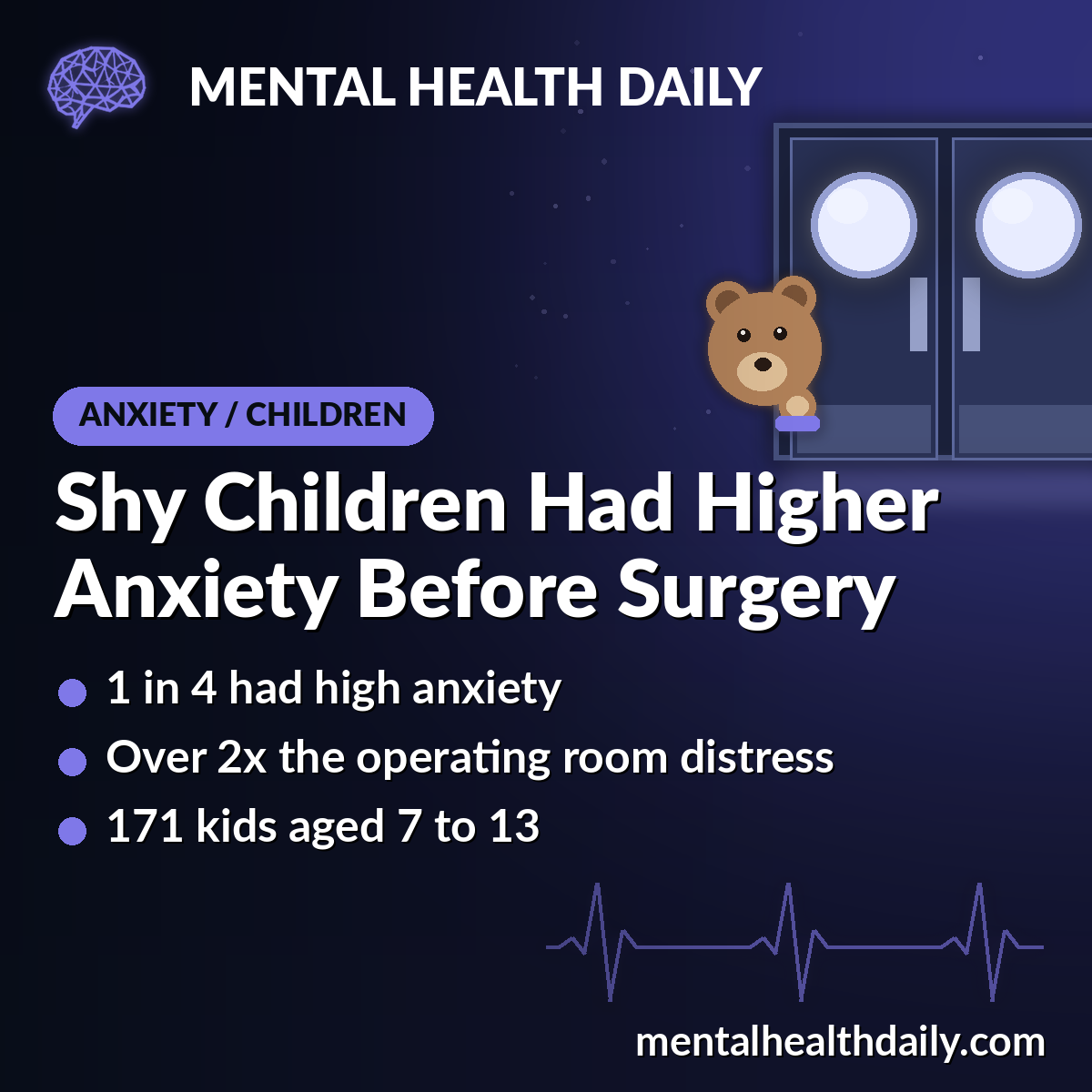
About 1 in 4 children having elective surgery showed high anxiety on several measures at once, in a Canadian study of 171 children aged 7 to 13.1
Those children were much shyer than the rest and showed more than twice as much distress in the operating room, such as crying, screaming, and resisting anesthesia.
Research Highlights
- A high-anxiety group stood out: 45 of 171 children (26%) formed a group with higher self-rated worry, a slightly faster heart rate, and a brain-activity pattern linked to anxious arousal.1
- Much higher shyness: children in the high-anxiety group scored far higher on shyness than the other children (Cohen’s d = 1.22, a large difference; p < 0.001).1
- More distress in the operating room: their observed distress score averaged 0.21 vs. 0.09 in the average-anxiety group (d = 1.06; p < 0.001).1
- Pain was only slightly higher: nurse-rated pain after surgery averaged 2.1 vs. 1.4 out of 10, a gap that was not statistically significant (p = 0.079).1
- Many measures were missing: shyness was measured in 71 children and operating-room behavior was filmed for 54, so the missing values were estimated statistically.1
How Researchers Measured Children’s Anxiety Before Surgery
A team from McMaster University and Wilfrid Laurier University followed children having planned outpatient operations, such as tonsil, adenoid, or hernia surgery, at McMaster Children’s Hospital in Hamilton, Ontario, between 2013 and 2018.1
The researchers measured anxiety twice: at a hospital visit 7 to 10 days before surgery and again on the morning of surgery. Each time they used 3 different measures:
- Self-rated worry: children filled out the CPMAS, a 5-item questionnaire built for surgery (for example, “Right now, how worried are you?”), scored from 0 to 500.
- Heart rate: recorded by nurses and taken from medical charts.
- Brain activity: a wireless EEG headband measured alpha waves over the front of the head. Lower alpha power reflects more brain activity, which the researchers treated as a sign of anxious arousal.
Parents and children also rated the child’s shyness, for example “Child feels shy about meeting new people.”
Research assistants filmed children with a GoPro camera from the moment they entered the operating room until anesthesia began.
Every 10 seconds they noted crying, screaming, signs of distress such as a sad face or posture, and resistance to anesthesia. After surgery, nurses rated pain on a 0 to 10 scale.
About 1 in 4 Children Fell Into a High-Anxiety Group
Across all 171 children, the 3 anxiety measures did not line up. A child who reported a lot of worry did not reliably have a faster heart rate or the anxious EEG pattern.1
So the researchers used latent profile analysis, a statistical method that sorts people into groups based on shared patterns across several measures. The best fit was 2 groups:
- Average-anxiety group (126 children, 74%): self-rated worry averaged about 105 out of 500, heart rate 89 beats per minute.
- High-anxiety group (45 children, 26%): self-rated worry averaged about 296, heart rate 93 beats per minute, with lower frontal alpha power (0.51 vs. 0.62).
Self-rated worry showed by far the biggest gap between the groups. The heart-rate gap was only about 4 beats per minute.
Researchers describe the high-anxiety children as the small group whose feelings and body signals both pointed toward anxiety, even though the measures were unrelated across the whole sample.
Shy Children Were More Likely to Be in the High-Anxiety Group
Shyness was combined from the parent and child reports into a single score. Children in the high-anxiety group scored well above the sample average on shyness, and children in the average group scored below it.1
The difference was large: Cohen’s d = 1.22, where 0.8 or more counts as large.
Researchers point to unfamiliarity as a likely reason. Shy children tend to react with fear to new people and places, and a hospital is full of strangers, equipment, and unfamiliar rooms.
Earlier research points the same way, though less strongly.
A 2019 meta-analysis by members of the same group pooled 12 studies of 1,064 children.2
Withdrawal from new people and situations was moderately linked to preoperative anxiety (r = 0.40), while shyness alone had a small link that fell short of statistical significance (r = 0.10, based on 3 studies).2
Distress in the Operating Room and Pain After Surgery
The clearest outcome was behavior. Children in the high-anxiety group showed more than twice the distress as they entered the operating room and went under anesthesia: an average distress score of 0.21 vs. 0.09 on a 0 to 1 scale (d = 1.06).1
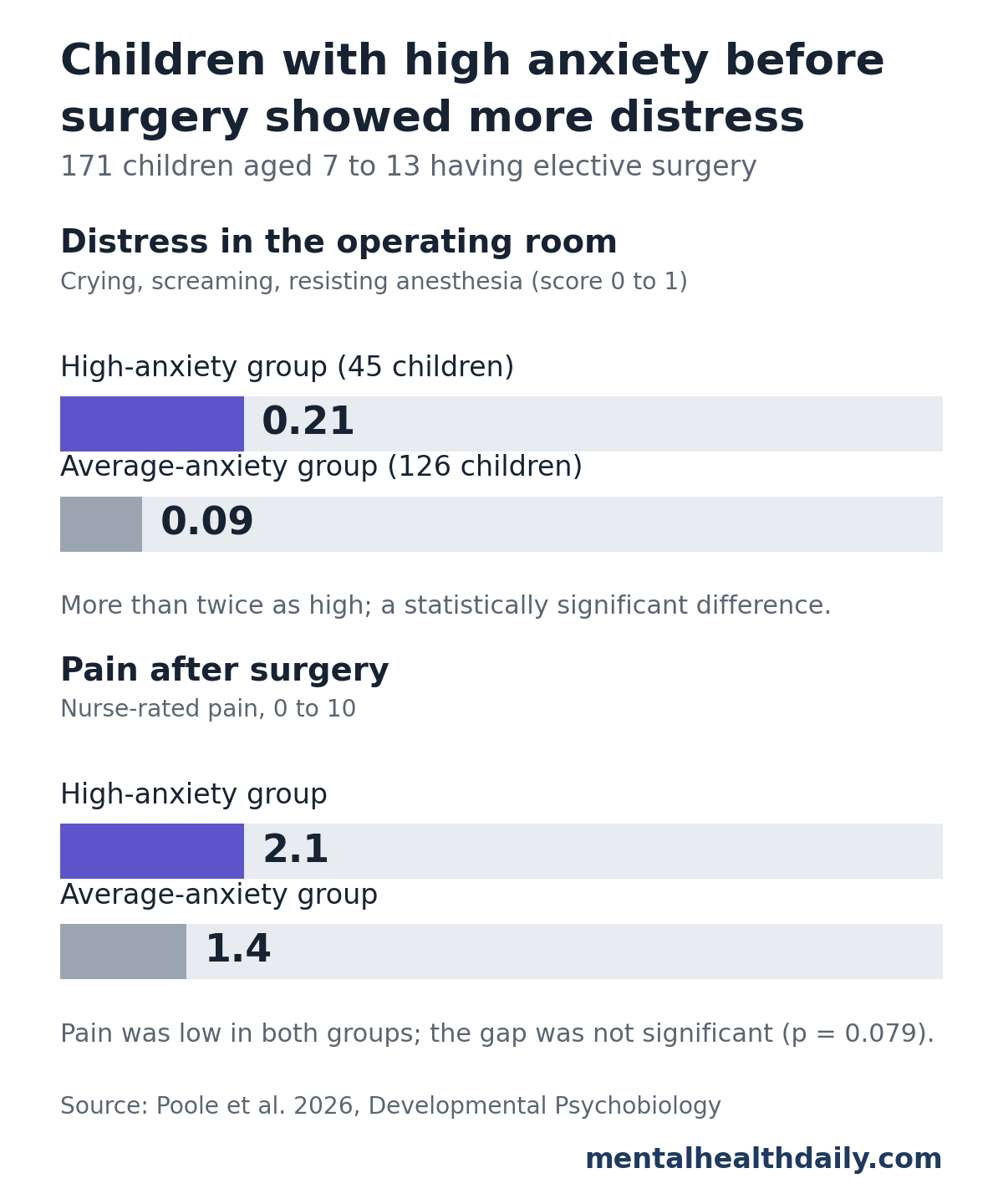
Pain after surgery was a weaker result. Nurse ratings averaged 2.1 out of 10 in the high-anxiety group and 1.4 in the average group, a small difference (d = 0.35) that missed statistical significance (p = 0.079).1
Researchers call the pain finding marginal and note that pain was low across the board, so its clinical importance may be limited.
A larger earlier study found a firmer pain link.
In 241 children aged 5 to 12 having their tonsils and adenoids removed, those who were anxious before surgery had more pain, as rated by parents, in the hospital and over the first 3 days at home.3
Anxious children also used more pain medicine at home and had more emergence delirium, a confused and agitated state while waking from anesthesia (9.7% vs. 1.5%).3
Limits of This Surgery Anxiety Study
This is an observational study, so it shows which children tended to struggle, not that shyness or anxiety caused the distress. It was not preregistered. Other limits:1
- Missing data: several measures were added after the first 100 children. Shyness was available for 71 children, EEG for 69, and operating-room video for 54. The rest were estimated statistically, and the authors say the gaps could have biased the groups.
- Noisy hospital conditions: EEG was recorded in a waiting area where children could play with toys, with varying noise, lighting, and people around. Frontal alpha is an indirect marker of anxiety.
- Mixed pain scales: nurses chose which pain scale to use for each child.
- Narrow sample: 1 hospital, mostly White families, children aged 7 to 13, and only planned outpatient surgery. Results may differ for younger children, emergency surgery, or children with chronic illness who have frequent operations.
What Parents and Care Teams Can Take From This
Children going into surgery are not all alike.
In this study, children with the high-anxiety pattern, who were also much shyer, had a harder time at anesthesia induction, the moment a child is put under. That makes them a natural group for extra preparation, although this study did not test any.1
Researchers argue for screening children for preoperative anxiety and trying to reduce it. One option they cite is audiovisual preparation.
A 2016 review of 18 studies by the same team found that videos, multi-part preparation programs, and interactive games reduced children’s preoperative anxiety. Music therapy and internet programs worked less well.4
The review called for larger, well-designed trials to confirm which approaches work best.4
References
- Poole KL, Chow CHT, Buckley N, Reddy D, Van Lieshout RJ, Schmidt LA. Profiles of anxiety in children undergoing elective surgery: predictors and perioperative outcomes. Developmental Psychobiology. 2026;68:e70196. doi:10.1002/dev.70196
- Chow CHT, Rizwan A, Xu R, et al. Association of temperament with preoperative anxiety in pediatric patients undergoing surgery: a systematic review and meta-analysis. JAMA Network Open. 2019;2(6):e195614. doi:10.1001/jamanetworkopen.2019.5614
- Kain ZN, Mayes LC, Caldwell-Andrews AA, Karas DE, McClain BC. Preoperative anxiety, postoperative pain, and behavioral recovery in young children undergoing surgery. Pediatrics. 2006;118(2):651–658. doi:10.1542/peds.2005-2920
- Chow CHT, Van Lieshout RJ, Schmidt LA, Dobson KG, Buckley N. Systematic review: audiovisual interventions for reducing preoperative anxiety in children undergoing elective surgery. Journal of Pediatric Psychology. 2016;41(2):182–203. doi:10.1093/jpepsy/jsv094