
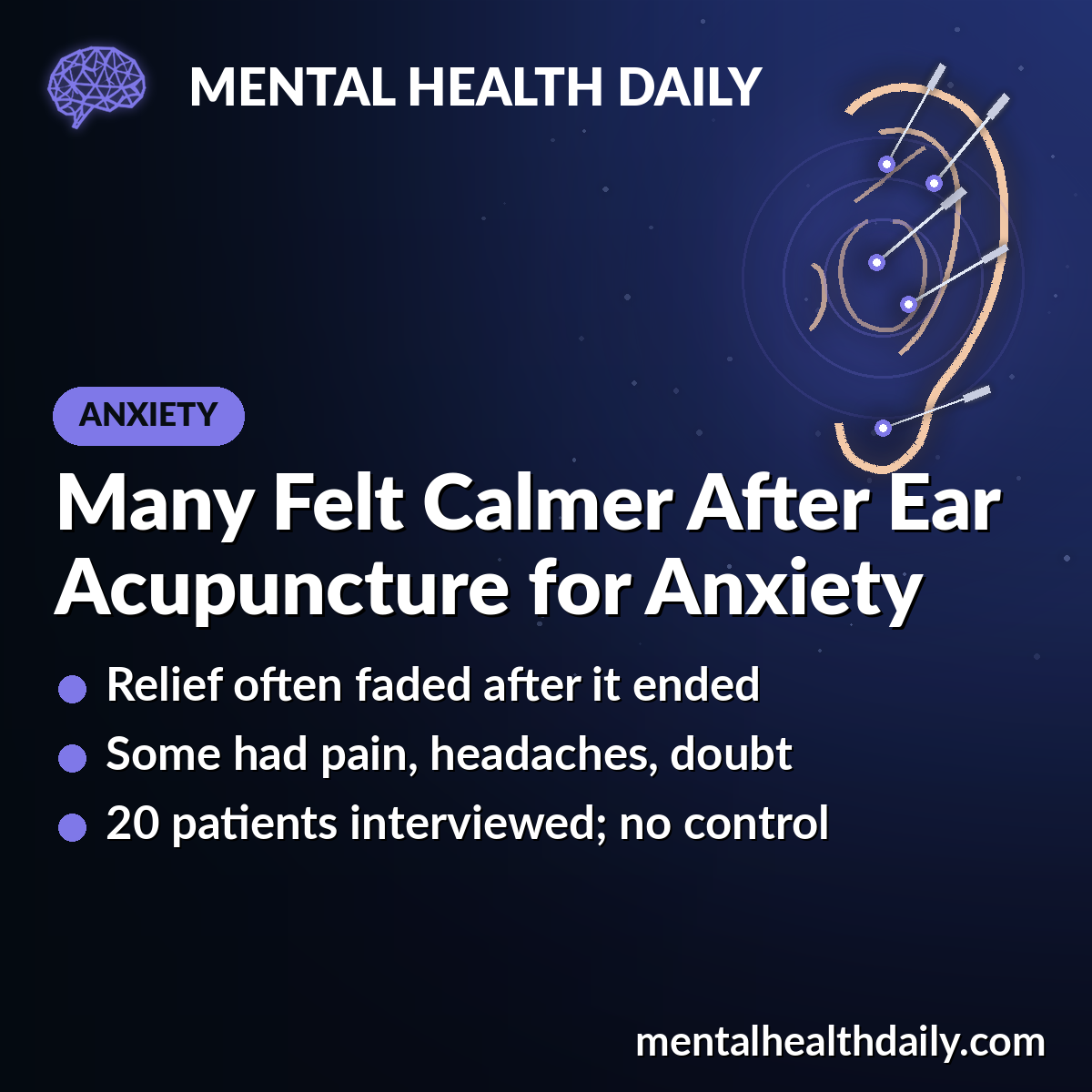
Swedish psychiatric outpatients with anxiety who finished 10 sessions of ear acupuncture mostly described feeling calmer, sleeping better and getting some relief, often only while treatment lasted. Others reported needle pain, headaches or doubt that it helped at all.1
Research Highlights
- Interview study, not a trial: researchers interviewed 20 adults (16 women, 4 men; mean age 42) after 10 sessions of NADA ear acupuncture added to their usual psychiatric care.1
- 4 themes: well-being that built up over sessions, relief that was often temporary, calm and relaxation, and passing discomfort and disappointment.1
- Relief often faded: anxiety often came back between sessions, or within days to weeks after the last one.1
- Not everyone benefited: some reported pain from the finger needles, headaches or dizziness, and some were unsure it helped at all.1
- 7 of 27 enrolled stopped early and were not interviewed, so the people heard from likely leaned toward those who liked the treatment.1
What NADA Ear Acupuncture Involved in This Swedish Study
NADA ear acupuncture is a standardized protocol from the National Acupuncture Detoxification Association: 5 fine needles go into fixed points on each ear. It was developed in the 1970s for addiction care and is now also used in psychiatric care in countries including Sweden, the US, Germany and Italy.1
Berggren et al. ran the study at outpatient psychiatric clinics in northern Halland County, Sweden, between September 2019 and June 2020. Nurses trained in NADA delivered the treatment.1
- Needles: 13 per session — 5 in each ear, 1 in the middle of the scalp and 1 in each little finger. The 3 extra needles were added based on staff clinical experience; the researchers say this enhanced version has not been tested.
- Schedule: 40 minutes sitting alone in a quiet room, twice a week for 5 weeks (10 sessions).
- Who took part: adults who reported anxiety and were already in outpatient psychiatric care. People with psychotic disorders, active substance use, severe suicidality or unstable bipolar disorder were not included.
- Usual care continued: everyone kept their regular therapy and medication during the study.
Within 1 to 2 weeks of the last session, nurses who had not given the treatment asked each person an open question: “Can you please describe your experience with NADA treatment?” Interviews ran from 20 minutes to 1.5 hours.1
The team then used latent content analysis, a qualitative method that groups what people said into codes and broader themes, including the meaning underneath their words. It describes the range of experiences; it does not count or measure symptom change.
4 Themes in How Patients Experienced Ear Acupuncture for Anxiety
The interviews sorted into 4 themes. The study did not report how many people fit each one, using words like “several” and “some” instead.1
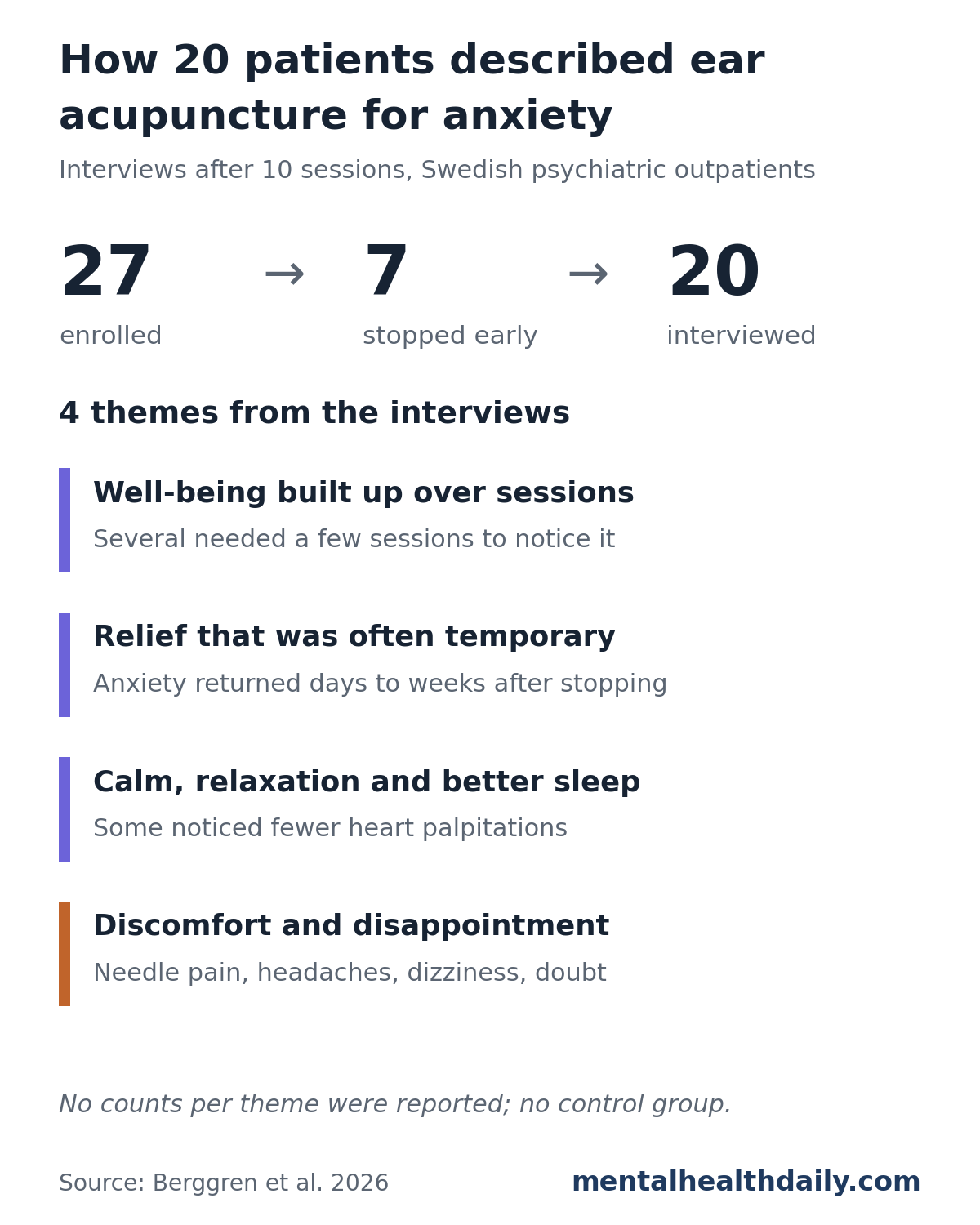
1. Well-being that built up over sessions. Several people said it took a couple of sessions before they noticed anything. Some found it hard to relax at first and said this got easier. One described it this way:
“The very first time I had a bit of a hard time relaxing… The second time it felt a little better but then after round three I really felt that it worked for me.”
2. Relief that was often temporary. For some, relief started after the first session and lasted through the 5 weeks. For others it lasted an hour to a day, with anxiety creeping back between sessions.1
Participants described anxiety returning a couple of days to weeks after treatment ended. One participant’s husband noticed the change before she did: “but now you have stopped the acupuncture!”
3. Calm, relaxation and better sleep. People described:
- feeling relaxed in the body and a sense of calm and harmony
- falling asleep more easily, sometimes during the session itself
- anxiety attacks passing more quickly and less time spent thinking about anxiety
- fewer heart palpitations and less sweating
Several said they had cut back on anti-anxiety medication during the treatment period, and some hoped to stop sleeping pills. Several wanted to continue after the study ended.1
4. Discomfort and disappointment. Needle insertion could hurt, especially in the little fingers, and occasionally caused bleeding. Several people had headaches, and some felt dizzy at the start of sessions.1
Some could not relax because of fear of pain, the silent room, or a sense of losing control. Getting to the clinic twice a week was hard for some. Others simply could not tell whether it did anything:
“But if it reduced my anxiety, I’m very uncertain… nothing got worse in any way… But I don’t know whether it made the situation any easier.”
Does Ear Acupuncture Reduce Anxiety? What Controlled Trials Show
An interview study can describe what treatment felt like, but it cannot show that ear acupuncture lowered anxiety more than time, attention, relaxation or usual care would have. That question needs randomized trials with a comparison group.
- Meta-analysis of ear acupuncture for anxiety: a 2022 review pooled 9 randomized trials. Ear acupuncture (auriculotherapy) reduced anxiety more than placebo (standardized mean difference −0.44) and more than a waiting list (−0.55), a small-to-moderate effect, with moderate certainty. The reviewers concluded it may help as an add-on mainly for situational anxiety, such as before surgery, and that safety evidence is thin.2
- NADA vs sham in drug withdrawal: a 101-person randomized trial in an addiction treatment service found the NADA protocol was no better than needles at sham points or the treatment setting alone for reducing anxiety over 3 days.3
Together, these results suggest ear acupuncture has a modest effect on anxiety, shown mostly for situational anxiety, while evidence for NADA specifically in ongoing anxiety is limited. The Swedish interviews fit that picture: relief was real to many people, but often brief and uneven.
Limitations of This Ear Acupuncture Interview Study
- No comparison group: calm and better sleep could come from 40 quiet minutes, attention from nurses or expectations, not the needles themselves.
- Dropouts were not heard: 7 of 27 stopped before finishing. The researchers note they may have found the treatment unhelpful or uncomfortable.
- Positive expectations: some participants had tried NADA before, which the researchers say may signal a favorable attitude going in.
- Usual care continued: therapy and medication ran alongside acupuncture, so changes cannot be credited to acupuncture alone.
- Not standard NADA: the 3 extra head and finger needles mean results may not apply to the usual ear-only protocol.
- Small, mostly female sample: 16 of 20 were women, from 1 Swedish region.
- Timing: COVID-19 began as treatment ended, and 2 interviews were delayed.
The researchers also call the treatment “safe and relatively well tolerated,” but the paper reports no systematic side-effect data, and the interviews themselves describe pain, headaches and dizziness.1
What This Means for People With Anxiety
- An add-on, not a replacement: participants kept their usual care. Ear acupuncture is best viewed as an extra option to discuss with a clinician.
- Give it a few sessions, but expect relief to fade: several people needed a couple of sessions to notice anything, and anxiety often returned after treatment stopped.
- The finger needles can hurt: headaches and dizziness also came up.
- Talk to a prescriber before cutting medication: some participants described reducing anti-anxiety medication, but this study did not test whether that is safe or effective.
References
- Berggren A, Stjernkvist R, Hedberg L, Larsson C, Rusch K, Aif H. Patients experience of ear acupuncture for anxiety — a qualitative interview study. Nursing Research and Practice. 2026;2026:5882178. doi:10.1155/nrp/5882178
- Vieira A, Moreira A, Machado JP, Robinson N, Hu XY. Is auriculotherapy effective and safe for the treatment of anxiety disorders? — A systematic review and meta-analysis. European Journal of Integrative Medicine. 2022;54:102157. doi:10.1016/j.eujim.2022.102157
- Black S, Carey E, Webber A, Neish N, Gilbert R. Determining the efficacy of auricular acupuncture for reducing anxiety in patients withdrawing from psychoactive drugs. Journal of Substance Abuse Treatment. 2011;41(3):279–287. doi:10.1016/j.jsat.2011.04.001