
In a 2026 online study of 106 young adults without diagnoses, people with more autism traits were less precise at telling whether a face was looking at them, while people with more social anxiety were more precise. Psychosis-prone traits showed no link.1
Research Highlights
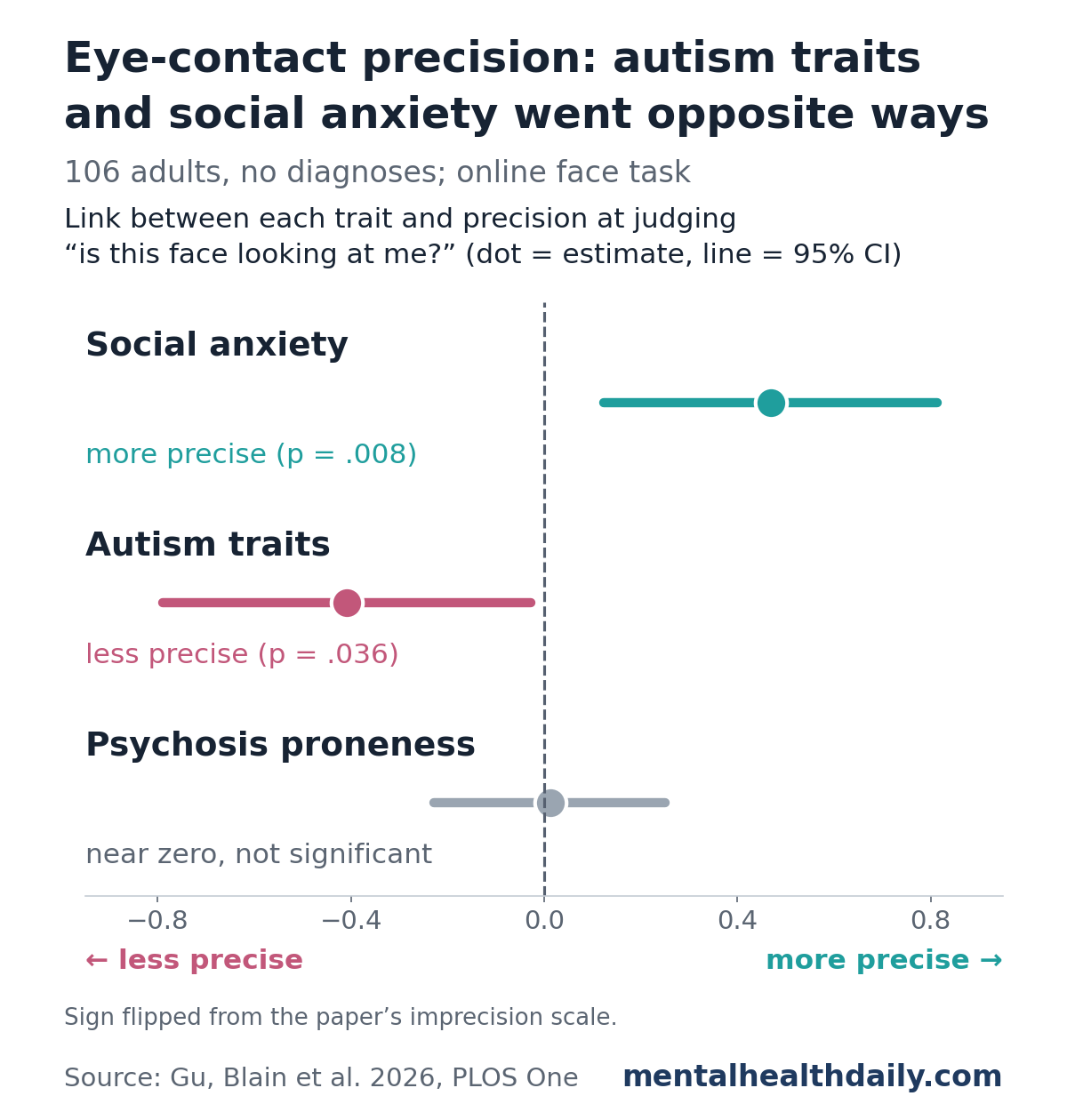
- Autism traits, less precision: higher autism-trait scores were linked to fuzzier judgments of eye contact (standardized β = 0.41, p = .036).1
- Social anxiety, more precision: contrary to the researchers’ prediction of a stronger “looking at me” bias, higher social anxiety was linked to sharper judgments (β = −0.47 on the imprecision scale, p = .008).1
- Noise wore down the anxious edge: when visual static was added to the faces, precision dropped more steeply in people with higher social anxiety (β = 0.58, p = .042).1
- No link for psychosis proneness: unusual perceptual experiences and delusion-like beliefs were unrelated to either gaze measure (p = .922 and p = .357).1
- Blurry or turned faces felt more “at me”: across everyone, static and turned heads made judgments less precise and widened the range of gazes taken as eye contact.1
How the Eye-Contact Task Measured Precision and “Looking at Me” Bias
Gaze perception is the split-second judgment of where another person is looking, and especially whether they are looking at you. Studies have found it altered in schizophrenia, autism and social anxiety disorder, and in people with milder versions of those traits.1
Gu, Blain et al., a team from the University of Michigan, Ohio State and other US universities, recruited adults aged 18 to 30 through the online research platform Prolific in August and early September 2020. Of 120 recruited, 106 passed data-quality checks, and 83 repeated the task 2 weeks later.1
Participants saw grayscale photos of 6 actors whose eyes were turned in small steps away from the viewer, from 0° (straight at you) to 10°. For each face they answered yes or no: is this person looking at me? Over 432 trials, the faces came in 4 versions:1
- Forward head, clear image
- Forward head, low visual noise (static laid over the photo)
- Forward head, high visual noise
- Head turned 30°, with eyes ranging from 0° to 24°, so head and eyes could point in different directions
From each person’s yes/no curve, the team pulled out 2 numbers:1
- Width (imprecision): how many degrees of eye turn it took to go from almost always saying “yes” to almost always saying “no.” A narrow width means sharp, precise judgments.
- Threshold (self-referential bias): the eye angle at which a person said “looking at me” half the time. A higher threshold means more sideways glances still felt like eye contact.
Questionnaires measured 3 trait dimensions. Psychosis proneness combined unusual perceptual experiences (such as hearing one’s thoughts echoed) and delusion-like beliefs. Social anxiety came from 2 scales of fear and avoidance in social situations, and autism traits from the 50-item Autism Spectrum Quotient.1
A statistical model then separated the 3 overlapping traits and tested each one’s link to width and threshold. Social anxiety correlated with both autism traits (r = .51) and psychosis proneness (r = .27), so this step kept one trait from borrowing another’s signal.1
Autism Traits Linked to Less Precise Eye-Contact Judgments
People with higher autism-trait scores had wider curves, meaning their yes/no answers changed more gradually as the eyes turned away (β = 0.41, 95% CI 0.03 to 0.79, p = .036). The researchers had predicted this.1
They also showed a somewhat higher threshold (β = 0.31, p = .044), so slightly averted gazes were more often read as eye contact. The researchers note that an earlier study found the opposite, possibly because it used a wider range of gaze angles.1
The result is consistent with clinical research: a 2017 study in Scientific Reports found that adults diagnosed with autism were less precise and less accurate than controls when judging where someone was looking, though which aspects were affected varied from person to person.3
Attention to the eyes does not seem to explain it. The researchers cite eye-tracking work using the same task in which less time on the eyes in people with more autism traits showed up only after they had made their judgment. They suggest a broader uncertainty in how ambiguous social signals are resolved.1
Social Anxiety Linked to Sharper Gaze Reading, Until the Faces Got Noisy
The team expected social anxiety to widen the “looking at me” zone. Instead, higher social anxiety was linked to narrower, more precise curves (β = −0.47 on the imprecision scale, 95% CI −0.81 to −0.12, p = .008), and it showed no link to threshold (p = .234).1
That runs against earlier work. A 2013 web study of 174 people found that higher social anxiety went with judging more gaze directions as aimed at oneself, especially on angry, fearful and neutral faces.2 The 2026 researchers suggest a larger sample or more severe anxiety may be needed to detect that bias.1
The advantage was fragile. As visual static increased, precision fell more steeply in people with higher social anxiety (β = 0.58, 95% CI 0.02 to 1.14, p = .042). Their sharper starting point shrank as the faces got noisier.1
The researchers’ explanation is vigilance: anxious people watch gaze cues closely, which helps on clear faces. When the image turns ambiguous, it may feel more threatening and prompt them to pull their attention away, costing precision.1
Psychosis Proneness Showed No Link to Gaze Judgments
Contrary to the third prediction, psychosis-prone traits were unrelated to precision (β = −0.01, p = .922) or threshold (β = −0.12, p = .357).1
This sample was relatively healthy, and psychosis-proneness scores ran a bit lower than in larger community samples. The 2 questionnaires also capture positive-symptom-type experiences; the researchers suggest that traits like social anhedonia (little pleasure from social contact) may be more closely linked to gaze processing.1
Blurry Faces and Turned Heads Made Everyone Feel Looked At
Across all participants, average width rose from 10.5° on clear forward faces to 12.5° with low noise and 14.6° with high noise. Threshold rose from 4.1° to 4.8° and 5.7°, so blurrier faces were read as looking at the viewer over a wider range of eye angles.1
Turning the head 30° had the largest effect on threshold, which jumped from 4.1° to 10.1°, while width rose to 16.1°. When head and eyes disagreed, people were both less precise and more likely to feel looked at.1
A default of “they’re looking at me.” The researchers read this as a sensible fallback. When the signal is unclear, assuming eye contact costs little (an awkward wave), while missing a real stare could matter more.1
A link to schizophrenia research. People with schizophrenia show the same pairing of reduced precision and stronger self-directed bias, and the researchers propose that greater internal sensory noise may be one reason.1 The task itself comes from a 2020 validation study, which found excellent 2-week reliability for the bias measure and moderate reliability for precision.4
Limitations of This Online Gaze Study
This was a cross-sectional study of trait scores in people without diagnoses, so it shows associations and cannot speak to diagnosed autism, social anxiety disorder or psychosis.
- Modest sample. With 106 people, several key links had confidence intervals that came close to zero (autism and precision, p = .036; social anxiety and the noise effect, p = .042).
- Narrow age range. All participants were 18 to 30.
- Fixed task order. Conditions always ran from easiest to hardest, so practice or fatigue may have added to the noise and head-turn effects.
- Unsupervised online testing. Screen size, lighting and viewing distance were not controlled.
- Pandemic timing. Data were collected in 2020, which may have raised self-reported social anxiety and autism traits.
- Limited range of traits. Psychosis-proneness scores were especially low, which may have hidden a real link.
What the Findings Mean for Autism and Social Anxiety
Different traits, different gaze patterns. Autism traits went with less precise eye-contact reading, while social anxiety went with sharper reading that held up poorly when faces were unclear. These are distinct patterns, even though the 2 traits often travel together.
Social anxiety did not widen the “looking at me” zone. In this sample, more anxious people did not feel looked at more often. Instead, they read clear faces more sharply and lost much of that edge when visual static was added.
Not a test for anything. The task measures trait-level differences in a research setting. It is not a screening or diagnostic tool, and the researchers call for larger studies that include people with clinical diagnoses.1
References
- Gu P, Blain SD, Lasagna CA, et al. Gaze processing across psychosis proneness, social anxiety, and autism traits: examining the role of sensory quality and context congruity. PLOS One. 2026;21(9):e0352116. doi:10.1371/journal.pone.0352116
- Schulze L, Lobmaier JS, Arnold M, Renneberg B. All eyes on me?! Social anxiety and self-directed perception of eye gaze. Cognition and Emotion. 2013;27(7):1305–1313. doi:10.1080/02699931.2013.773881
- Pantelis PC, Kennedy DP. Deconstructing atypical eye gaze perception in autism spectrum disorder. Scientific Reports. 2017;7(1):14990. doi:10.1038/s41598-017-14919-3
- Lasagna CA, McLaughlin MM, Deng WY, Whiting EL, Tso IF. Deconstructing eye contact perception: measuring perceptual precision and self-referential tendency using an online psychophysical eye contact detection task. PLOS One. 2020;15(3):e0230258. doi:10.1371/journal.pone.0230258