
Higher estradiol went with more acting without thinking ahead in young adults with low cortisol, and less in those with high cortisol, a 2026 study of 197 men and women in Israel found.1
Anxiety shifted the picture for both estradiol and testosterone, but only for planning and follow-through.1
Research Highlights
- Who was studied: 197 healthy university students (66 men, 68 women on the pill, and 63 women not on hormonal birth control), mostly in their mid-20s, each giving one afternoon saliva sample.1
- Cortisol flipped estradiol’s link to planning: with low cortisol, higher estradiol went with more acting without thinking ahead; with high cortisol, it went with less.1
- Anxiety flipped estradiol’s link to follow-through: higher estradiol went with poorer follow-through at low anxiety and better follow-through at high anxiety.1
- Testosterone and follow-through: higher testosterone was linked to poorer follow-through only in people reporting higher anxiety.1
- No pattern for emotional or thrill-seeking impulsivity: cortisol and anxiety did not change hormone links to rash, emotion-driven acts or to sensation seeking.1
- Exploratory evidence: a single snapshot in a convenience sample, with many statistical tests and no correction for them.1
Four Kinds of Impulsivity, Three Key Hormones
Impulsivity is a tendency to act quickly without weighing the long-term consequences. It shows up in ADHD, addiction, gambling problems and mood disorders, but it is not one single trait.1
Efrat Barel et al., at the University of Haifa and partner institutions in northern Israel, measured it with the UPPS Impulsive Behavior Scale, a 45-item questionnaire that splits impulsivity into 4 facets:1
- Urgency: acting rashly when upset. This is the emotional, “heat of the moment” facet.
- Lack of premeditation: acting without thinking ahead or planning.
- Lack of perseverance: trouble sticking with tasks that are boring or hard, or poor follow-through.
- Sensation seeking: a pull toward thrills and new, exciting experiences.
Higher scores mean more impulsive on every facet. Planning and follow-through are usually grouped as the “cognitive” or self-control facets, because they lean on the brain’s prefrontal control systems rather than on emotional reactivity.1
The researchers measured 3 hormones in saliva:
- Testosterone: the main androgen (“male” sex hormone), present in both sexes but much higher in men. It has been linked to sensation seeking and aggression in earlier work.
- Estradiol: the main form of estrogen. Men make it too, largely by converting testosterone. It influences prefrontal brain function partly through dopamine signaling.
- Cortisol: the body’s main stress hormone, released by the HPA axis (the hypothalamus–pituitary–adrenal stress system). High levels tend to go with stress and avoidance.
Progesterone was also measured and statistically controlled, because it runs high in the second half of the menstrual cycle.1
Why Cortisol Might Change a Sex Hormone’s Effect
The idea comes from the dual-hormone hypothesis: sex hormones and stress hormones work together, so a sex hormone can push behavior one way when cortisol is low and a different way when it is high.
In a 2010 paper, Mehta and Josephs found that testosterone was linked to more dominant behavior only in people with low cortisol. With high cortisol, the link disappeared or reversed.2
Tackett et al. extended the idea to estradiol in 2015. In 105 teenagers aged 13 to 18, high estradiol went with more rule-breaking and aggressive (externalizing) behavior only when cortisol was low and certain difficult personality traits were high.3
Barel et al. asked whether the same kind of interplay, plus a person’s anxiety in the moment, shapes how hormones relate to each impulsivity facet.
Who Took Part and How Hormones Were Measured
Sample: 197 undergraduate students recruited from college notice boards. All were healthy non-smokers with no serious medical, hormonal or psychiatric condition and no self-reported ADHD or learning disability.1
- Men: 66, average age about 26
- Women on the pill: 68, average age about 23.5, all using the same type of combined pill (ethinylestradiol plus gestodene) for at least 1 year
- Naturally cycling women: 63, average age about 24, tested on day 21 of a confirmed regular cycle (the mid-luteal phase)
Procedure: each person gave one saliva sample between noon and 6 p.m., then filled out the UPPS and a standard state-anxiety questionnaire (the STAI-S, which asks how anxious someone feels right now).1
As expected, men had several times more testosterone than either group of women, and naturally cycling women had the most estradiol. Cortisol did not differ between the 3 groups.1
Cortisol and Anxiety Flipped Estradiol’s Link to Impulsivity
The researchers tested whether each hormone’s link to each facet changed between people with low and high cortisol, and between people with low and high anxiety. To check for a flip, they compared the hormone links in people about 1 standard deviation below average (low) and above average (high) on cortisol or anxiety.1
Estradiol and planning, by cortisol: with low cortisol, higher estradiol was linked to more acting without thinking ahead. With high cortisol, higher estradiol was linked to less of it (both significant).1
Estradiol and follow-through, by cortisol: with low cortisol, higher estradiol went with poorer follow-through. With high cortisol, the link pointed the other way but was not significant.1
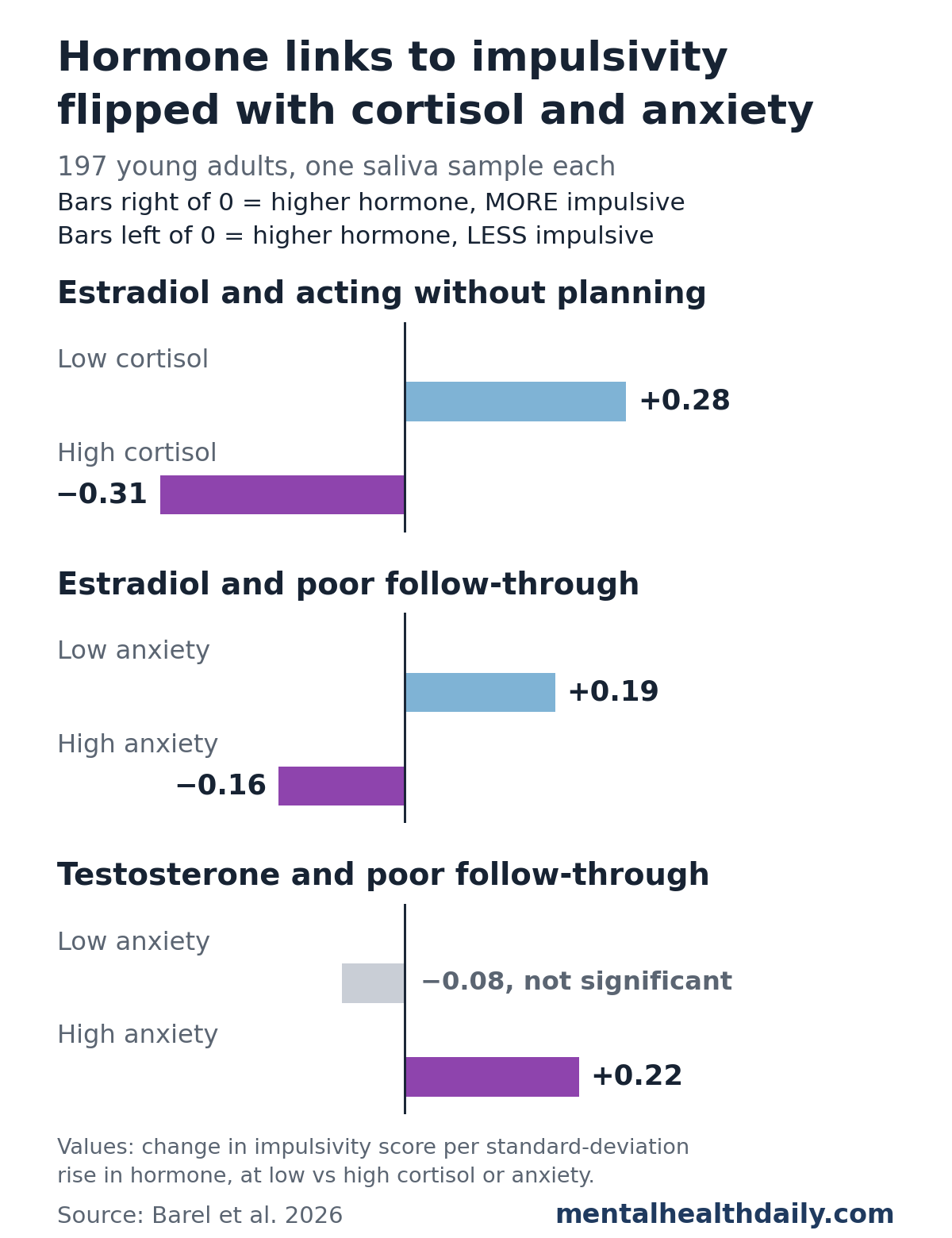
Estradiol and follow-through, by anxiety: in people reporting low anxiety, higher estradiol went with poorer follow-through. In people reporting high anxiety, it went with better follow-through. Both slopes were significant.1
Anxiety also changed estradiol’s link to planning, but when the researchers looked at high-anxiety people on their own, the link fell just short of significance (p = 0.088).1
Testosterone Was Linked to Poorer Follow-Through Only With Higher Anxiety
Among people reporting higher anxiety, higher testosterone went with more trouble sticking with tasks. Among people reporting low anxiety, there was no significant link.1
Cortisol did not change any of testosterone’s links to impulsivity, even though the dual-hormone hypothesis began with testosterone.12
Urgency and sensation seeking: neither cortisol nor anxiety changed how either hormone related to these 2 facets. A few simpler links did appear:1
- Higher cortisol went with more urgency, more sensation seeking and more acting without planning.
- Higher testosterone went with more sensation seeking and less acting without planning.
- Higher anxiety went with more urgency but better follow-through.
The patterns did not differ significantly between men, women on the pill and naturally cycling women, and they held when the researchers adjusted for group.1
How Strong Is the Evidence on Hormones and Impulsivity?
This was a cross-sectional study of a convenience sample, and its moderation findings are exploratory: useful leads for future research, not proof that raising or lowering a hormone changes how impulsive someone is. The main limits:1
- One snapshot. Hormones and anxiety were measured once, in the afternoon. Hormones swing across the day and the menstrual cycle, so a single sample is a rough reading.
- No cause and effect. The design cannot show whether hormones shape impulsivity, impulsive habits shape hormones, or something else drives both.
- Many tests. The team ran 8 regression models with 16 hormone-by-context tests and did not correct for multiple comparisons. Five reached significance. In a simpler correlation table that was corrected, only 1 of 28 links survived.
- Narrow sample. Healthy students in their 20s in Israel. Naturally cycling women were tested only in the mid-luteal phase, missing the estradiol peak around ovulation.
- Self-report. Impulsivity was measured by questionnaire, not by behavioral tasks.
The results fit a growing view that hormone–behavior links depend on context, and the low-cortisol estradiol pattern is consistent with the earlier teen study.3 Repeated hormone sampling over time, behavioral impulsivity tasks and larger samples would show whether these flips hold up.
For readers: these findings come from healthy volunteers and do not apply to choosing a contraceptive or hormone therapy. Anyone struggling with impulsive behavior, such as in ADHD or addiction, should talk with a clinician about proven treatments.
References
- Barel E, Cohen A, Mahagna L. Gonadal hormones and impulsivity facets: moderating roles of cortisol and anxiety. Frontiers in Psychology. 2026;17:1871253. doi:10.3389/fpsyg.2026.1871253
- Mehta PH, Josephs RA. Testosterone and cortisol jointly regulate dominance: evidence for a dual-hormone hypothesis. Hormones and Behavior. 2010;58(5):898–906. doi:10.1016/j.yhbeh.2010.08.020
- Tackett JL, Reardon KW, Herzhoff K, et al. Estradiol and cortisol interactions in youth externalizing psychopathology. Psychoneuroendocrinology. 2015;55:146–153. doi:10.1016/j.psyneuen.2015.02.014