
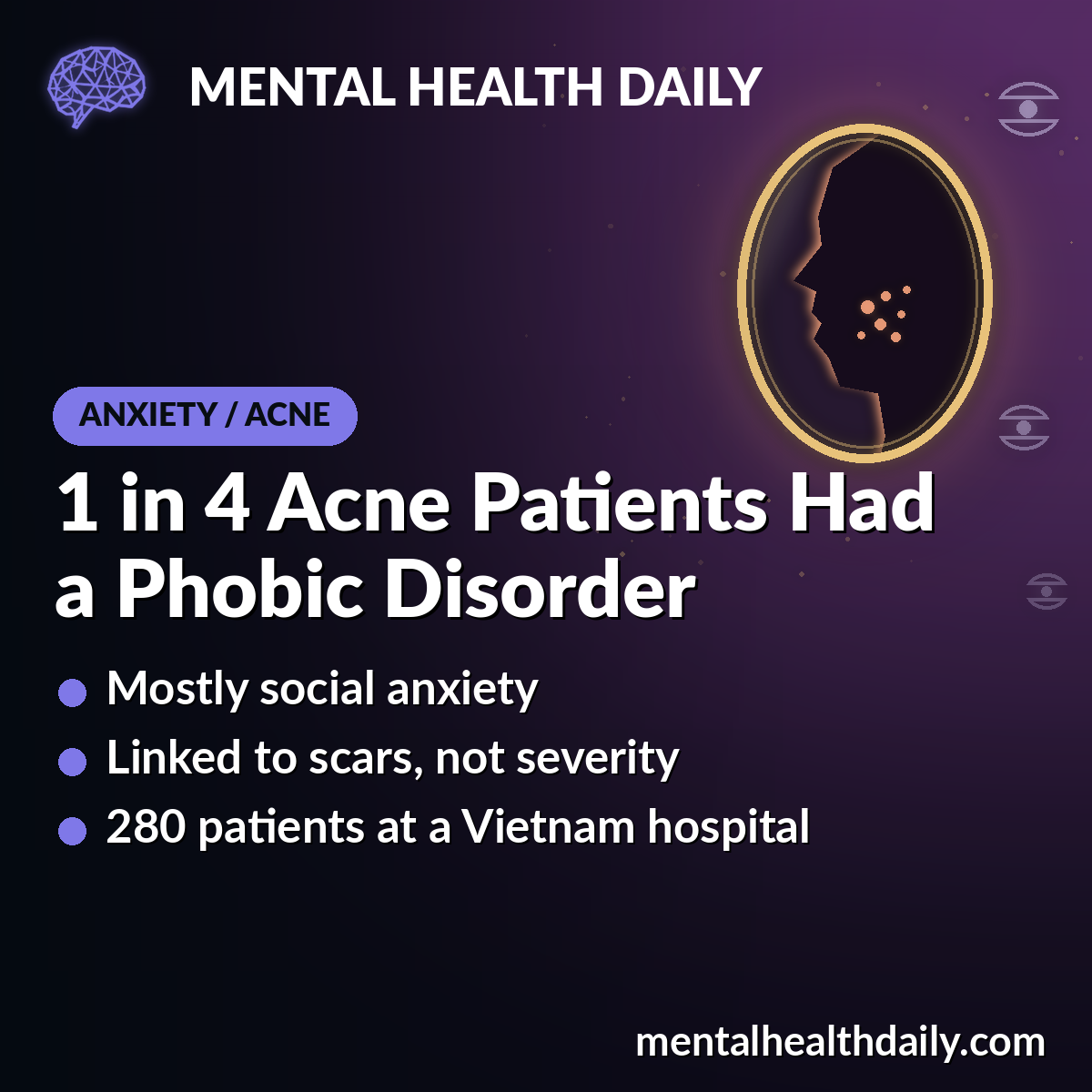
About 1 in 4 people treated for acne at Vietnam’s national dermatology hospital had a phobic anxiety disorder, mostly social phobia, a 2026 study found. Acne scarring and acne that had not responded well to treatment were linked to these disorders; how severe the acne was at the visit was not.1
Research Highlights
- 24.6% had a phobic disorder: a psychiatrist diagnosed at least one phobic anxiety disorder in 69 of 280 acne outpatients.1
- Mostly social phobia: fear of being watched and judged accounted for 64 of the 69 cases; specific phobias were less common, and agoraphobia was rare.1
- Scars and stubborn acne stood out: after adjustment, acne scarring (about 2.3 times the odds) and poor treatment response (about 5 times the odds) were linked to phobic disorders.1
- Severity alone was not: severe acne showed no clear link once scarring, treatment response and other factors were taken into account.1
- Hospital sample, one point in time: the cross-sectional design shows links, not causes, and the rate applies to a specialist hospital, not everyone with acne.1
How the Hanoi Study Diagnosed Phobic Disorders in Acne Patients
Phobic anxiety disorders involve fear that is out of proportion to the real threat, worry ahead of time, and avoidance that gets in the way of daily life. The ICD-10 system groups them into 3 types:1
- Social phobia (called social anxiety disorder in DSM-5): fear and avoidance of situations where other people might scrutinize or judge you
- Specific phobia: fear limited to one object or situation
- Agoraphobia: fear of places where escape or help might be hard to reach
Nguyen Van Tuan et al. recruited patients with acne vulgaris (ordinary acne) at the National Hospital of Dermatology and Venereology in Hanoi between December 2025 and June 2026. Patients joined as they came in for care (convenience sampling) rather than being randomly selected.1
- Sample: 280 outpatients; average age 21.3; 68.6% women
- Acne profile: 51.1% had severe acne, 57.9% had scarring, and 62.1% were taking isotretinoin, a strong oral acne drug
- Diagnosis: a psychiatrist interviewed each patient face to face and applied ICD-10 criteria; questionnaire scores did not decide who had a disorder
A dermatologist rated acne severity (mild, moderate or severe), scarring, and treatment response (marked, partial or none). Several other factors, including whether a patient was “easily anxious,” came from study-specific checklist items rather than validated scales.1
Social Phobia Accounted for Nearly All Phobic Disorder Cases
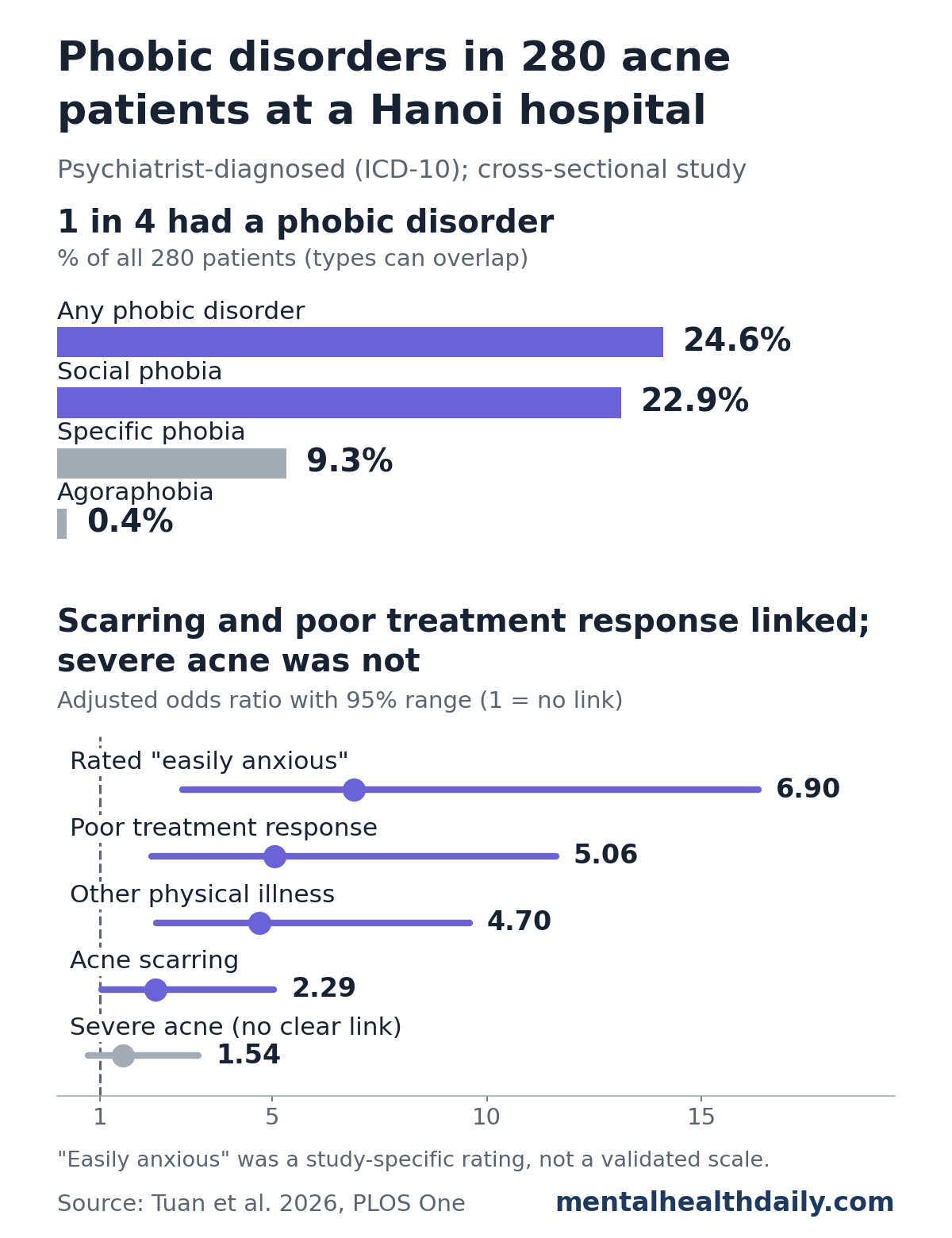
Sixty-nine of the 280 patients (24.6%; 95% CI 20.0% to 30.0%) met criteria for at least one phobic disorder. Some had more than one type:1
- Social phobia: 64 patients (22.9% of the sample; 92.8% of cases)
- Specific phobia: 26 patients (9.3%)
- Agoraphobia: 1 patient (0.4%)
- Overlap: 22 of the 69 had 2 types; none had all 3
Fear Questionnaire scores, collected only from patients with a diagnosis, pointed the same way. The social phobia section averaged 17.8, compared with 5.2 for specific phobia and 1.5 for agoraphobia.1
A 2011 Turkish study found a similar pattern: social phobia in 45.7% of 140 acne patients vs. 18.4% of 98 people without acne. Its methods, setting and age mix differed, so the numbers are not directly comparable.3
Scarring and Poor Treatment Response, Not Severe Acne, Linked to Phobic Disorders
The researchers built an exploratory model that weighed 9 factors at once, so each estimate is adjusted for the others. Four had confidence ranges that stayed clear of “no link”:1
- Rated “easily anxious”: adjusted odds ratio (aOR) 6.90 (95% CI 2.92 to 16.32)
- Poor treatment response (partial or no improvement): aOR 5.06 (2.20 to 11.62)
- Another physical illness: aOR 4.70 (2.30 to 9.60)
- Acne scarring: aOR 2.29 (1.04 to 5.05)
An odds ratio compares the odds of having a phobic disorder in people with a factor vs. people without it; 1 means no difference. In raw numbers, 36.6% of patients with a poor treatment response had a phobic disorder, compared with 8.4% of those whose acne had improved markedly.1
Severe acne dropped out. Before adjustment, 30.8% of patients with severe acne had a phobic disorder vs. 18.2% with milder acne. After adjustment, the link shrank to an aOR of 1.54 (0.72 to 3.29), consistent with no association.1
Age, sex, how long someone had acne, and current isotretinoin use showed no clear link. A rating of major acne-related life impact came close (aOR 2.09, 0.99 to 4.41) but was not conclusive.1
Reading the “easily anxious” result: it was the strongest link, but it came from a single checklist item that likely overlaps with the anxiety it is being compared against. The researchers treat it as an exploratory signal, not evidence that a measured personality trait predicts phobias.1
Why Acne Scars and Hard-to-Treat Acne Could Feed Social Fear
Scars stay visible after active breakouts heal, so they can keep appearance worries going even when a dermatologist would call the acne improved. The researchers suggest that visible aftereffects and a long, frustrating treatment course may weigh more on social fear than the acne’s current severity.1
That fits with evidence on how others see acne. In a 2024 online survey, 1,357 people shown photos digitally edited to add acne rated those faces as less attractive and less trustworthy and wanted more social distance, especially when the acne was severe.4
The link could also run the other way. People with social phobia may avoid follow-up visits, struggle with treatment routines, or judge their results more harshly, which could make treatment response look worse.1
The broader pattern is well established: a 2020 meta-analysis of 42 studies found acne linked to both depression and anxiety, with stronger links in adults and in clinic patients than in community samples.2
Limitations of This Acne and Phobic Disorder Study
This was a cross-sectional study, which captures everyone at one point in time. It can show which factors go together but not which came first or what caused what.1
- Specialist hospital sample: half had severe acne and most were on isotretinoin, so 24.6% likely overstates the rate among people with typical acne
- Unknown participation rate: records of how many patients were approached or declined were not kept
- Small model: 69 cases spread across 9 factors makes estimates unstable; the confidence range for scarring crossed 1 when people with current anxiety or depression symptoms were removed (aOR 2.47, 0.98 to 6.19)
- Study-specific measures: severity, treatment response, life impact and “easily anxious” were unvalidated ratings
- Diagnosis method: no validated structured interview was documented, and the Vietnamese Fear Questionnaire had not been formally validated
- Not measured: self-esteem, body image and perceived stigma
What This Means for People With Acne and Social Anxiety
The researchers recommend that acne clinicians ask about avoidance, fear of being judged, and whether acne is interfering with school, work or relationships, especially when a patient has scarring or a difficult treatment course.1
Short questionnaires such as the Social Phobia Inventory (SPIN) or Mini-SPIN can flag people who may need a closer look. A positive screen is not a diagnosis, and this study did not test a cutoff or referral pathway for Vietnamese patients.1
If acne has you skipping social events, avoiding cameras, or dreading class or work, that is worth raising with your dermatologist or primary care clinician. Social anxiety is a recognized, treatable condition, and it can be addressed alongside the skin.
References
- Tuan NV, Ha VT, Duong MS. Phobic anxiety disorders among patients with acne vulgaris at a national dermatology hospital in Vietnam: prevalence, clinical phenotype, and associated factors. PLOS One. 2026;21(9):e0357803. doi:10.1371/journal.pone.0357803
- Samuels DV, Rosenthal R, Lin R, Chaudhari S, Natsuaki MN. Acne vulgaris and risk of depression and anxiety: a meta-analytic review. Journal of the American Academy of Dermatology. 2020;83(2):532–541. doi:10.1016/j.jaad.2020.02.040
- Bez Y, Yesilova Y, Kaya MC, Sir A. High social phobia frequency and related disability in patients with acne vulgaris. European Journal of Dermatology. 2011;21(5):756–760. doi:10.1684/ejd.2011.1418
- Shields A, Nock MR, Ly S, Manjaly P, Mostaghimi A, Barbieri JS. Evaluation of stigma toward individuals with acne. JAMA Dermatology. 2024;160(1):93–98. doi:10.1001/jamadermatol.2023.4487