
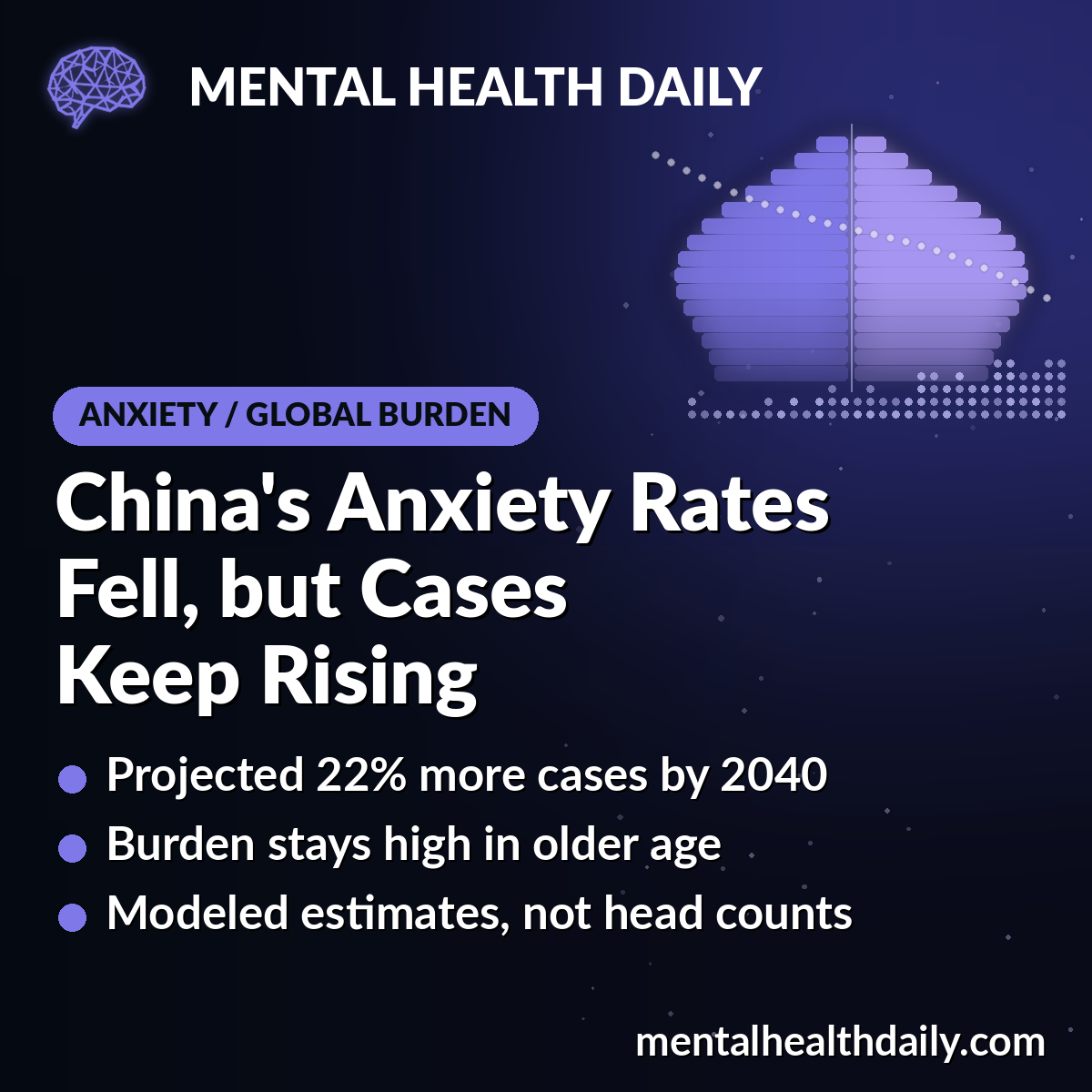
Age-adjusted anxiety disorder rates in China fell after 2000, according to a 2026 analysis comparing China with the Group of Twenty (G20) major economies.1
Total cases are still projected to climb through 2040, and China’s anxiety burden sits later in life than in most other G20 countries.
Research Highlights
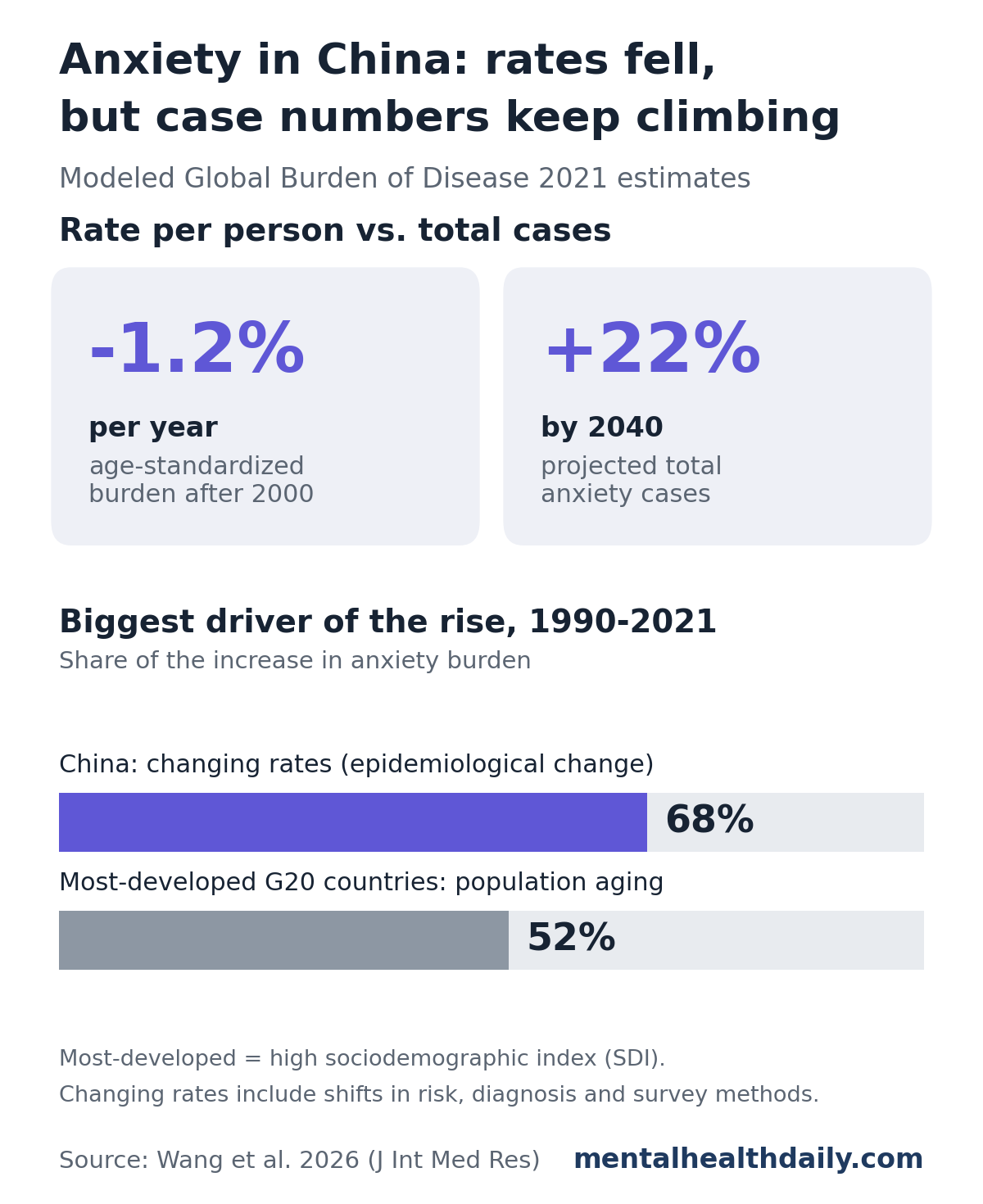
- Rates fell in China: the age-standardized anxiety burden declined by an average of 1.2% per year after 2000.1
- Cases still rising: forecasting models projected a 22% increase in China’s total anxiety cases between 2021 and 2040, even with stable rates.1
- Later-life burden: in most G20 countries anxiety peaked at ages 20 to 30; in China a larger share of the burden fell on middle-aged and older adults.1
- Women affected more: anxiety disorders were 1.8 times as common in women as in men.1
- Different drivers: changing rates explained most of China’s rise in cases, while population aging accounted for 52% of the rise in the most developed G20 countries.1
How Anxiety Burden Was Measured in China and the G20
Yuling Wang et al., at Chuzhou City Vocational College and Chuzhou hospitals in China, analyzed estimates from the Global Burden of Disease (GBD) Study 2021. GBD is a large international project that combines surveys, health records and published studies, then uses statistical models to estimate how common each disease is in 204 countries and territories.1
Those numbers are modeled, not counted. Where a country has few good surveys, the models borrow information from similar places and years, so every national figure is an estimate with a range of uncertainty.
The study team compared China with the G20 — 19 major economies plus the European Union, covering about 85% of world economic output and about two-thirds of the world’s population — from 1990 to 2021. “Anxiety disorders” here covers the whole group, including generalized anxiety disorder, panic disorder and phobias.1
Key terms in this analysis:
- Prevalence: how many people are living with an anxiety disorder at a given time, whether the condition is new or long-standing
- Incidence: how many new cases start in a year
- DALYs (disability-adjusted life years): one combined measure of healthy life lost; for anxiety it mostly reflects years lived with a disabling condition
- Age-standardized rate: a per-person rate adjusted as if every country, in every year, had the same age mix — this allows fair comparisons when one population is older than another
China’s Anxiety Rates Fell While Case Counts Rose
China’s age-standardized anxiety burden declined after 2000, by an average of 1.2% a year. Across G20 countries as a group, the age-standardized rate stayed roughly flat from 1990 to 2021 while the total number of cases kept rising.1
A rate can fall while cases rise. China’s population grew and aged over these 3 decades, so even a slightly lower risk per person can still add up to more people living with anxiety.
The researchers used 2 forecasting methods: ARIMA, which extends past year-to-year trends, and a Bayesian age-period-cohort model, which separates the effects of age, calendar time and birth generation. Their ARIMA projections showed China’s total anxiety cases rising 22% from 2021 to 2040, with age-standardized rates staying stable.1
Forecasts for G20 countries showed incidence and overall burden continuing to rise through 2040.1 Forecasts like these cannot anticipate shocks. The COVID-19 pandemic shows how big those can be: a separate GBD analysis estimated 76.2 million additional anxiety disorder cases worldwide in 2020, a 25.6% jump over the expected level.3
Anxiety in China Stays High Into Middle and Older Age
In G20 countries as a whole, anxiety burden rose sharply in adolescence, peaked between ages 20 and 30, and then gradually declined with age. In China, a relatively high share of the burden stayed with middle-aged and older adults.1
A separate GBD 2021 analysis found the same shift. Fan et al. reported that China’s anxiety cases peaked at ages 50 to 54, compared with 30 to 34 worldwide, and that China’s DALY rates peaked at ages 75 to 84.2
Wang et al. offered several possible explanations for the persistent burden in older Chinese adults:
- Accumulated stress: a lifetime of psychological pressure during fast economic change
- Missed early cases: mild anxiety that went undiagnosed earlier in life
- Physical illness: anxiety that often accompanies chronic diseases of aging
Sex differences: women carried more of the burden in both China and the G20, and in China their prevalence was 1.8 times that of men. Among middle-aged and older Chinese adults, though, new cases appeared higher in men than in women.1
The researchers suggested job competition, heavy family caregiving duties and reluctance to seek mental health help as possible reasons, but the GBD data cannot test them.
Population Aging Drove Anxiety Burden in the Most Developed G20 Countries
To see why anxiety burden grew from 1990 to 2021, the researchers split the change into 3 parts:
- Population growth: more people overall
- Population aging: a shift toward older age groups
- Epidemiological change: changes in the anxiety rate within each age group
In China, epidemiological change was the main driver, at 68% of the rise in anxiety cases, followed by population growth; aging contributed little.1 Epidemiological change is a catch-all, though. It includes real shifts in risk, along with changes in diagnosis, survey methods and coding.
The pattern flipped in the most developed G20 countries (those with the highest sociodemographic index, a GBD score built from income, education and fertility). There, population aging accounted for 52% of the increase. In the least developed G20 regions, population growth was the main driver.1
Prevalence also tracked development. Regions with a higher sociodemographic index had higher anxiety prevalence, with the highest rate in Tropical Latin America and the lowest in Central Asia.1
Limits of These Modeled Anxiety Estimates
This is an ecological study: it compares whole populations, not individuals, using estimates that are themselves model outputs. It describes patterns well but cannot explain them.
- Cause unknown: the researchers state that the decline after 2000 cannot be attributed to any specific policy, economic growth or improved health literacy.
- Likely undercounting: stigma and limited diagnosis, especially in rural China, may mean true prevalence is higher than estimated.
- All anxiety types combined: generalized anxiety, phobias and other subtypes may follow different trends.
- Data end in 2021: China’s rate curve showed a recent rebound, and projections only extend past trends.
- Loose reporting: headline numbers came without uncertainty ranges, and a few text descriptions do not match the figure captions (for example, which regions had the highest burden).
The researchers called their policy ideas tentative: anti-stigma outreach aimed at middle-aged men and routine anxiety screening in primary care and chronic disease clinics in China, and more mental health services adapted for older adults in aging G20 countries.1
What Falling Rates and Rising Cases Mean for Anxiety Care
Falling per-person rates do not mean fewer people need help. China’s growing, aging population is projected to bring more anxiety cases over the next 2 decades, many of them in middle-aged and older adults.
Anxiety care in China and other aging countries may need to reach well beyond students and young adults — into primary care, chronic disease clinics and services for older people. Studies that follow individuals over time will be needed to show why China’s pattern differs.
References
- Wang Y, Wang W, Liu X, et al. Anxiety disorders in China and G20 countries: a comparative burden study. Journal of International Medical Research. 2026;54(9):1–12. doi:10.1177/03000605261485098
- Fan R, Pan C, Fang H, Zhang J. The changing trend and prediction of the burden of anxiety disorder in Chinese population from 2022 to 2035. Frontiers in Public Health. 2025;13:1580771. doi:10.3389/fpubh.2025.1580771
- COVID-19 Mental Disorders Collaborators. Global prevalence and burden of depressive and anxiety disorders in 204 countries and territories in 2020 due to the COVID-19 pandemic. Lancet. 2021;398(10312):1700–1712. doi:10.1016/S0140-6736(21)02143-7