
In a 2026 survey of 480 people working in informal gold mines in French Guiana, about 1 in 5 screened high on a mental-health vulnerability check.1 Feeling isolated and feeling unsafe at the mining site were the factors most strongly linked to high scores.
Research Highlights
- About 1 in 5 had an elevated score: 21.9% met the study’s threshold for elevated mental-health vulnerability, an exploratory measure built from 4 yes/no questions rather than a diagnosis.1
- Isolation and feeling unsafe stood out: high scores were about twice as common among people who felt isolated (adjusted prevalence ratio 2.24) or unsafe at the mining site (2.19).1
- Women scored higher than men: 37% of women vs. 17% of men had an elevated score.1
- Hunger was common: 20.6% reported moderate household hunger, and 19.2% had gone a full day without eating in the previous 4 weeks.1
- Violence was part of the work setting: 29.8% had experienced or witnessed violence, and 43.7% felt unsafe at mining sites.1
Who Works in French Guiana’s Informal Gold Mines
French Guiana is an overseas department of France on the northeast coast of South America, mostly covered by Amazon rainforest. Researchers estimate that about 10,000 people work there in unlicensed gold mining, largely migrants from the poorest states of northern and northeastern Brazil.1
Many work without legal status in camps that can be days from a town by river or on foot. Police operations against unlicensed mining are frequent, and earlier research on this group focused mostly on malaria, other infections and mercury or lead exposure.1
Douine et al. set out to describe the mental health, hunger, safety and social support of this hard-to-reach workforce, and to see which of these problems tend to occur together.
How the Gold Miner Survey Was Done
The survey ran from December 2024 to April 2025 as part of Curema, a malaria-elimination project (trial registration NCT05540470).1
- Where: river logistics hubs where miners stop to trade gold, buy supplies or rest, along the Maroni River at the Suriname border (including the city of Paramaribo) and the Oyapock River at the Brazil border
- Who: adults who had been on a mining site in the previous 7 days; 480 were analyzed (289 recruited at the Suriname border, 191 at the Brazil border)
- Recruitment: chance encounters plus snowball sampling, where participants refer others they know, run by a health mediator from the miners’ own community and a nurse
- Format: a standardized questionnaire read aloud in the participant’s language, mostly Portuguese, with written consent
Sample: 95.4% born in Brazil, about 3 men for every woman, median age 42, and a median of 13 years in gold mining. Nearly two-thirds (63.3%) had no formal schooling or only primary school.1
Mental-health measure. The researchers built a 0-to-4 score from 4 yes/no questions:
- Feeling depressed most of the time in the past 2 weeks
- Loss of interest or pleasure in things
- Feeling tired almost all the time, without energy
- Ever being followed or hospitalized by a psychiatrist or psychologist
The first 2 come from the PHQ-2, a standard 2-question depression screener, but were asked as yes/no instead of its usual frequency scale, so its validated cutoff could not be used. A score of 2 or more counted as “elevated mental-health vulnerability.” The researchers describe this as an exploratory stand-in for psychological distress, not a diagnosis.1
Hunger measure. The Household Hunger Scale asks 3 questions about running out of food, going to bed hungry and going a whole day and night without eating over the past 4 weeks, and sorts answers into little or no, moderate or severe hunger.
21.9% of Miners Had Elevated Mental-Health Vulnerability Scores
Individual answers show how common low mood and exhaustion were:1
- Felt depressed most of the time: 24.2%
- Lost interest or pleasure: 15.6%
- Answered yes to both depression questions: 12.7% (60 people)
- Constant tiredness or lack of energy: 35.6%
- Ever seen by a psychiatrist or psychologist: 6.0%
- Felt they had lived through a traumatic event: 10.5%
Combined, 21.9% (95% CI 18.2% to 25.9%) reached the elevated score.1 Because the questions were adapted, the researchers note that these rates cannot be compared directly with depression rates measured by standard tools in other groups.
Isolation, Feeling Unsafe and Being a Woman Were Linked to High Scores
To see which factors went along with high scores, the researchers used a regression model that estimates adjusted prevalence ratios (aPR): how many times more common an elevated score was in one group than another after accounting for age, sex, recruitment site and the other factors in the model.1
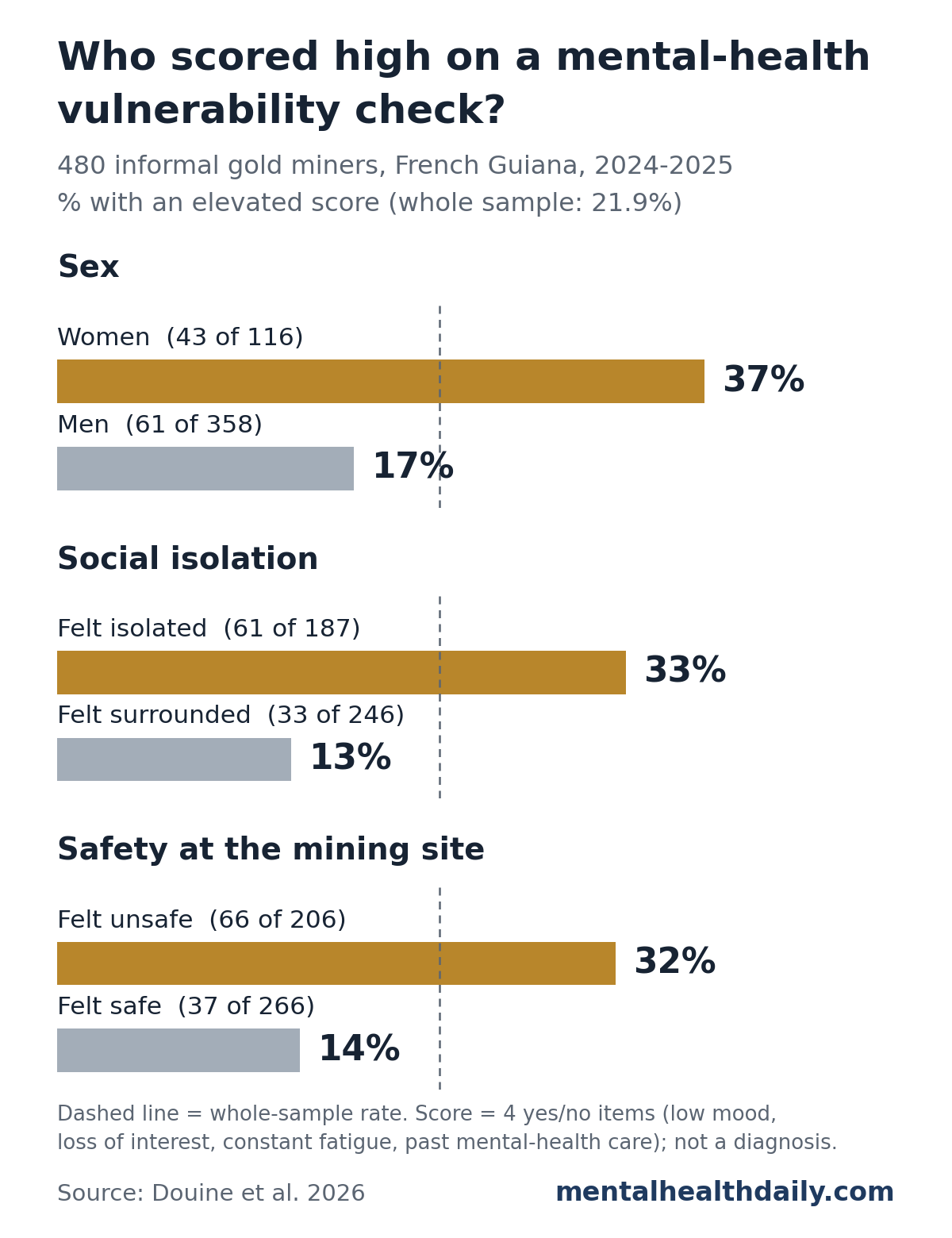
- Social isolation: 32.6% of people who reported isolation or loneliness had an elevated score, vs. 13.4% of those who felt surrounded by others (aPR 2.24, 95% CI 1.51 to 3.34). This was the strongest link in the model.
- Feeling unsafe at the mining site: 32.0% vs. 13.9% (aPR 2.19, 95% CI 1.52 to 3.14)
- Sex: 37.1% of women vs. 17.0% of men (aPR for men 0.41, 95% CI 0.29 to 0.58)
- Money problems: people who described their finances as difficult also had higher scores in the adjusted model (33.7% vs. 19.5%; aPR 1.65, 95% CI 1.12 to 2.43)
Exposure to violence and hunger were each linked to high scores on their own (32.9% vs. 17.1% for violence; 31.6% vs. 19.3% for hunger), but neither stayed significant once isolation, safety and the other factors were in the model.1 These problems overlap heavily in this population, so the model has trouble separating them.
Results held up when the researchers tried other cutoffs for the mental-health score.1
1 in 5 Miners Reported Moderate Hunger
On the Household Hunger Scale, 79.0% had little or no hunger, 20.6% had moderate hunger and 0.4% had severe hunger. In the previous 4 weeks, 23.8% had gone to bed hungry at least once and 19.2% had gone 24 hours without eating.1
Food reaches remote camps through supply routes built to avoid police checkpoints, so fresh food is scarce. Miners interviewed said police operations had sometimes destroyed food and medicine stocks.1 In the adjusted model, hunger was more common among people who:
- Had more trouble moving between or leaving sites in the past 2 years (aPR 2.02)
- Felt isolated (aPR 1.90)
- Described their finances as difficult (aPR 1.72)
- Were recruited at the Brazil border rather than the Suriname border (aPR 1.56)
- Had no one to rely on for support (aPR 1.52)
People aged 40 or older were less likely to report hunger (aPR 0.60). Going through a police operation in the past year was linked to hunger on its own, but that link did not hold in the adjusted model.1
Violence and Insecurity at the Mining Sites
Nearly half the sample (43.7%) felt unsafe at mining sites, and 29.8% had experienced or witnessed violence. Rates were similar for women (33.0%) and men (29.4%).1
- How often: among the 143 people exposed, 52.5% said it happened rarely, 26.6% sometimes and 16.8% often
- Where: 49% placed the violence at mining sites in French Guiana and 23% in Brazil
- What kind: physical violence was the most common type reported, and 15% of the whole sample said they had witnessed a homicide
Police operations were also part of daily life: 47.3% had been through at least one in the past year, and a third reported that moving between or leaving sites had become harder, mostly because of these operations.1
3 Profiles of Vulnerability Among Gold Miners
An exploratory clustering analysis of 462 participants with complete answers grouped people by which problems tended to occur together:1
- Relatively secure and supported (45.2%): the lowest rates of every problem, with 6.2% at elevated mental-health risk and no hunger or lack of support
- Exposed to danger but socially supported (23.2%): 94.4% felt unsafe, 76.6% had been exposed to violence and 58.9% had an elevated mental-health score, while hunger and lack of support were less common
- Economically deprived (31.6%): marked mainly by hunger (53.4%) and money problems
People in the danger-exposed group were the most likely to have gone without needed medical care (19.6% vs. 8.7% and 11.0%) and to say life was worse than before they started mining (46.5% vs. 25.6% and 40.1%).1 The pattern suggests that safety and mental health travel together in this workforce, somewhat separately from hunger and poverty.
Access to Health Care Is Measured in Days of Travel
For 43.9% of participants, the trip from their mining site to the hub where they were recruited took more than a day, and sometimes up to 10 days. Median travel cost was about €100.1
Most said their nearest health center was in Maripasoula, an average of 3 days away. Self-rated health was good for 46.5%, medium for 46.9% and poor for 5.8%, and 11.5% had gone without care they needed.1
Why people mine. In open-ended answers, the most common reasons for starting and staying were economic necessity, lack of other work, quick money, building a better life and supporting family. Some described the work as a habit that was hard to leave. Just under half (48.0%) said their life was better than before mining, while 34.3% said it was worse.1
Limitations of This Gold Miner Survey
A cross-sectional survey shows which problems occur together at one point in time. It cannot show that isolation or insecurity causes distress, or which came first. Other limits:
- Unvalidated mental-health score: the 4-item score was built for this study, and the depression questions were asked in a simplified yes/no format, so the 21.9% figure is not a depression rate.
- Who was reached: recruitment at river hubs likely missed the most isolated, sickest and least mobile workers, so true levels of hardship may be higher.
- Self-report on sensitive topics: violence and mental-health problems were probably underreported, and interviews took place behind tarpaulin partitions with only partial privacy.
- Sample size: the survey was sized for a malaria question and fell short of its target, though most estimates still have reasonably narrow confidence intervals.
- Internal number mismatches: a few figures in the paper’s abstract and discussion differ from its results tables; the numbers here come from the results and tables.
- Exploratory profiles: the 3 clusters shifted somewhat with different model choices and are best seen as descriptive patterns.
What the Findings Suggest for Supporting Gold Miners
The researchers argue that purely repressive approaches deepen this population’s exclusion and call for harm-reduction strategies instead.1 Their suggestions include:
- Community-based health services and better information on how to reach care
- Training for health workers to recognize the specific pressures these miners face, including isolation, insecurity and hunger
- Cross-border cooperation among France, Brazil and Suriname on access to care
- Economic development in the Brazilian regions people leave, since most described mining as their only option
The strong link between isolation and high distress scores points to social connection as one practical target: peer mediators from the miners’ own community, like the one who ran this survey, are one way health services could reach people who rarely see a clinic.
References
- Douine M, Lambert Y, Bardon T, et al. Psychosocial vulnerability of people working in informal gold mines in French Guiana: a multicentric cross-sectional survey in 2024–2025. Frontiers in Public Health. 2026;14:1894124. doi:10.3389/fpubh.2026.1894124