
Women with higher anxiety scores felt less in control during labor, according to a 2026 survey involving 169 mothers who had just given birth at a hospital in the United Arab Emirates (UAE).1 First-time mothers stood out on both measures.
Research Highlights
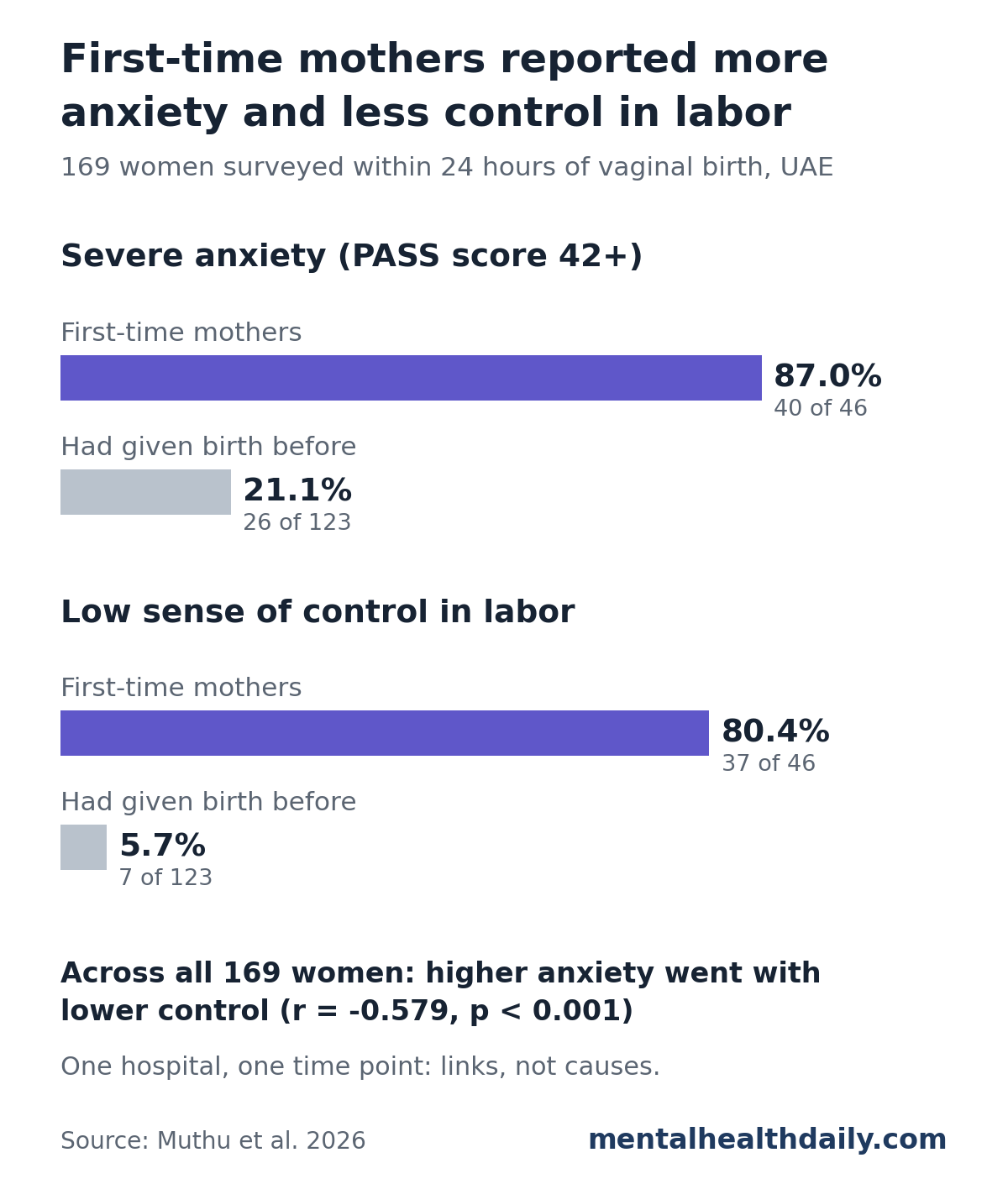
- Anxiety and control moved in opposite directions: across all 169 women, higher anxiety scores went with lower perceived control in labor (r = −0.579, p < 0.001), a fairly strong correlation.1
- Anxiety was common: 39.1% scored in the severe range and another 40.8% in the mild-to-moderate range; only 20.1% had minimal anxiety.1
- First-time mothers had the most anxiety: 87.0% (40 of 46) scored in the severe range vs 21.1% (26 of 123) of women who had given birth before.1
- First-time mothers felt the least control: 80.4% reported low control in labor vs 5.7% of experienced mothers.1
- Snapshot design: both questionnaires were filled out within 24 hours after birth, so the study shows links, not which one drives the other.1
How the UAE Study Measured Anxiety and Control in Labor
Muthu et al. recruited women admitted for a full-term vaginal delivery at Kanad Hospital, a 200-bed hospital in Al Ain that handles about 300 births a month. The results were published in the International Journal of Women’s Health in September 2026.1
- Who: 169 women aged 20 to 45; 85.2% Arab, 61.5% UAE nationals, 90.5% Muslim, and 72.8% had given birth before.
- Who was left out: women with chronic illness, gestational diabetes, eclampsia, previous delivery complications, or a planned cesarean.
- When: questionnaires were completed in the labor and delivery unit within 24 hours after birth.
Anxiety measure: the Perinatal Anxiety Screening Scale (PASS) is a 31-item questionnaire built to pick up anxiety around pregnancy and birth, including acute anxiety, general worry, perfectionism, and social anxiety. Scores of 42 or higher count as severe. It is a screening tool, not a diagnosis.
Control measure: the Labor Agentry Scale (LAS) asks how much a woman felt in charge of herself and her care during labor. This study used a 10-item Arabic version; women in the bottom half of the possible score range were classed as having low control.1
Higher Anxiety Went With Less Control During Labor
The central result was a correlation of r = −0.579 between anxiety and perceived control. The minus sign means the two ran in opposite directions: the more anxious a woman scored, the less control she reported. A value near 0.6 is fairly strong for questionnaire data.1
Labor control overall was mixed. About a quarter of women (26.0%) reported low control, 45.6% moderate control, and 28.4% high control.1
First-Time Mothers Had Far More Anxiety and Less Control
Parity, or how many times a woman has given birth, showed the biggest gaps in the whole study. Only 46 women were first-time mothers, but they made up most of the severe-anxiety and low-control groups.1
- Severe anxiety: 87.0% of first-time mothers vs 21.1% of experienced mothers.
- Low control: 80.4% of first-time mothers vs 5.7% of experienced mothers.
- High control: only 3 of 46 first-time mothers reported it.
Facing labor for the first time, with no past birth to compare against, could explain part of these gaps. But first-time mothers also tend to be younger, and the researchers did not adjust for age or other factors, so the parity figures are raw comparisons.
Other Factors Linked to Anxiety and Labor Control
- Age at marriage: 44.6% of women who married before age 20 had severe anxiety, and age at marriage was linked to anxiety level (p = 0.041).
- Ethnicity: 31.3% of Arab women reported high control vs 8.7% of Asian women (p = 0.009). Only 23 Asian women took part.
- Age and income: both were linked to labor control (p = 0.046 and p = 0.002).
None of these were tested together in one model, so it is unclear how much they overlap with parity.1
Other Studies on Pregnancy Anxiety and Control in Labor
Anxiety before birth: a Portuguese study by Brandão et al. followed 57 women from pregnancy to 6 to 8 weeks after birth, so anxiety was measured before labor rather than after it.
Higher anxiety and depression in pregnancy were linked to more post-traumatic stress symptoms after childbirth, through a lower sense of control in labor.2
First-time vs experienced mothers: a 2024 study of 347 women in early labor in China found that women who had given birth before had lower fear-of-childbirth scores than first-time mothers. Lower childbirth self-efficacy (confidence in coping with labor) and more fear went with stronger perceived labor pain.3
Both studies are consistent with the UAE results: anxiety and a weaker sense of control in labor travel together, and first-time mothers carry more of both.
Limitations of This UAE Labor Anxiety Study
Evidence strength: this is a single-hospital, cross-sectional survey. It can show that anxiety and labor control are linked, but not whether anxiety reduces control, a hard labor raises anxiety, or both stem from something else.
- Anxiety measured after birth: the anxiety scale was given within 24 hours of delivery, and no baseline was taken in pregnancy. The researchers note that the scores may reflect the labor experience itself rather than anxiety carried in from pregnancy.1
- Same-day self-report: both questionnaires were filled out at the same time, so a woman’s mood right after birth could color both answers.
- Narrow sample: one hospital, a convenience sample, and only uncomplicated vaginal births; women with cesareans or high-risk pregnancies may differ.
- Unadjusted comparisons: parity, age, age at marriage, ethnicity, and income were each tested on their own.
- Small subgroups: the first-time mother figures rest on 46 women.
What This Means for First-Time Mothers and Maternity Care
First-time mothers were far more likely than experienced mothers to feel anxious and out of control in labor, which makes them a clear group for extra support. The researchers recommend routine anxiety screening and childbirth preparation focused on coping skills, especially for first-time mothers.1
This survey did not test any of those programs, so it cannot say how much they would help. Anyone pregnant who is struggling with worry or fear about birth can raise it with their midwife or doctor before labor, when there is time to plan support.
References
- Muthu P, Al Marzouqi AAA, Nair MA. Perinatal anxiety and perceived labor control among parturients in the United Arab Emirates: a cross-sectional study guided by Roy’s adaptation model. International Journal of Women’s Health. 2026;18:607377. doi:10.2147/IJWH.S607377
- Brandão T, Brites R, Nunes O, Pires M, Hipólito J. Anxiety and depressive symptoms during pregnancy, perceived control and posttraumatic stress symptoms after childbirth: a longitudinal mediation analysis. Journal of Health Psychology. 2020;25(13–14):2085–2095. doi:10.1177/1359105318787018
- Huang Y, Zhong Y, Chen Q, et al. A comparison of childbirth self-efficacy, fear of childbirth, and labor pain intensity between primiparas and multiparas during the latent phase of labor: a cross-sectional study. BMC Pregnancy and Childbirth. 2024;24:400. doi:10.1186/s12884-024-06571-3